


Key Highlights
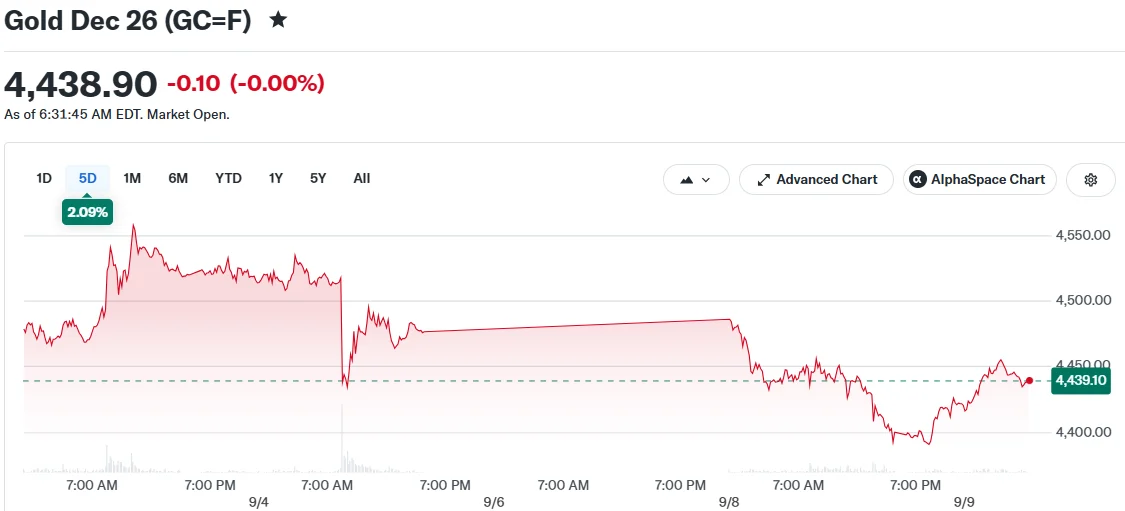
- Spot gold advanced 1.0% to reach $4,397.47 per ounce on Wednesday, while gold futures edged up marginally to $4,441.86
- U.S. dollar weakness is providing tailwinds for gold, partially driven by yen strength
- Renewed U.S.-Iran tensions in the Middle East have propelled Brent crude oil beyond the $100 per barrel threshold
- Traders are now assigning a 60% probability to a 25 basis point Federal Reserve rate increase at next week’s policy meeting
- Critical August inflation reports—CPI and PPI—are expected this week and may influence Fed policy direction
Gold extended its advance on Wednesday, buoyed by a declining U.S. dollar and escalating Middle East hostilities, though the rally faced headwinds from mounting anticipation of Federal Reserve monetary tightening.
Spot gold appreciated 1.0% to settle at $4,397.47 per ounce. Meanwhile, gold futures registered a modest 0.1% increase to $4,441.86 per ounce during early market hours.
The U.S. dollar index remained relatively unchanged at 98.77. Market observers point to the Japanese yen’s recent appreciation as a contributing factor applying modest downward pressure on the greenback. When the dollar weakens, gold becomes more affordable for international buyers holding alternative currencies, potentially boosting purchasing activity.
Escalating Middle East Situation Weighs on Markets
Fresh military exchanges between the United States and Iran in the Middle East region have driven Brent crude oil prices back above the psychologically significant $100 per barrel level. The Strait of Hormuz, a critical chokepoint for global oil transportation located along Iran’s southern coastline, remains at the epicenter of supply disruption fears.
Climbing oil prices amplify inflationary concerns. This development carries particular significance as central banking institutions, notably the Federal Reserve, maintain their commitment to curbing inflation.

Current market pricing reflects a 60% likelihood that the Federal Reserve will implement a 25 basis point interest rate increase during its policy meeting scheduled for next Wednesday. This probability has risen sharply from the 40% figure recorded just seven days earlier.
Elevated interest rates typically create headwinds for gold. Since the precious metal generates no income or dividend, rising rates enhance the relative attractiveness of yield-bearing instruments such as government bonds.
“Gold has recently come under increased pressure following a change in expectations around U.S. interest rates,” said Rick Kanda, Managing Director at The Gold Bullion Company.
Upcoming Inflation Reports May Determine Gold’s Direction
Gold registered an impressive nearly 10% advance during August, marking its strongest monthly performance since January. The rally reached its zenith in late August at $4,685 per ounce.
Kanda observed that rapid price appreciation often triggers profit-taking behavior, particularly when incoming economic indicators reinforce the argument for monetary policy tightening.
He cautioned that gold could retreat toward the low-$4,000 range should rate-hike expectations continue strengthening. However, he acknowledged the potential for a rebound toward August’s peak level.
Naeem Aslam from Zaye Capital Markets emphasized that geopolitical turbulence can channel investment flows toward gold as a protective hedge. Yet he cautioned that if escalating conflict triggers higher energy and commodity inflation, it could simultaneously elevate Treasury yields and diminish gold’s attractiveness.
Market participants are closely monitoring the forthcoming August Consumer Price Index and Producer Price Index releases scheduled for later this week. These inflation metrics could prove instrumental in determining the Federal Reserve’s policy stance at next week’s gathering.
The Federal Reserve has maintained its commitment to combating inflation. Recent evidence of labor market resilience has bolstered the rationale for additional rate tightening.
Gold currently finds itself navigating conflicting pressures: safe-haven buying driven by deteriorating geopolitical conditions, versus the opportunity cost associated with holding non-yielding assets in a rising rate environment.
Get 3 Free Stock Ebooks
Discover top-performing stocks in AI, Crypto, and Technology with expert analysis.
- Top 10 AI Stocks - Leading AI companies
- Top 10 Crypto Stocks - Blockchain leaders
- Top 10 Tech Stocks - Tech giants



