


Key Takeaways
- Wednesday’s Federal Reserve decision marked the first rate increase since 2023, implementing a 0.25% hike
- Spot gold rebounded 1.2% to reach $4,314.57 following an initial decline, though gold futures dropped 0.8%
- The central bank’s rate forecast for late 2026 climbed to 4.1% from the previous 3.8% projection
- Chair Kevin Warsh emphasized persistent inflation challenges, noting numerous goods categories exceed 3% annual price growth
- Market experts indicate gold must surpass $4,539 to exit its current bearish trajectory
In a widely anticipated move, the Federal Reserve increased its key interest rate by 25 basis points on Wednesday, marking the first such action in more than two years. The decision received unanimous support from voting members.
[[LINK_START_1]]Spot gold[[LINK_END_1]] experienced immediate downward pressure following the announcement but staged a recovery, gaining 1.2% to settle at $4,314.57 per ounce in early Thursday sessions. Conversely, gold futures contracts declined 0.8%, trading at $4,354.09 per ounce.
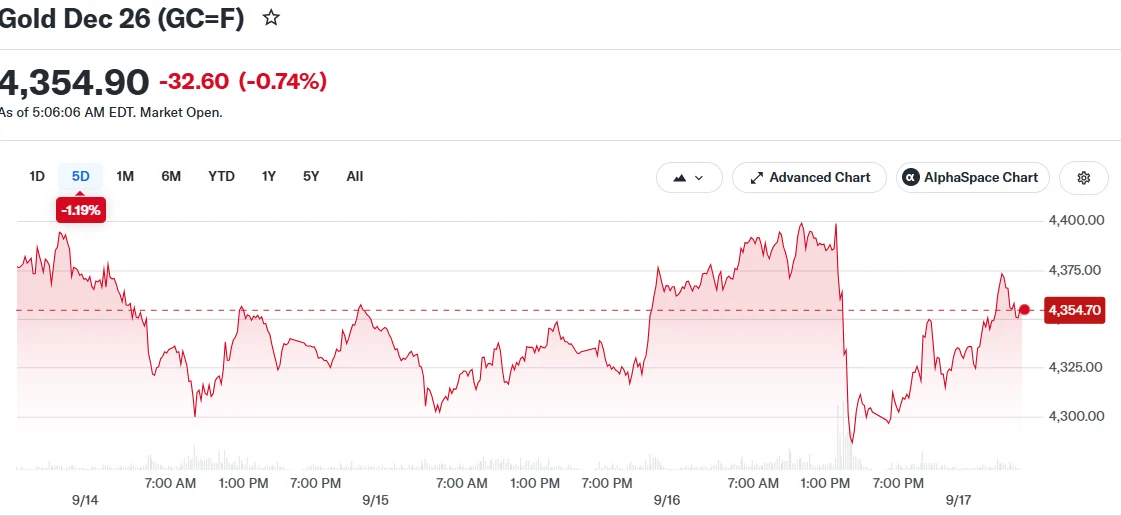
Later New York trading showed gold declining 0.5% to $4,365.50 per troy ounce, underscoring the ongoing market uncertainty surrounding the monetary policy shift.
The Interest Rate Impact on Gold
As a non-yielding asset, gold struggles to compete when interest rates climb. Higher yields on competing investments such as bonds draw capital away from precious metals, diminishing their appeal.
The dollar‘s strength compounds this challenge. A rising greenback makes gold more costly for international purchasers, potentially suppressing global demand.

Following the Fed’s announcement, Treasury yields declined across maturities while the dollar gained strength. This dynamic maintained downward pressure on gold throughout most trading hours.
In his post-meeting remarks, Fed Chair Kevin Warsh highlighted that numerous categories across goods and services continue displaying price increases exceeding 3% annually, whether measured over six or twelve months.
The central bank’s updated median rate forecast for year-end 2026 now stands at 4.1%, representing an increase from the prior 3.8% estimate. This revision suggests additional rate increases remain on the table.
Financial markets interpreted this forward guidance as hawkish, indicating more restrictive monetary conditions ahead.
Expert Perspectives on Gold’s Outlook
According to Tony Sycamore, senior market analyst at IG, market expectations now include another Fed rate hike before year-end, followed by an additional 50 basis points of tightening during the first half of 2027, creating substantial obstacles for gold.
Sycamore emphasized that gold must break above its 200-day moving average around $4,539 to signal an end to the correction from the $4,697 peak.
Without such a breakout, Sycamore projects potential downside to approximately $4,200. He identified $4,000 as the subsequent critical support level should weakness persist.
Soojin Kim, an analyst with MUFG, observed that gold’s trajectory has become closely linked to the velocity of U.S. rate adjustments.
Kim noted that persistent inflation and elevated Treasury yields constrain gold’s upward momentum, despite ongoing support from geopolitical tensions and safe-haven investment flows.
The Federal Reserve’s forward guidance suggesting additional rate hikes maintains near-term downward pressure on precious metal prices.
Get 3 Free Stock Ebooks
Discover top-performing stocks in AI, Crypto, and Technology with expert analysis.
- Top 10 AI Stocks - Leading AI companies
- Top 10 Crypto Stocks - Blockchain leaders
- Top 10 Tech Stocks - Tech giants



