



TLDR
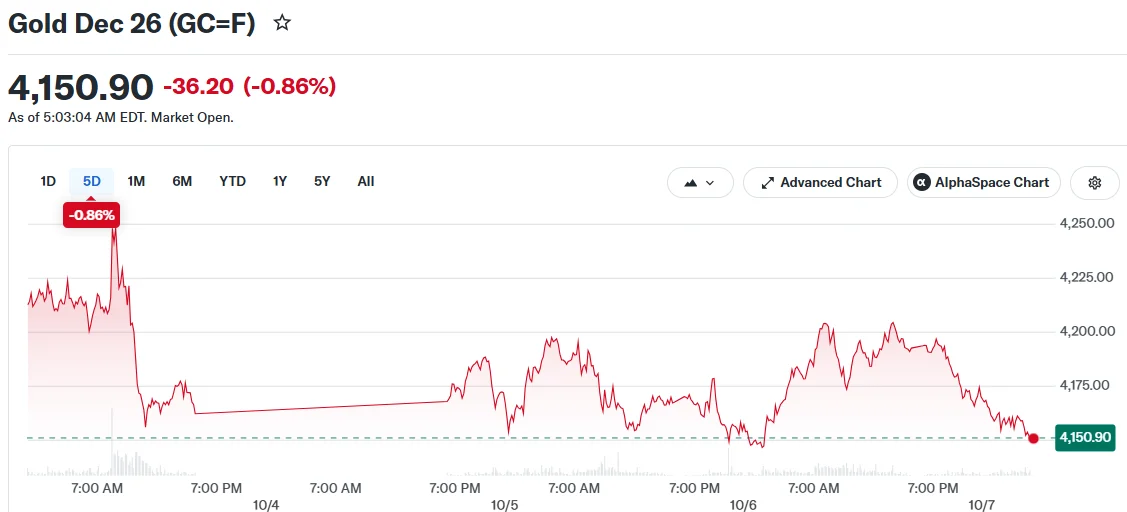
- The precious metal declined approximately 1% on Wednesday following a 0.4% rise in the US dollar index to 102.26.
- Spot bullion prices touched $4,126 per ounce during morning trade before recovering toward $4,167 later in the day.
- Market participants are awaiting the Federal Reserve’s September meeting minutes, following the central bank’s first rate increase since 2023.
- Improved crude flows from the Middle East and declining Treasury yields have diminished expectations for additional Fed tightening this month.
- Global central banks purchased 39 tonnes of the yellow metal in August, pushing 2023 acquisitions to 170 tonnes, World Gold Council figures show.
Gold prices retreated on Wednesday as the greenback strengthened, applying downward pressure on the precious metal. Market participants are closely monitoring upcoming Federal Reserve meeting records for indications about the trajectory of monetary policy.
During mid-morning activity, spot bullion declined 0.9% to reach $4,126.02 per ounce. Futures contracts for the yellow metal fell 0.8% to settle at $4,151.90 per ounce.
The dollar index advanced 0.4% to reach 102.26. When the American currency strengthens, gold becomes costlier for international purchasers, typically dampening demand.
Federal Reserve Policy Path Remains Key Question
Attention remains centered on the Federal Reserve’s September policy gathering, during which officials implemented their first interest rate increase since 2023. Forecasts released at that meeting suggested additional tightening measures before year-end.
Consumer price growth has persisted above the central bank’s 2% objective for several months. A significant portion of this pressure stems from elevated energy costs linked to the continuing conflict between the United States and Iran.

Notwithstanding these inflationary concerns, market expectations for another rate adjustment at the October meeting have diminished. Multiple Federal Reserve officials have signaled a more measured approach.
Employment figures released recently fell short of projections. This development has prompted policymakers to adopt greater caution regarding aggressive tightening, given potential economic consequences.
Rising borrowing costs typically create headwinds for bullion. The non-yielding nature of gold makes it less appealing when alternative investments deliver higher returns.
Current market pricing reflects below 20% probability of an October rate increase. This represents a sharp decline from approximately 40% odds observed just seven days prior.
Middle East Crude Flows and Treasury Movements Shift Dynamics
As trading progressed, the precious metal stabilized and recovered toward $4,167 per ounce. This rebound coincided with improving oil supply from Middle Eastern producers and softening bond yields.
Shell’s Chief Executive Wael Sawan indicated Tuesday that regional crude flows have rebounded to approximately 80% of pre-conflict volumes. Multiple banking institutions and maritime analysts have confirmed comparable assessments.
Nevertheless, regional tensions persist. Iranian forces have intensified operations targeting vessels transiting the Strait of Hormuz in recent days.
Energy industry leaders have cautioned that global contingency capacity to address conflict disruptions is increasingly constrained. The US-Iran confrontation has now extended into its eighth month.
Government bond yields retreated Tuesday following stabilization in oil prices. This movement followed a period during which longer-dated yields reached multi-decade peaks.
Equity markets achieved record valuations Tuesday. Market participants are expressing confidence in corporate resilience amid persistent price pressures.
Official sector purchases have provided ongoing support for bullion despite interest rate headwinds. World Gold Council statistics revealed that monetary authorities acquired 39 tonnes during August.
This brings cumulative official sector purchases for the year to 170 tonnes. ING analysts have identified this consistent institutional buying as an important price floor.
The yellow metal remains more than 20% below levels recorded before the US-Iran conflict erupted in late February. Central banking officials convening in Italy this week emphasized gold’s expanding importance in reserve diversification strategies amid ongoing geopolitical volatility.
As of early Wednesday trading in Singapore, spot bullion showed minimal movement at $4,167.05 per ounce. Silver maintained stability at $61.34, while platinum and palladium quotations held steady.
The Federal Reserve’s September policy meeting minutes are scheduled for release later Wednesday and are anticipated to provide additional clarity regarding the monetary policy outlook.
Get 3 Free Stock Ebooks
Discover top-performing stocks in AI, Crypto, and Technology with expert analysis.
- Top 10 AI Stocks - Leading AI companies
- Top 10 Crypto Stocks - Blockchain leaders
- Top 10 Tech Stocks - Tech giants



