


Key Highlights
- The greenback retreated modestly from its strongest position in two months following a diplomatic breakthrough between Israel and Iran after intervention from President Trump.
- Traders are now assigning a 70% probability to a Federal Reserve interest rate increase by year-end, driven by robust employment figures.
- Wednesday’s U.S. inflation report has become the critical focus for currency markets, potentially setting the dollar’s trajectory.
- European currency strengthened modestly as investors await Thursday’s ECB policy decision, with a quarter-point rate increase widely anticipated.
- Indonesia’s central bank delivered an unexpected 25 basis point rate increase, triggering the rupiah’s strongest daily rally in more than twelve months.
The greenback experienced a modest retreat on Tuesday following its climb to the highest level in eight weeks, as a tentative pause in hostilities between Israel and Iran encouraged risk-taking behavior in international financial markets.
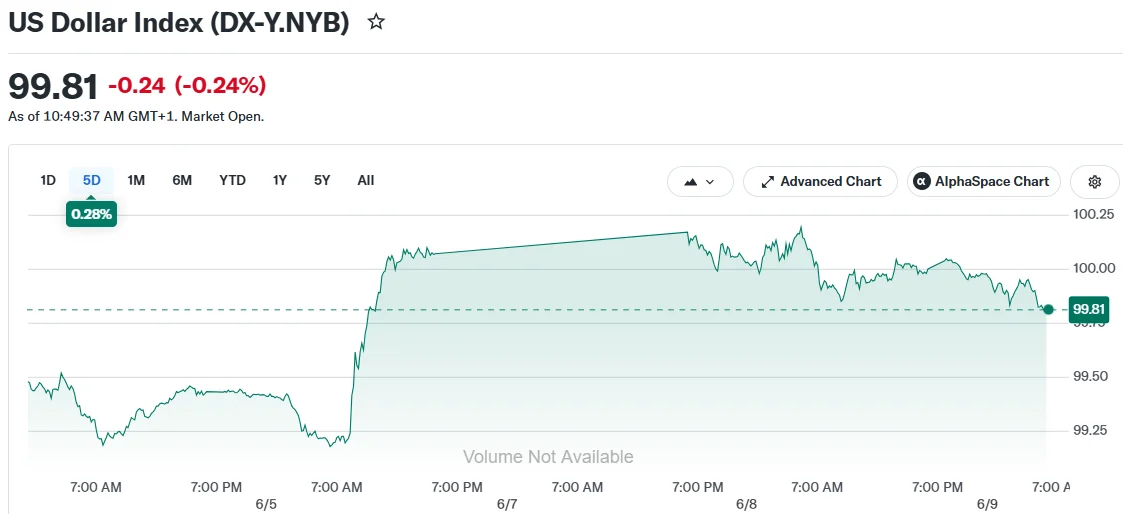
The Dollar Index declined 0.1% to settle at 99.93, marginally below Monday’s session high of 100.21. This pullback materialized after President Donald Trump announced the United States was approaching a “total victory” declaration regarding the Iranian conflict and projected that crude oil prices would decline.
Despite reduced near-term geopolitical risks, market participants maintained a defensive posture. Iranian officials cautioned that military operations could restart if Israeli forces continued targeting Hezbollah positions in Lebanese territory. Additionally, concerns about the Strait of Hormuz—a critical passage for worldwide petroleum shipments—continued to unsettle commodity traders.
U.S. government bond yields stayed elevated following last week’s robust employment data. The two-year Treasury note remained near its 15-month high, while the 10-year benchmark continued trading above the 4.5% threshold.
Market Pricing Shifts Toward Fed Tightening
The unexpectedly strong payroll numbers have prompted futures markets to assign approximately 70% odds to a Federal Reserve rate hike materializing before December, based on CME FedWatch calculations. This recalibration of policy expectations has served as a primary catalyst for dollar appreciation in recent trading sessions.

Tony Sycamore, an analyst at IG Markets, noted that an inflation reading exceeding forecasts on Wednesday “would undoubtedly add to mounting fears of a Fed rate hike before year-end.” He emphasized that such an outcome would reinforce dollar strength while creating headwinds for American equity markets.
The Wednesday inflation data release has emerged as the most critical economic indicator for foreign exchange traders this week. Thursday will bring producer price figures as a follow-up.
The Australian dollar slipped 0.1% to $0.7039, while New Zealand’s currency changed hands at $0.5804, both currencies pressured by cautious market sentiment and greenback resilience.
European Central Bank and Asian Rate Moves
The euro extended gains for a consecutive session, fluctuating between $1.1528 and $1.1561. Market attention has shifted to Thursday’s European Central Bank policy meeting, where officials are expected to deliver a 25 basis point rate adjustment. Investors will scrutinize accompanying commentary for insights into how policymakers intend to address energy-related inflationary pressures.
Speculation is building for an additional rate move in September, as the ECB navigates the challenging balance between elevated energy costs and deteriorating economic growth across the eurozone.
In an unanticipated policy action, Indonesia’s central bank lifted its key lending rate by 25 basis points on Tuesday to 5.50%. The decision aimed to bolster the rupiah, which has faced downward pressure from declining foreign currency reserves and subdued international investment flows. The rupiah surged nearly 1% following the announcement, recording its strongest single-session gain in over a year.
The Japanese yen traded relatively flat, maintaining its position above the 160-per-dollar level. This threshold remains under close surveillance by currency market participants as a potential intervention point for Japanese monetary authorities.
NAB’s senior FX strategist Rodrigo Catril captured the prevailing market sentiment, noting: “We’ve seen the dollar being stronger because of this uncertainty, but also because of strong data in the U.S.”
Get 3 Free Stock Ebooks
Discover top-performing stocks in AI, Crypto, and Technology with expert analysis.
- Top 10 AI Stocks - Leading AI companies
- Top 10 Crypto Stocks - Blockchain leaders
- Top 10 Tech Stocks - Tech giants



