



Key Highlights
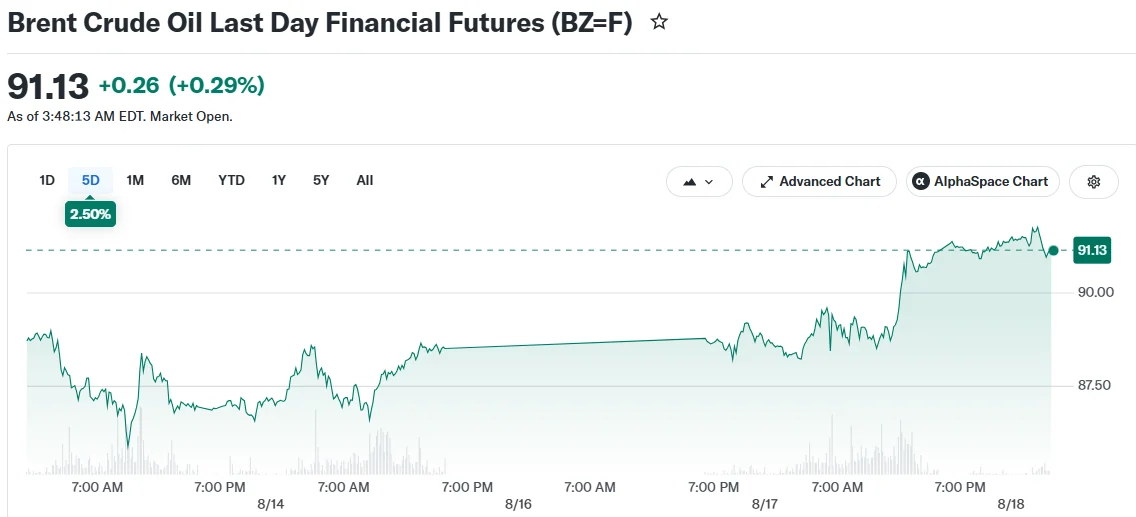
- Brent crude advanced to $91.50 while WTI reached $85.22, marking three-week peak levels
- President Trump declined to renew the Iran ceasefire agreement that lapsed on Monday, fueling market volatility
- UK maritime officials confirmed a vessel was hit by a projectile during transit through the Strait of Hormuz
- Tehran seized a tanker with UAE connections, citing violations of its waterway transit regulations
- Shipping volumes through the strategic strait continue to languish far below historical norms
Crude oil markets extended their rally on Tuesday, reaching their strongest position in close to three weeks as U.S.-Iranian friction intensified around the strategically vital Strait of Hormuz.
Brent crude futures advanced 0.7% to settle at $91.50 per barrel. Meanwhile, West Texas Intermediate crude posted a 0.85% gain, touching $85.22 per barrel. These price points represented the highest valuations recorded since July 30 for both benchmark contracts.
The upward momentum followed President Donald Trump’s announcement that Washington would not be prolonging its ceasefire arrangement with Tehran. The temporary agreement, originally inked in mid-June, officially lapsed on Monday.
Trump reiterated his assertion that American forces maintain complete authority over the Strait of Hormuz, a characterization that Iranian officials have consistently rejected.
Maritime Incidents Amplify Market Concerns
The crude rally gained additional momentum following reports from the UK Maritime Trade Operations authority regarding a vessel that sustained damage from an unidentified projectile during its outbound passage through the Hormuz waterway.

Concurrently, Iranian state-affiliated media sources disclosed that authorities in Tehran had apprehended a tanker with links to the United Arab Emirates. Iranian officials claimed the vessel had breached regulations governing passage through the contested waterway.
The Fars News Agency, a state-connected outlet, announced via X that the tanker “has been detained,” referencing Iran’s enforcement of mandatory transit fees for vessels navigating through Hormuz. Specific details regarding the ship’s identity and cargo contents remained unverified.
The previous trading session saw Brent crude close at $90.87, representing a substantial 2.7% increase, with gains accelerating after initial reports of the tanker detention surfaced.
Throughout the ongoing conflict, oil prices have experienced significant volatility driven by information—occasionally contradictory or inaccurate—emanating from both Washington and Tehran. Iranian forces have adopted an increasingly aggressive posture in recent weeks, targeting multiple tankers attempting passage through the strait.
Presidential Warning to Oman as Negotiations Falter
Trump issued a stark warning that the United States would “bomb the s*** out of” Oman should it “get in the way,” a statement that emerged as Iran and Oman indicated they were pursuing discussions regarding the potential restoration of maritime shipping corridors through Hormuz.
Neither nation has formally announced any conclusive arrangement emerging from these diplomatic exchanges.
Commercial vessel traffic navigating through Hormuz continues to operate at dramatically reduced capacity compared to pre-conflict volumes. Concerns regarding potential Iranian military action have deterred many shipping companies from attempting the hazardous transit.
Prior to the outbreak of hostilities, the Strait of Hormuz served as a conduit for approximately 20% of worldwide crude oil supply. The effective blockade has severely constrained the availability of petroleum products in international markets.
According to Washington, diplomatic discussions between American and Iranian representatives remain active. Tehran has challenged this assessment.
Energy market participants are closely monitoring developments in the Oman-Iran shipping negotiations, as any breakthrough agreement could potentially alleviate current supply bottlenecks.
Currently, market sentiment reflects expectations of ongoing disruption, with minimal optimism for an imminent diplomatic breakthrough.
Get 3 Free Stock Ebooks
Discover top-performing stocks in AI, Crypto, and Technology with expert analysis.
- Top 10 AI Stocks - Leading AI companies
- Top 10 Crypto Stocks - Blockchain leaders
- Top 10 Tech Stocks - Tech giants



