



Key Takeaways
- Brent crude closed above the $100 threshold on Thursday for the first time since late May
- Ongoing U.S. military operations against Iran reached day 12, severely impacting Strait of Hormuz transit
- Yemen-based Houthi militants targeted Saudi oil tankers in Red Sea waters, escalating supply concerns
- Tehran dismissed ceasefire negotiations backed by Washington, signaling diplomatic breakdown
- Goldman Sachs projects prices will maintain elevated levels through summer months, potentially declining to $80 by December if hostilities subside
Global crude markets witnessed a dramatic surge this week, with benchmark prices breaching the $100-per-barrel threshold as U.S. military operations against Iran intensified and Middle Eastern shipping corridors faced unprecedented disruption.
Brent crude futures concluded Thursday’s trading session at $100.69, representing a substantial 7% daily increase. This marked the first closing price above the century mark since May 22. Meanwhile, West Texas Intermediate climbed 6.2% to reach $92.19 per barrel.
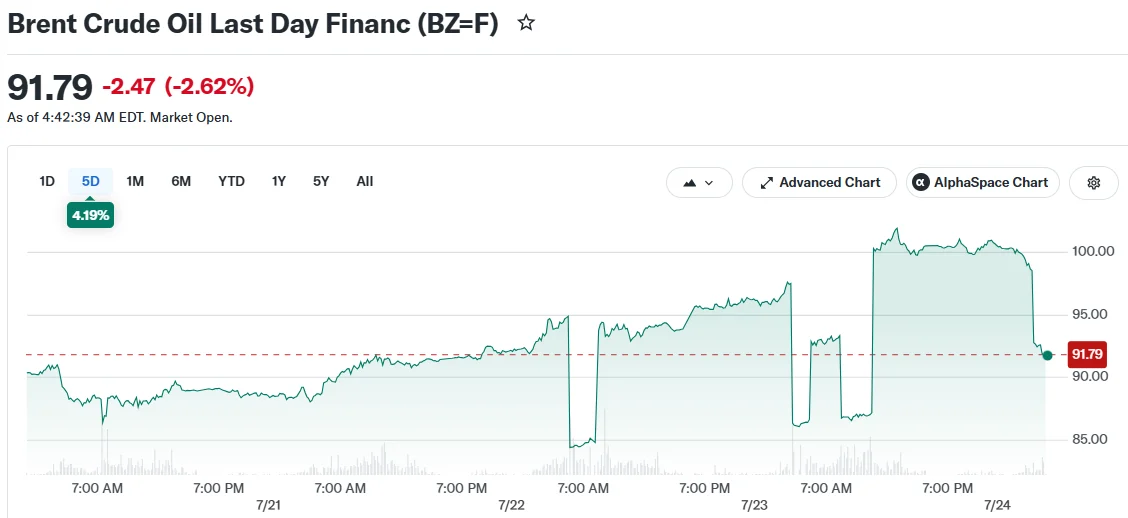
Friday brought modest corrections as both major benchmarks retreated. Brent declined 1.7% to settle at $99.01, while WTI slipped to $90.64 as market participants locked in profits following a robust trading week.
Despite Friday’s pullback, Brent has registered approximately 14% growth over the week, marking its third consecutive week of substantial appreciation.
Critical Maritime Chokepoints Under Pressure
American military strikes against Iranian targets extended to their twelfth consecutive day by Thursday, creating significant obstacles for petroleum transport through the Strait of Hormuz. This narrow waterway represents one of the world’s most vital corridors for energy transportation.

Iran-aligned Houthi militants operating from Yemen announced responsibility for dual assaults on Saudi Arabian tankers navigating Red Sea waters. These strikes focused on the Bab al-Mandap Strait, an alternative passage Saudi operators had been utilizing to circumvent Hormuz-related complications.
President Trump issued stern warnings Thursday regarding “major military punishment” directed at both Iranian forces and Houthi operatives. He further declared that Iranian financial resources would cover compensation for damaged vessels and lost cargo.
According to reporting from The New York Times, Iran has refused to accept a ceasefire framework supported by the United States. Iranian officials stated they would not entertain temporary arrangements, pointing to fundamental disagreements regarding sovereignty over the Strait of Hormuz.
Iraqi Prime Minister Ali al-Zaidi had served as the intermediary for the proposed agreement. Regional peace brokers, including representatives from Pakistan and Qatar, have maintained diplomatic engagement despite deteriorating circumstances.
Market Analysis and Price Projections
Daan Struyven, a leading analyst at Goldman Sachs, forecasts that petroleum prices will retain the majority of recent gains throughout July and August, underpinned by reduced Middle Eastern production capacity and robust summer transportation demand.
Should hostilities fail to de-escalate, Goldman Sachs cautions that Brent crude could surge beyond $120 per barrel during the final quarter and maintain a $100 average through 2027 if Hormuz transit remains compromised.
Natasha Kaneva, analyst at J.P. Morgan, observed that current pricing incorporates only a moderate risk premium related to geopolitical instability. She highlighted that worldwide consumption has simultaneously weakened, with Chinese authorities reducing oil imports and curtailing petrochemical manufacturing activities.
Energy Sector Gains While Broader Markets Retreat
Elevated crude valuations provided a boost to petroleum company equities. Exxon Mobil advanced 2% while Chevron posted 1.2% gains. France-based TotalEnergies disclosed its strongest second-quarter earnings performance in over two years.
The S&P 500 index declined 1.4% during Thursday’s session, with energy sector strength insufficient to offset broader market weakness.
Iranian leadership is reportedly making contingency preparations for potential expanded military confrontation with the United States, as American strike operations entered their thirteenth consecutive day by Friday.
Get 3 Free Stock Ebooks
Discover top-performing stocks in AI, Crypto, and Technology with expert analysis.
- Top 10 AI Stocks - Leading AI companies
- Top 10 Crypto Stocks - Blockchain leaders
- Top 10 Tech Stocks - Tech giants



