


Key Highlights
- Brent crude surpassed the $100 per barrel threshold for the first time since July
- U.S. forces eliminated five Iranian oil tankers following attacks targeting an American warship
- Tehran fired missiles at U.S. installations in Jordan and issued warnings to Gulf nations against backing U.S. operations
- Goldman Sachs projects Brent could surpass $120 per barrel amid escalating shipping disruptions
- Current oil transit through the Strait of Hormuz operates at approximately 50% of pre-conflict capacity
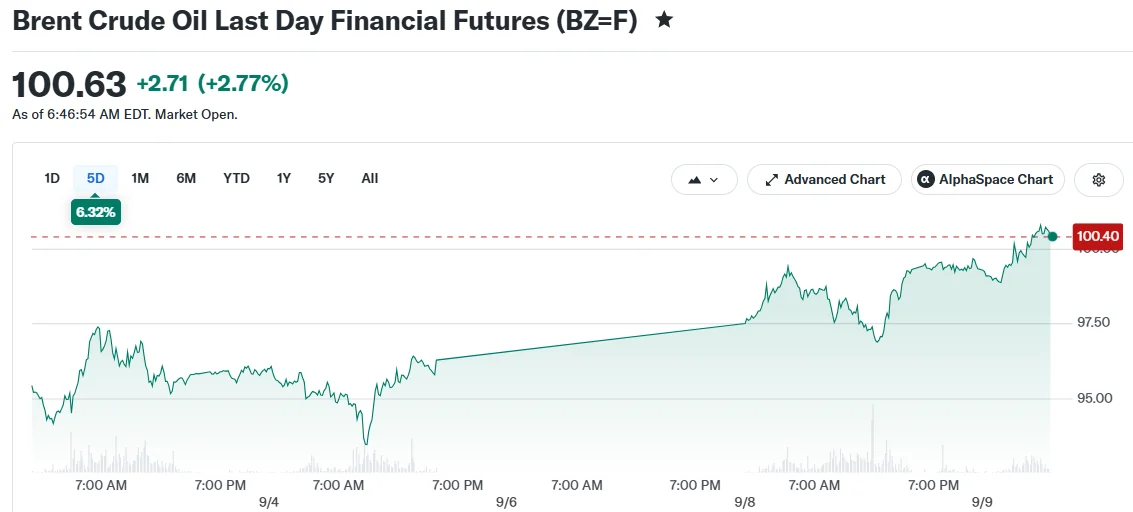
Energy markets experienced a significant rally on Wednesday as mounting hostilities between Washington and Tehran drove Oil prices beyond the crucial $100 per barrel mark for Brent crude—a level not witnessed since July.
Brent crude contracts climbed 2.6% to settle at $100.45 per barrel, while U.S. West Texas Intermediate advanced 2.3% to $95.19 per barrel.
The dramatic price movement came after intensified military confrontations between both nations. American military forces took out five Iranian oil tankers on Tuesday in what officials described as a retaliatory response to attempted strikes against a U.S. naval vessel. American forces sustained no casualties.
In response, Tehran launched missile strikes targeting a U.S. military installation near Al Azraq in Jordan’s eastern region. Iranian officials also issued stern warnings to Gulf nations, including Kuwait and Bahrain, cautioning them against providing assistance to American military operations.
According to Iran’s Islamic Revolutionary Guard Corps, their forces engaged 10 vessels total, comprising two American ships and eight commercial oil tankers. The ongoing confrontation has now entered its seventh month.

Yemen-Based Houthi Forces Expand Conflict Zone
Regional instability expanded when Iranian-supported Houthi militants launched strikes against energy infrastructure and economic targets across multiple cities in southern Saudi Arabia on Tuesday. These attacks resulted in over 70 casualties.
Secretary of State Marco Rubio issued a firm warning to Tehran, stating that the United States would maintain its campaign against Iranian oil vessels in response to continued aggression toward American naval assets.
Market analysts from ING noted that commodity traders will likely continue factoring in elevated risk premiums given the absence of diplomatic progress. “Recent developments only reinforce the view that we’re still some way from a restart in talks,” their analysis stated.
Even amid heightened regional tensions, assessments of crude oil movement through the Strait of Hormuz show modest improvement. Current flow rates stand at approximately 10 million barrels daily, representing roughly 50% of pre-conflict volumes.
Investment Bank Projects Potential $120 Price Point
Goldman Sachs commodities analyst Daan Struyven indicated that the likelihood of Brent crude surpassing $120 per barrel is increasing as attacks on maritime shipping operations escalate.
“It’s definitely plausible,” Struyven stated in an interview with CNBC when questioned about the possibility of $120 oil.
The investment bank’s primary forecast still anticipates a gradual restoration of Persian Gulf oil exports, assuming producers successfully establish alternative transportation routes and expand pipeline infrastructure.
However, Struyven emphasized that recent military escalation increases the probability of an alternative scenario where export volumes remain stagnant for extended periods, driving prices significantly higher.
“The probability of that scenario is definitely going up as we’re seeing an intensification and broadening of the shipping attacks,” he explained.
Military operations between the United States and Iran had temporarily subsided for approximately one month as Washington pursued economic sanctions against Tehran. Combat operations resumed in late last month, with the conflict zone subsequently expanding.
Brent crude last exceeded the $100 threshold in July. Without diplomatic negotiations on the horizon, market participants are closely monitoring whether disruptions to maritime oil transport will deepen in coming weeks.
Get 3 Free Stock Ebooks
Discover top-performing stocks in AI, Crypto, and Technology with expert analysis.
- Top 10 AI Stocks - Leading AI companies
- Top 10 Crypto Stocks - Blockchain leaders
- Top 10 Tech Stocks - Tech giants



