



Key Takeaways
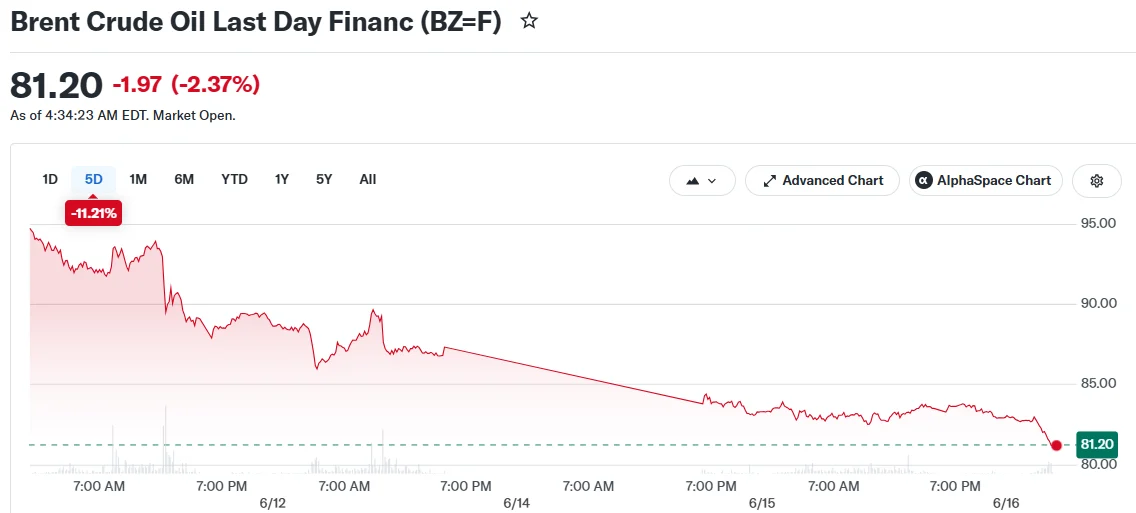
- Brent crude prices tumbled beneath $83 per barrel on Tuesday, marking the sharpest weekly decline of 2026
- An impending US-Iran agreement to restore access through the Strait of Hormuz will be formalized in Switzerland this Friday
- Goldman Sachs revised its fourth-quarter Brent projection downward to $80, a $10 reduction from earlier estimates
- Morgan Stanley similarly adjusted its forecast, now anticipating Dated Brent to settle around $90 during the third quarter
- Latest figures revealed Monday show US strategic petroleum reserves at their most depleted since 1983
Crude oil markets extended losses for a fourth consecutive session Tuesday following news of a diplomatic breakthrough between Washington and Tehran on reopening the Strait of Hormuz. The development has dramatically shifted supply expectations, putting both Brent crude and West Texas Intermediate on course for their steepest weekly decline this year.
Brent slipped under the $83 per barrel threshold during early European market hours, with WTI hovering around $81. Week-to-date, both key benchmarks have surrendered approximately 9% of their value.
The anticipated accord between Washington and Tehran will be officially executed in Switzerland come Friday. This arrangement is projected to restore the flow of Persian Gulf crude shipments through the strategic waterway, which typically handles approximately one-fifth of global oil supply.
At the G7 gathering in France, President Donald Trump confirmed the strait’s imminent reopening. “Numerous shipping channels are already operational,” he informed journalists. “Come Friday, it’ll be fully accessible with no transit fees.”
Investment Banks Downgrade Price Targets
Goldman Sachs projects that Persian Gulf crude shipments will normalize to pre-conflict volumes by late July. Accordingly, the financial institution slashed its fourth-quarter Brent projection to $80 per barrel from a previous $90 estimate.

Morgan Stanley has similarly recalibrated its market view. The bank now anticipates Dated Brent will average $90 per barrel throughout the July-September period, down from its earlier $100 prediction. Its fourth-quarter target was reduced by $15 to reach $80.
RBC Capital Markets adopted a more measured stance. The firm’s analysts suggested that achieving pre-conflict shipping volumes could require several months. “The peak throughput levels for Hormuz may already be behind us,” RBC stated.
Lingering Uncertainty Tempers Enthusiasm
The complete text of the US-Iran framework agreement remains unpublished. Industry participants in shipping and trading sectors emphasized their need for comprehensive details before dispatching tankers to the region.
Energy sector representatives from Persian Gulf nations reported receiving substantial interest from potential purchasers inquiring about renewed crude transit capabilities through the strait. However, ambiguity surrounding operational protocols and maritime security continues to restrain market commitment.
Brent’s prompt spread—an indicator reflecting immediate supply conditions—contracted to 83 cents per barrel. Just one month prior, this metric exceeded $4, illustrating the dramatic reversal in market psychology.
The effective blockage of Hormuz had already depleted US strategic petroleum stockpiles to their thinnest levels in over four decades, according to official statistics published Monday.
The International Energy Agency is scheduled to publish its monthly market assessment Wednesday, potentially offering additional insights into evolving supply dynamics.
Get 3 Free Stock Ebooks
Discover top-performing stocks in AI, Crypto, and Technology with expert analysis.
- Top 10 AI Stocks - Leading AI companies
- Top 10 Crypto Stocks - Blockchain leaders
- Top 10 Tech Stocks - Tech giants



