


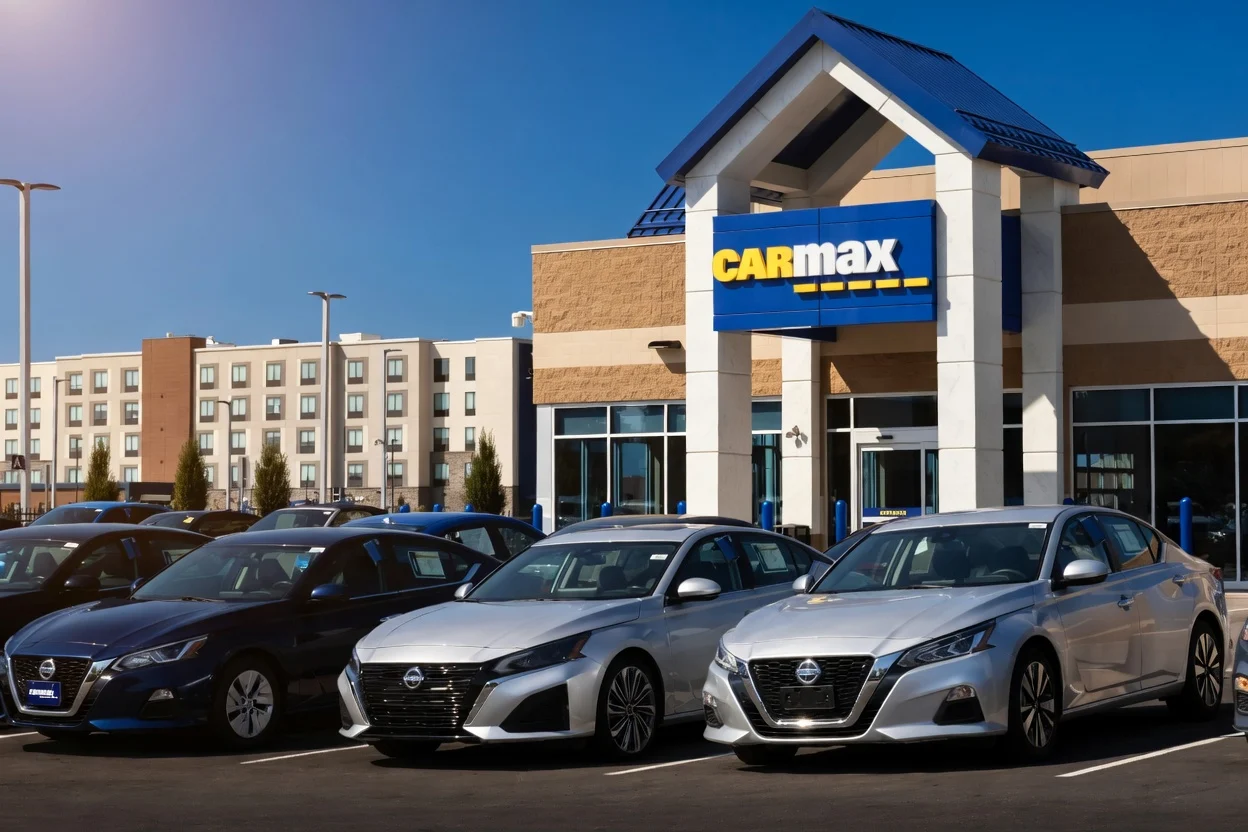
Key Highlights
- CarMax recorded a Q4 net loss of $120.7 million, translating to 85 cents per share, primarily due to a $141.3 million goodwill impairment.
- Shares declined 6.8% during premarket hours on Tuesday.
- On an adjusted basis, earnings per share reached $0.34, surpassing analyst projections of $0.18; quarterly sales of $5.95 billion exceeded the $5.65 billion forecast.
- Gross profit per retail used vehicle declined to $2,115 from $2,322 year-over-year; wholesale unit profitability fell to $940 from $1,045.
- The company announced expansion plans for fiscal 2027 including four new retail locations and four reconditioning/auction centers, backed by approximately $400 million in capital investment.
CarMax (KMX) shares slid 6.8% before the opening bell Tuesday following the disclosure of a fourth-quarter deficit and a substantial $141.3 million goodwill impairment.
The Virginia-headquartered automotive retailer reported a quarterly deficit of $120.7 million, equivalent to a loss of 85 cents per share. This marks a reversal from the year-ago quarter when the company generated earnings of $89.9 million, or 58 cents per share.
However, excluding the goodwill impairment, performance tells a more favorable story. CarMax’s adjusted earnings reached 34 cents per share — nearly double the Street’s expectation of 18 cents.
Quarterly revenue totaled $5.95 billion, representing a modest 1% decline from the prior-year period but comfortably exceeding analyst forecasts of $5.65 billion.

The goodwill charge didn’t catch seasoned observers off guard. CarMax attributed the impairment to declining market capitalization, underwhelming fiscal 2026 performance, and adjustments to long-range projections.
Profitability Continues to Erode
Profit margins on used vehicles remained under significant pressure. Retail gross profit per unit contracted to $2,115 during the quarter, down from $2,322 in the comparable period last year. Similarly, wholesale unit profitability decreased to $940 from $1,045.
The retailer implemented price reductions to accelerate inventory turnover. The strategy yielded mixed results — wholesale volume climbed 3% to 122,781 units. However, average wholesale transaction prices dropped approximately $270 per vehicle, constraining profitability gains.
Retail used vehicle sales volume edged down 0.8% year-over-year to 181,188 units. Same-store sales declined 1.9%. Average retail transaction prices fell roughly $110 per vehicle.
Total combined retail and wholesale volume remained essentially unchanged, increasing just 0.7% to 303,969 units.
Consumer purchasing behavior has added additional headwinds. Gasoline prices lingering around $4 per gallon have dampened consumer confidence. This has accelerated interest in electric and hybrid vehicles, reshaping demand dynamics throughout the pre-owned vehicle marketplace.
Leadership Change Brings Strategic Reset
Newly appointed President and CEO Keith Barr utilized his inaugural earnings call to outline a strategic recalibration.
“We are moving with urgency to improve execution, drive efficiencies, and sharpen our customer offering,” Barr stated. He emphasized that competitive pricing and comprehensive vehicle selection would serve as primary competitive advantages for attracting consumers.
Barr stressed the objective of positioning CarMax as “the obvious choice for customers” by delivering superior pricing, extensive inventory availability, and an enhanced overall purchasing journey.
Looking ahead to fiscal 2027, CarMax outlined expansion initiatives encompassing four new retail stores and four supplementary reconditioning and auction operations. The company anticipates capital expenditures of approximately $400 million.
Full-year quarterly revenue decreased 1% to $5.95 billion.
Adjusted annual earnings per share contracted to 34 cents from 64 cents in the previous fiscal year, underscoring the persistent margin compression throughout operations.
Get 3 Free Stock Ebooks
Discover top-performing stocks in AI, Crypto, and Technology with expert analysis.
- Top 10 AI Stocks - Leading AI companies
- Top 10 Crypto Stocks - Blockchain leaders
- Top 10 Tech Stocks - Tech giants



