



Key Highlights
- On July 18, Cardano successfully deployed the Van Rossem hard fork, transitioning to Protocol Version 11
- This marks the first network upgrade ratified through community governance rather than by founding entity Input Output
- Protocol 11 reduces smart contract execution fees and introduces additional Plutus built-in capabilities
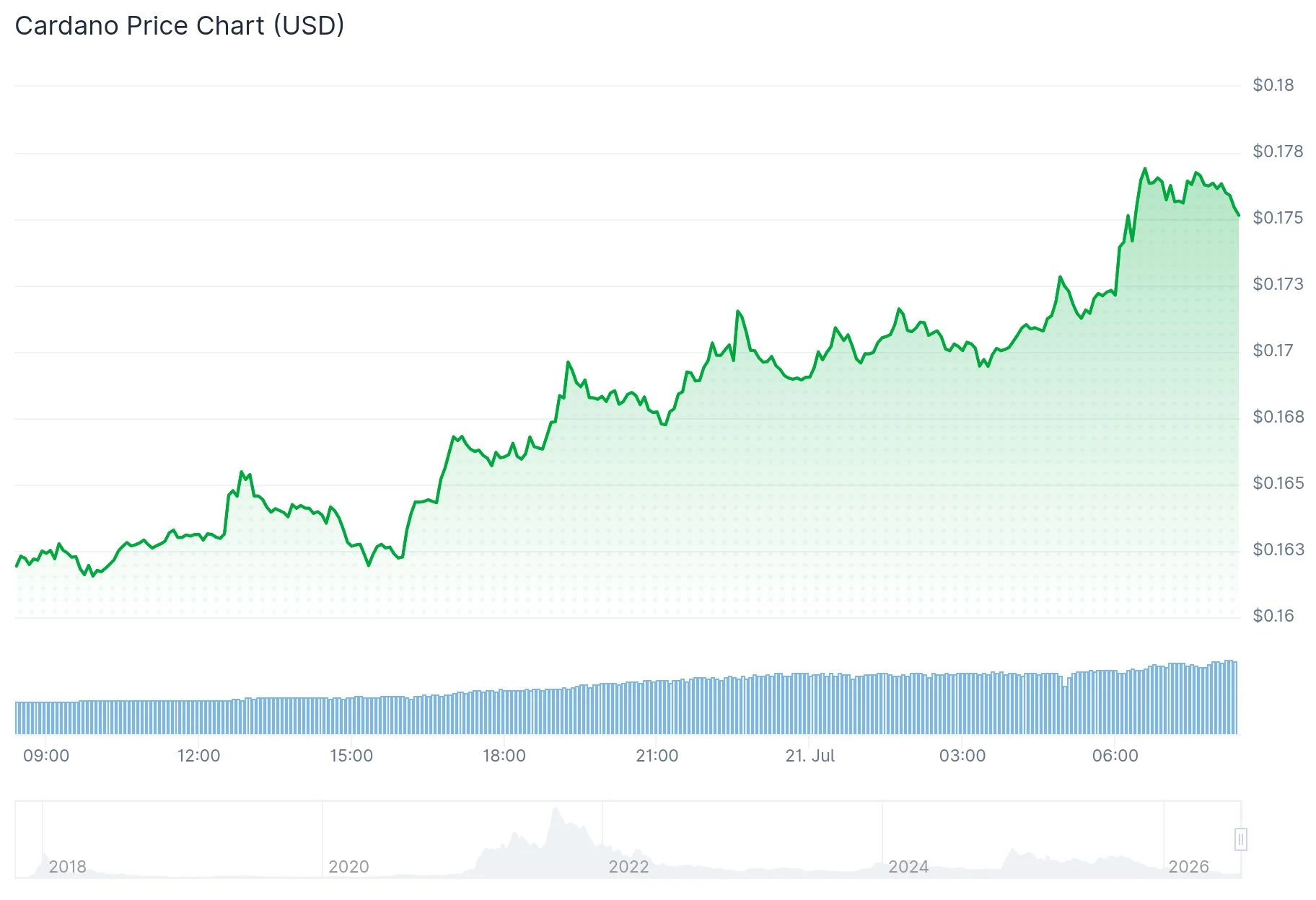
- Following the upgrade, ADA price hovers around $0.1663, reflecting a 24-hour gain of approximately 1.2%
- Large holders with 100K–100M ADA tokens have amassed more than 25.6 billion coins, reaching their peak since February 2023
The Cardano blockchain reached a significant milestone on July 18 with the successful deployment of its Van Rossem hard fork, transitioning the network to Protocol Version 11. The upgrade became operational at 21:44 UTC, experiencing only a minimal ten-minute pause in block production with zero interruption to network participants.
What distinguishes this particular hard fork from all previous Cardano upgrades is its governance origin. For the first time since the network’s inception, Input Output—the development company behind Cardano—did not initiate or mandate the upgrade. The entire process, from initial proposal through debate to final ratification, occurred through Cardano’s decentralized on-chain governance framework established during the Voltaire era.
The voting results demonstrated strong community support. Delegated representatives (DReps) approved the measure with 78.97% in favor, significantly surpassing the 60% approval threshold. The constitutional committee provided unanimous endorsement. Stake pool operators narrowly approved the upgrade with 53.02% support.
Prior to final ratification, network requirements mandated that a minimum of 85% of stake pools operate compatible node software. Monitoring data confirmed that approximately 93% of block production had already migrated to version 11 before the scheduled activation time.
DRep Jason Appleton highlighted the governance achievement in a post on X, stating: “The best part: it was ratified on-chain by delegated community reps before activation. Upgrades by governance, not decree.” This transition represents a fundamental change in Cardano’s evolution—token holders now exercise direct voting authority over protocol modifications instead of simply accepting directives from a centralized development team.

Technical Modifications in Protocol Version 11
From a technical perspective, version 11 constitutes an intra-era upgrade. It operates within the existing Conway governance framework without altering transaction architecture, which minimizes the upgrade burden across the broader ecosystem.
The protocol revision standardizes Plutus built-in functions across all three platform versions, enabling legacy applications to access more recent functionality. Additionally, it strengthens ledger validation protocols, including implementing a restriction that prevents multiple stake pools from utilizing identical cryptographic identity keys.
For typical ADA users, the upgrade remains transparent. Wallet software requires no updates, transaction fees for sending ADA remain constant, and normal transaction operations continue unchanged.
Preparing for Future Scaling Enhancements
Beyond its immediate improvements, Van Rossem establishes critical infrastructure for the forthcoming Dijkstra era hard fork, which will deploy Ouroboros Leios—a comprehensive scaling solution designed to dramatically boost transaction throughput while maintaining security guarantees. This major upgrade is anticipated to launch sometime in 2026.
Cryptocurrency analyst Sssebi observed on X that ADA recently closed above its 50-day moving average and characterized the technical configuration as “looking bullish right now,” projecting that a rally toward the $0.20 price level appears “highly likely” provided the asset maintains support at current levels.
ADA is currently trading around $0.1663, registering a 24-hour increase of roughly 1.2%. Meanwhile, whale addresses holding between 100,000 and 100 million ADA have collectively acquired more than 25.6 billion tokens, representing their largest holdings since February 2023.
Looking ahead, Input Output has announced plans to transfer core infrastructure responsibilities, including management of the Plutus platform and Daedalus wallet, to independent organizations beginning in August.
Get 3 Free Stock Ebooks
Discover top-performing stocks in AI, Crypto, and Technology with expert analysis.
- Top 10 AI Stocks - Leading AI companies
- Top 10 Crypto Stocks - Blockchain leaders
- Top 10 Tech Stocks - Tech giants



