



Key Takeaways
- Saturday saw the launch of Cardano’s Van Rossem hard fork, bringing Protocol Version 11 to the network
- This marks Cardano’s inaugural hard fork executed exclusively via onchain governance mechanisms
- Enhanced Plutus functionality seeks to reduce fees associated with smart contract operations
- ADA maintains a sideways trajectory at $0.165, positioned beneath its 50, 100, and 200-day EMAs
- Current long-to-short positioning shows 0.90, reflecting bearish trader outlook
On Monday, Cardano (ADA) maintains its position at $0.165, showing little movement following a modest uptick in the previous week. The token’s price remains subdued even after a significant network enhancement was deployed during the weekend.
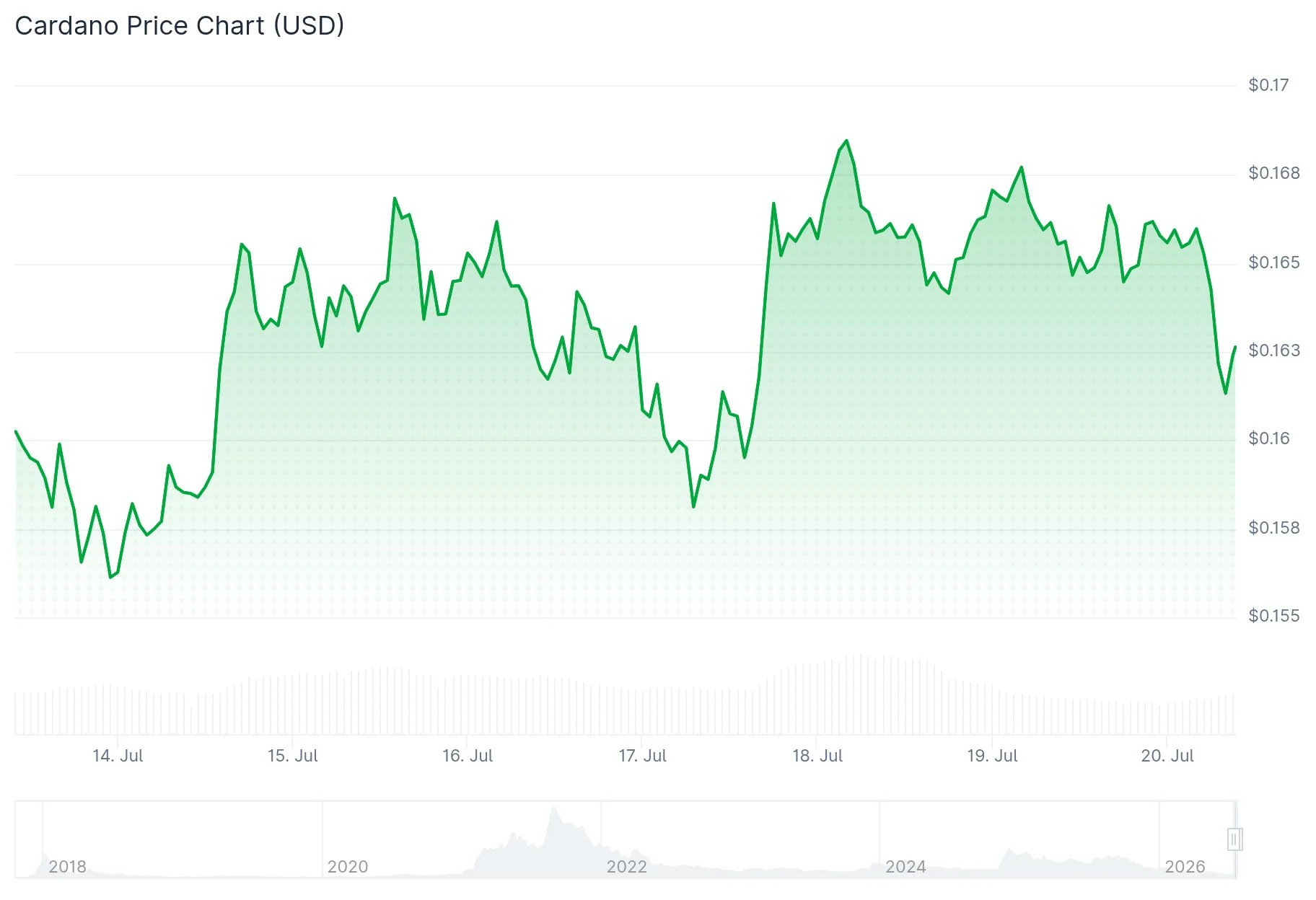
The Van Rossem hard fork went live on Cardano’s mainnet this past Saturday, transitioning the blockchain from Protocol Version 10 to the latest Version 11. Blockchain records from Cardanoscan show the network successfully shifted from epoch 643 into epoch 644 throughout this upgrade process.
This deployment represents a watershed moment for Cardano—it’s the blockchain’s first hard fork to receive complete approval and ratification through decentralized onchain governance procedures. Earlier network upgrades relied on direct coordination from Input Output, the technical organization responsible for Cardano’s development and architecture.
With the Van Rossem implementation, the network gains advanced Plutus features alongside refined cost-model optimizations. The central objective centers on decreasing the operational expenses tied to smart contract deployment and execution.
In their Friday weekly technical update, Input Output explained: “Beyond the Plutus upgrades and Cost Model refinements, this hard fork establishes critical infrastructure for the upcoming Dijkstra era hard fork, which will bring Ouroboros Leios capabilities to Cardano.”

Looking Ahead: The Path Toward Ouroboros Leios
Ouroboros Leios represents an advanced scaling framework designed to enhance Cardano’s current proof-of-stake consensus infrastructure. The anticipated rollout in late 2026 aims to substantially boost transaction throughput while preserving the network’s foundational security architecture.
The Van Rossem deployment functions as essential preparatory infrastructure for this future evolution, positioning itself as a foundational upgrade rather than an isolated enhancement.
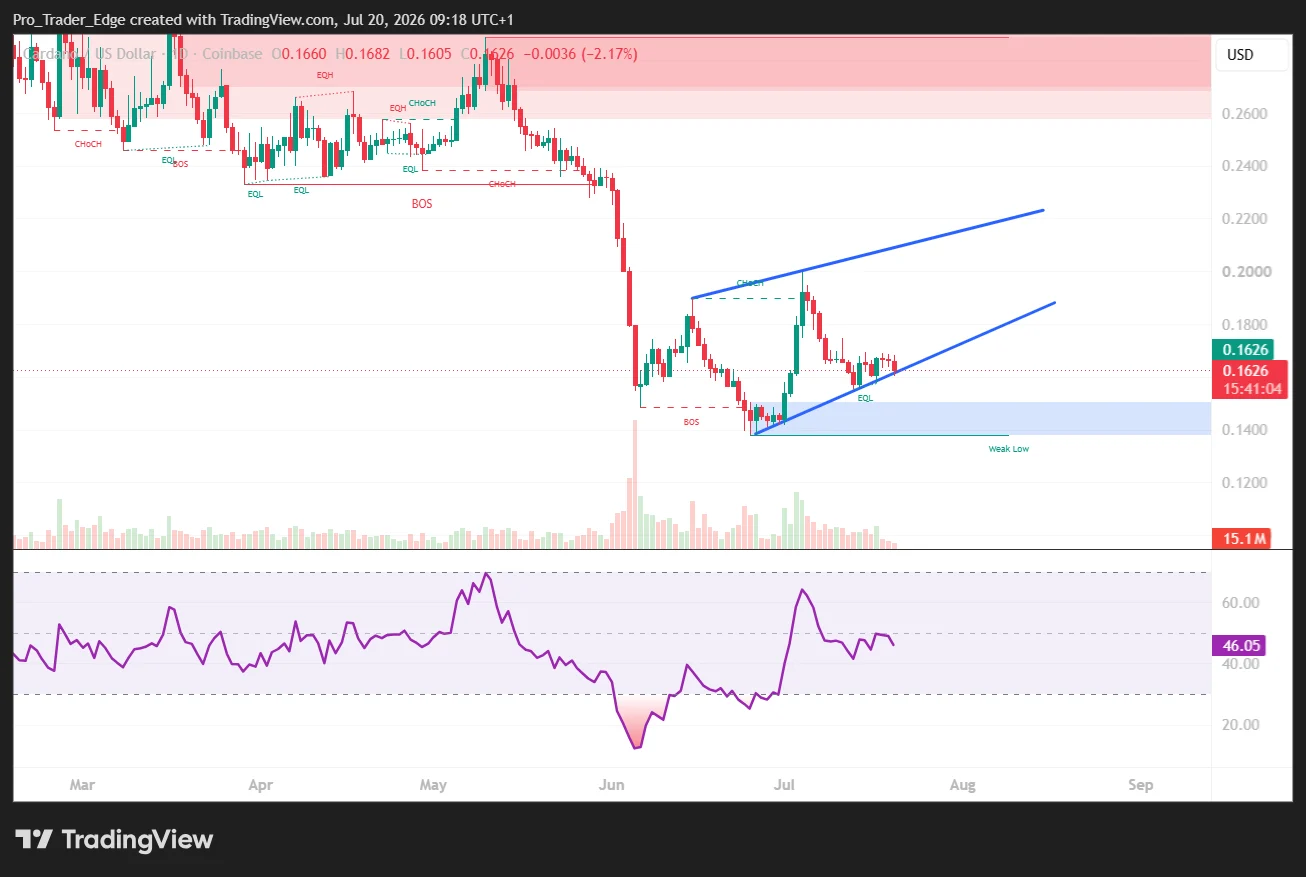
Market response to the technical milestone has been notably muted. ADA continues trading significantly beneath its key moving averages—the 50-day, 100-day, and 200-day Exponential Moving Averages range between $0.180 and $0.270.
Derivative Market Signals Mixed Trader Sentiment
According to Coinglass metrics, the funding rate turned positive on Friday, registering 0.0061% as of Monday. This positive funding rate structure indicates long position holders are compensating short holders, suggesting a marginal improvement in market sentiment.
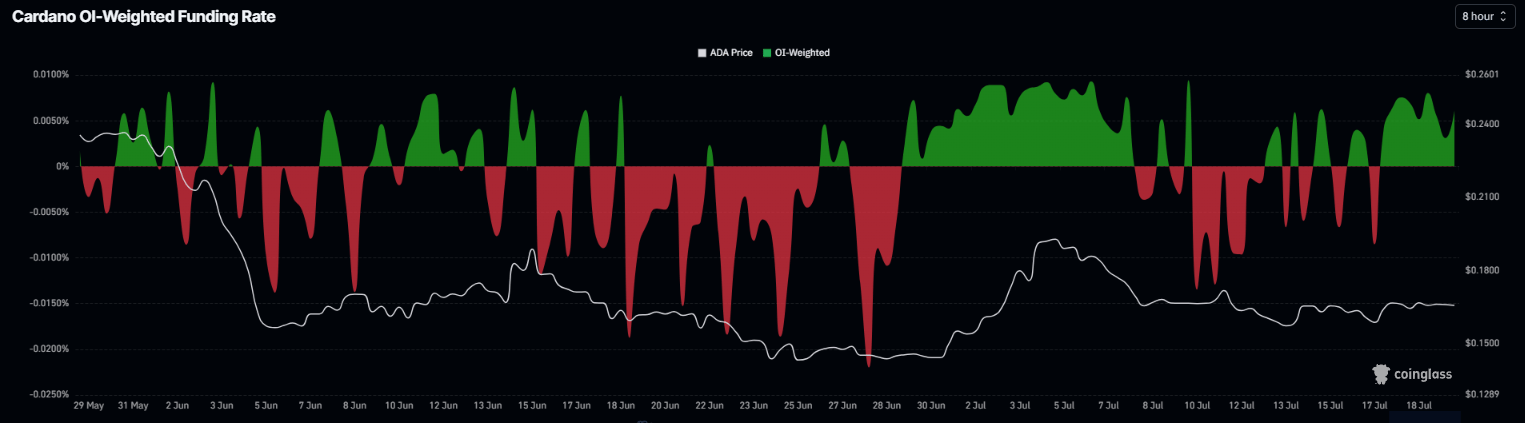
Despite this, Monday’s long-to-short ratio for ADA registers at 0.90. Any figure beneath 1.0 reveals that bearish positions outnumber bullish ones among active traders.
The Relative Strength Index lingers just beneath the neutral 50 threshold, signaling an absence of decisive directional momentum. Meanwhile, the MACD indicator shows slight positive territory but lacks substantial strength.
Price resistance emerges at $0.173 initially, with the 50-day EMA creating a barrier at $0.177. Additional resistance zones exist at $0.195 and $0.202. Downside support levels can be found at $0.150 and $0.138.
Following the Van Rossem hard fork activation, ADA’s long-to-short ratio remains at 0.90 on Monday, with the cryptocurrency holding steady at $0.165.
Get 3 Free Stock Ebooks
Discover top-performing stocks in AI, Crypto, and Technology with expert analysis.
- Top 10 AI Stocks - Leading AI companies
- Top 10 Crypto Stocks - Blockchain leaders
- Top 10 Tech Stocks - Tech giants



