



Key Takeaways
- Cardano price declined more than 7% over the past week, hovering around $0.210 by Friday
- Large holder wallets bought 160 million ADA tokens throughout the recent downturn starting Sunday
- Trader sentiment leans bearish with a long-to-short ratio of 0.74
- Leios testnet demonstrated six-fold throughput improvement versus mainnet during 41-day trial
- Conflicting on-chain and derivatives signals create uncertainty about ADA’s immediate direction
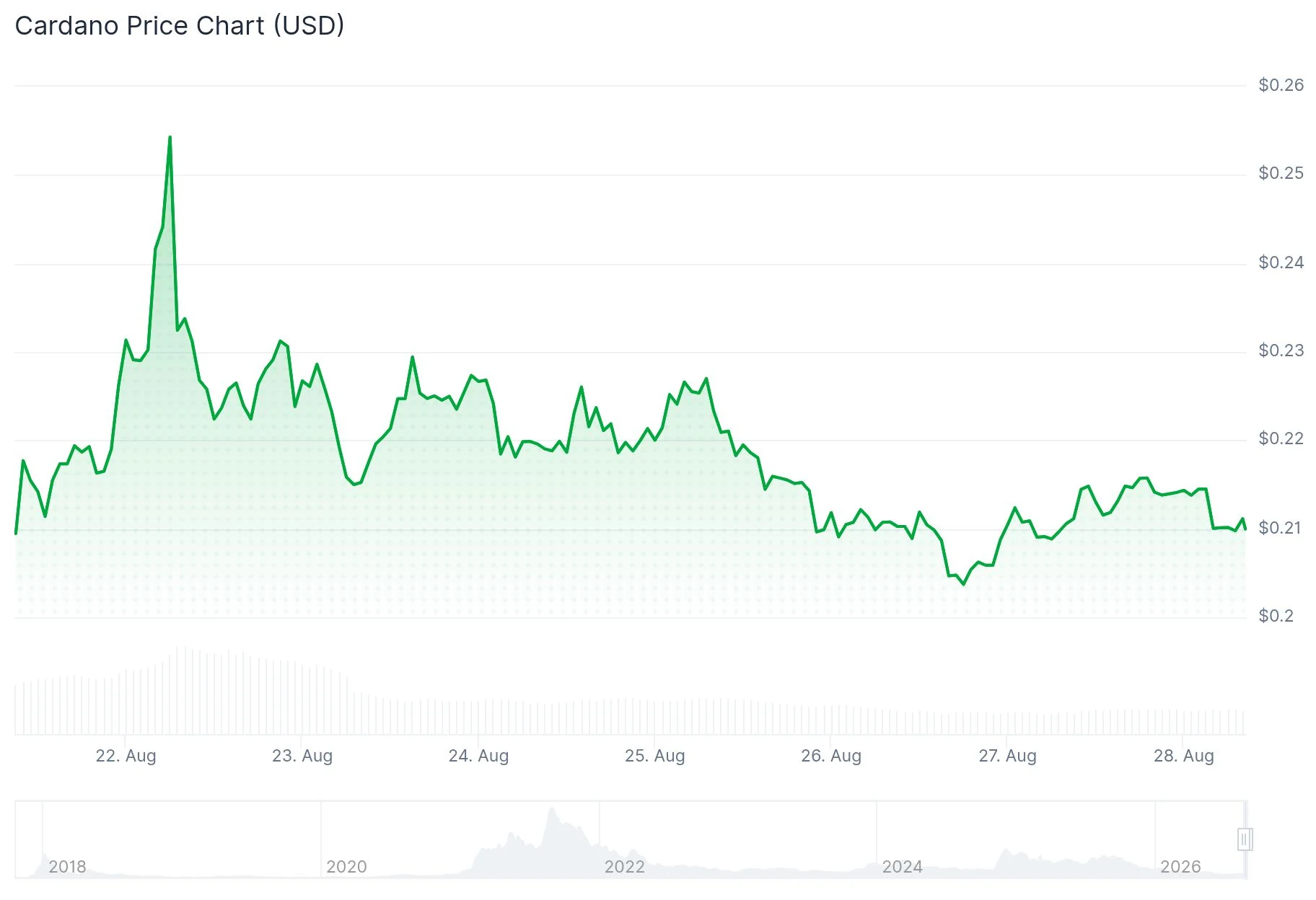
Cardano (ADA) is hovering around the $0.210 mark on Friday following a weekly decline exceeding 7%. The downward move has taken ADA beneath the $0.220 threshold, capturing the focus of market participants and blockchain data specialists.
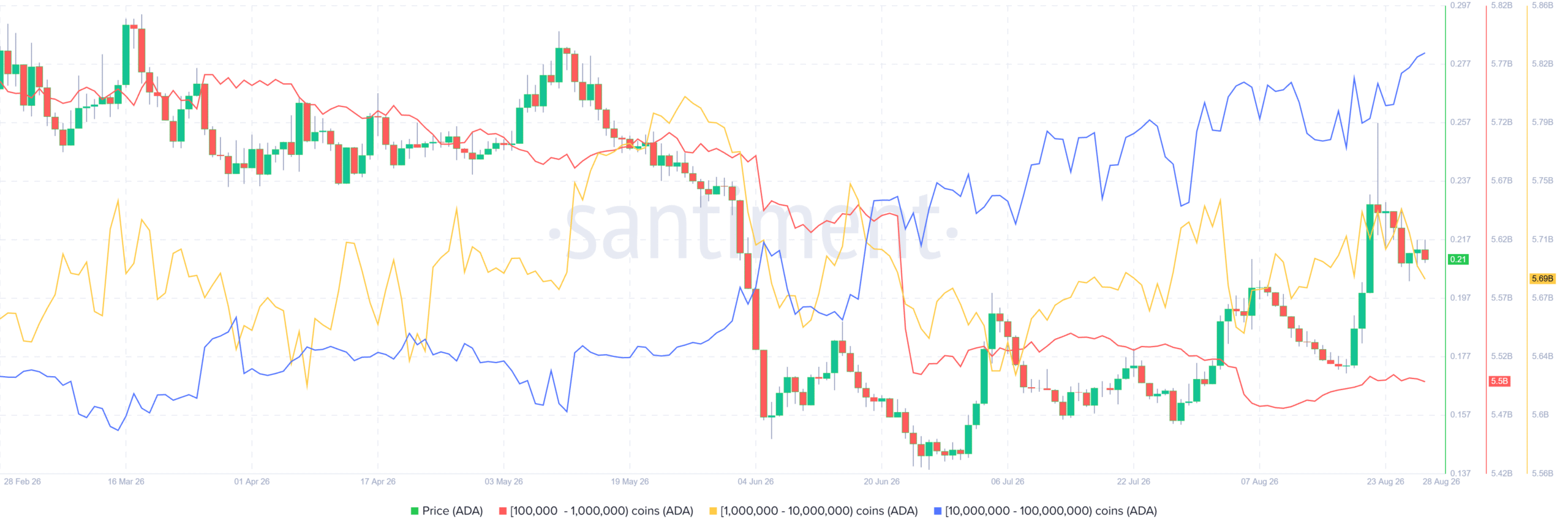
While the price trend remains weak, large-scale investors have been actively purchasing during the decline. According to Santiment metrics, addresses containing between 10 million and 100 million ADA tokens added 160 million coins to their holdings starting Sunday. This demonstrates sustained conviction from major stakeholders, even though it hasn’t yet triggered a price recovery.
Futures market indicators present a contradictory picture. CoinGlass data reveals Cardano’s long-to-short ratio currently stands at 0.74, marking one of the lowest readings in more than 30 days. When this ratio falls below the 1.0 threshold, it indicates traders are predominantly positioning for additional downside.
Conversely, funding rates shifted into positive territory Thursday, registering 0.0013% on Friday. Positive funding rates mean long position holders are compensating short sellers, suggesting some bullish activity persists in the derivatives space.
CryptoQuant analytics reinforce the conflicting signals. While significant whale-sized orders appear in futures markets, selling activity maintains dominance. Additional indicators show neutral readings.

Critical Price Levels Under Focus
ADA has moved back above both its 50-day and 100-day exponential moving averages, positioned at $0.190 and $0.197 respectively. This recovery provides a moderately constructive short-term setup, though overhead resistance presents challenges.
The Relative Strength Index is declining back toward the upper-50s while the MACD histogram shows compression. These technical indicators suggest waning upward momentum. Important resistance zones are located at $0.213, $0.231, and $0.236. The 200-day EMA positioned at $0.246 marks the primary barrier above current levels.
For downside protection, support emerges around $0.195, followed by $0.173. A sustained breakdown beneath these levels could potentially expose the $0.150 region.
Market analyst Sssebi shared on X that a weekly candle close above a critical resistance trendline would confirm a substantial bullish breakout. The analyst emphasized the significance of this weekly timeframe close as the catalyst for ADA’s next major upward movement.
Strong Performance From Leios Testing Phase
Beyond market dynamics, Cardano’s engineering team announced impressive outcomes from the inaugural public Leios testnet deployment. The experimental network achieved six times the transaction capacity of the current mainnet throughout the 41-day evaluation period. During peak efficiency, Leios managed 54% of total network activity, executing 18 times the transaction volume of actual mainnet operations and processing 3.3 times the data volume.
All technical challenges identified during testing originated from implementation code rather than fundamental protocol design. The development team addressed these issues through weekly public code releases.
Leios functions as a supplementary layer built atop Cardano’s existing Ouroboros Praos consensus mechanism. It generates endorser blocks positioned between Praos blocks, enabling parallel transaction processing at higher volumes. The subsequent testing stage, designated Water, has already launched and features incentive mechanisms for stake pool operators.
Get 3 Free Stock Ebooks
Discover top-performing stocks in AI, Crypto, and Technology with expert analysis.
- Top 10 AI Stocks - Leading AI companies
- Top 10 Crypto Stocks - Blockchain leaders
- Top 10 Tech Stocks - Tech giants



