


Key Takeaways
- Savita Subramanian from BofA expresses a bearish stance on megacap technology and the Magnificent Seven stocks
- Massive AI infrastructure investments may decelerate economic growth and impact white-collar employment, reducing consumer expenditure
- Technical analysis from BofA points to a potential “three-wave correction” that could send the S&P 500 down to 6,850
- With a price target of 7,100, BofA holds the most pessimistic S&P 500 outlook on Wall Street
- The firm advises shifting toward large-cap value plays in energy, financial services, and industrial sectors
Bank of America analysts are raising red flags about U.S. equity markets, with senior strategists urging investors to exercise caution as we move deeper into 2026.
Savita Subramanian, who leads U.S. equity and quantitative strategy at Bank of America, shared with Barron’s that she holds a “neutral to negative” view on equities overall. Her primary apprehension centers on megacap technology companies.
“I see no compelling case to continue accumulating Magnificent Seven or megacap tech positions,” she explained.
The Hidden Costs of the AI Buildout
According to Subramanian, the massive investment in artificial intelligence infrastructure presents significant economic hazards. She drew a parallel to home remodeling projects — they invariably take more time and consume more capital than initially projected.
Her deeper concern revolves around the economic impact during this AI infrastructure expansion phase. Given that consumer spending accounts for 70% of U.S. economic activity, she observes AI beginning to chip away at white-collar employment opportunities.
She highlighted that corporations are already hitting pause on recruiting recent college graduates — a demographic that has powered consumer spending growth for three decades.

“Markets have priced in much of the upside, but haven’t adequately accounted for the downside risks,” she noted.
Middle-class consumers, who represent the engine of spending expansion, are already shifting to lower-cost alternatives. Insurance premiums and other major expenses are climbing disproportionately for this segment.
Subramanian further observed that long-term growth projections for the S&P 500 have reached heights last seen during the 1980s, describing this as “somewhat peculiar.”
Technical Analysis Points to Multi-Stage Decline
From a technical perspective, Paul Ciana, who serves as Bank of America’s Global Head of Technical Strategy, shares similar concerns.
Ciana cautioned that the S&P 500 may experience a three-stage decline — known technically as a “three-wave correction” — potentially pushing the index down to 6,850.
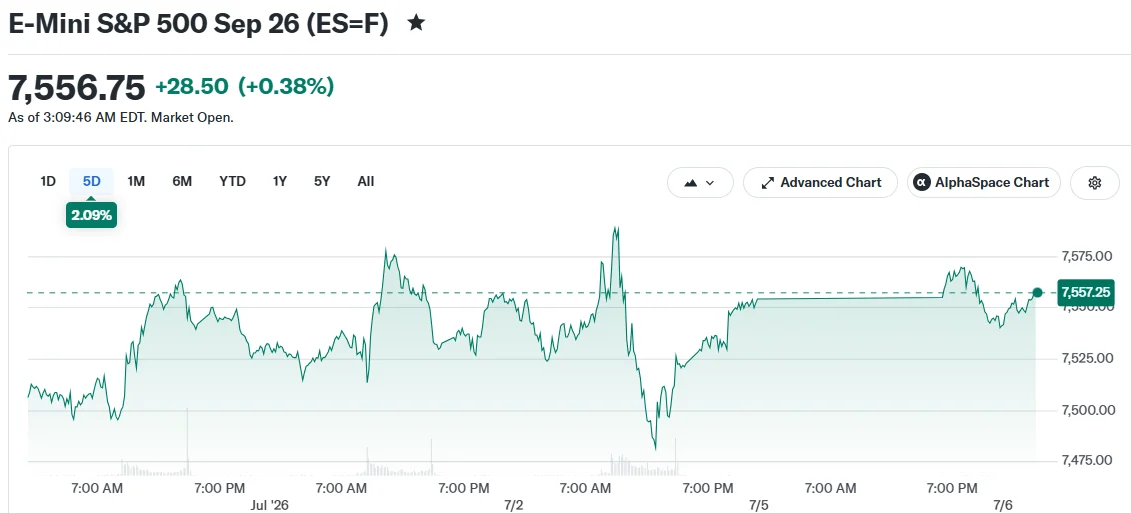
This scenario would translate to approximately an 8.5% decline from present values.
He identified 7,741 as a critical level, warning that a push to this area might constitute a “bull trap” — a deceptive upward breakout followed by a swift reversal.
Ciana characterizes current price behavior as “overextended” and advises investors to adopt defensive positioning throughout the July-September period.
Bank of America maintained its 2026 S&P 500 year-end target of 7,100 this week. This represents the most conservative forecast among Wall Street firms and suggests roughly 5% downside from today’s prices.
The investment bank pointed to weakening market liquidity, reduced corporate buyback activity, and diminishing institutional appetite as justification for their cautious stance.
BofA’s Preferred Investment Alternatives
Notwithstanding the pessimistic broader market view, Subramanian identifies pockets of opportunity. She noted that earnings are expanding across all sectors this year.
Her preference leans toward large-cap value equities — especially within energy, financial services, and manufacturing industries. These areas continue to deliver attractive dividend yields and share repurchase programs.
She also views semiconductor companies more favorably than hyperscalers, since chipmakers are recipients of AI capital expenditures rather than bearing those costs.
Should new equity offerings continue their recent acceleration, combined with rising long-term interest rates, she cautioned this combination could precipitate a more extensive market downturn.
Get 3 Free Stock Ebooks
Discover top-performing stocks in AI, Crypto, and Technology with expert analysis.
- Top 10 AI Stocks - Leading AI companies
- Top 10 Crypto Stocks - Blockchain leaders
- Top 10 Tech Stocks - Tech giants



