



Key Highlights
- Bitcoin slipped more than 2.3% to approximately $63,919, breaking beneath the $64,000 threshold
- Climbing US Treasury yields are fueling speculation about additional Federal Reserve rate increases
- Stablecoin deposits to cryptocurrency exchanges reached their weakest point since 2025
- Analyst Ted cautioned that $65,000 support has broken, with $62,500–$63,000 emerging as the next critical area
- Legislative delays around the Digital Asset Market Clarity Act are creating regulatory ambiguity
Bitcoin (BTC) slipped beneath the $64,000 level on Saturday, with trading data from Binance showing prices hovering near $63,919. This represents a drop of approximately 2.3% across the previous 24-hour period.
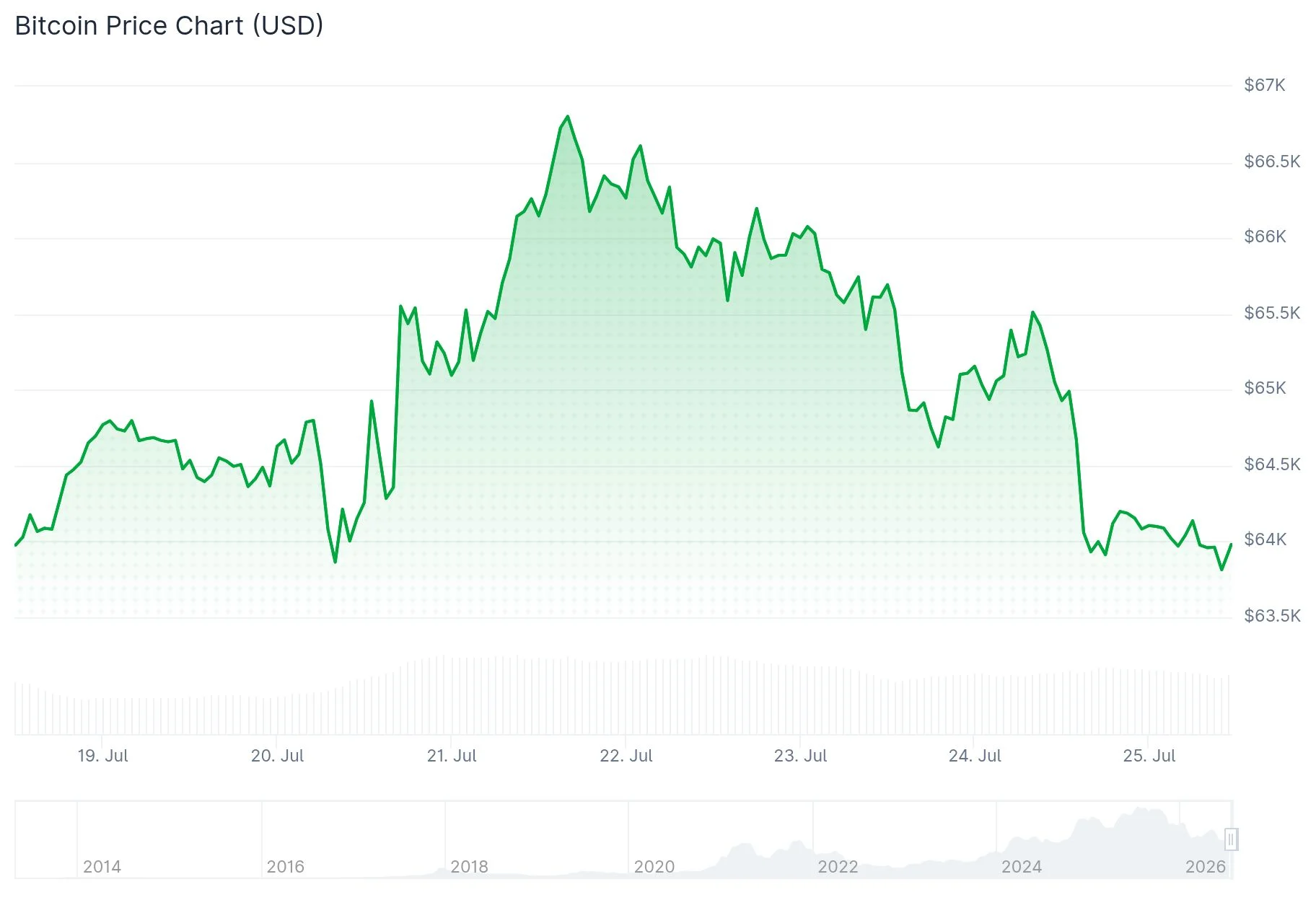
The downward momentum intensified following Friday’s Wall Street opening bell. Throughout that trading session, BTC/USD fluctuated within a range of approximately $63,703 to $65,396.
Mosaic Asset Company, a trading operation, identified climbing US Treasury yields as a primary catalyst. The two-year Treasury yield advanced to 4.31%, positioning itself considerably above the Federal Reserve’s established target corridor.
According to Mosaic’s analysis, “massive moves are underway across the yield curve” even following a softer-than-anticipated CPI reading. Their assessment indicates that elevated yields are exerting downward force on equity indices alongside risk-oriented assets such as cryptocurrencies.
Market expectations reflected in CME Group’s FedWatch Tool suggest the Federal Reserve will maintain current interest rates at next week’s meeting. Nevertheless, traders have priced in a 0.25% rate increase for September, representing one of two anticipated hikes before the year concludes.

Market commentator Ted, writing on X, drew attention to the breach of the $65,000 support level. He stated: “BTC has lost the $65,000 support zone. The next key zone is $62,500–$63,000, which should hold for the next leg up in Bitcoin.” This observation suggests market participants are closely monitoring that price range as a possible support foundation.
Stablecoin Activity Drops to Weakest Levels in Years
CryptoQuant’s analyst Darkfost reported that stablecoin movements to cryptocurrency exchanges have declined to their weakest point since 2025. The 30-day rolling average for USDT and USDC transfers on Ethereum currently registers $2.3 billion, significantly beneath the 365-day moving average of $3.7 billion.
During Bitcoin’s all-time high period, these metrics stood at $5.6 billion and $4.3 billion correspondingly. Diminished inflow volumes indicate reduced available capital entering trading venues, signaling softer purchasing appetite among market participants.
Market observer Killa commented on X that BTC appears to be retracing a recognizable short-term formation, pointing out what he termed a “plunge protection team” active on Binance. Multiple layers of buy-side liquidity materialized beneath current spot pricing, potentially serving as a cushion against more substantial declines.
The Wealthmanager analytics account cautioned that a definitive breach below $64,000 would “invalidate” the near-term market framework.
Market analyst Rekt Capital observed that Bitcoin continues to exhibit 2022 bear market characteristics, facing rejection at the 50-month exponential moving average positioned at $65,950.
Legislative Delays Compound Market Headwinds
The Digital Asset Market Clarity Act faces significant obstacles in advancing through the Senate. Democratic lawmakers have dismissed suggested ethics provisions as inadequate, especially concerning President Trump’s cryptocurrency holdings. Senate Majority Leader John Thune indicated that approval prior to summer recess appears improbable.
Bitcoin currently trades approximately 50% beneath its all-time peak as the bear cycle that commenced in October persists.
Get 3 Free Stock Ebooks
Discover top-performing stocks in AI, Crypto, and Technology with expert analysis.
- Top 10 AI Stocks - Leading AI companies
- Top 10 Crypto Stocks - Blockchain leaders
- Top 10 Tech Stocks - Tech giants



