



Key Highlights
- BTC maintains support around $83,000 following a retreat from the $87,000+ levels reached last week.
- Zcash tumbled 12% to approximately $1,380, marking the largest decline among prominent digital assets.
- Surging crude oil and government bond yields are intensifying speculation of an additional Federal Reserve interest rate increase.
- Spot Bitcoin ETFs recorded $2.39 billion in net inflows during the past week, marking the strongest performance since October 2025.
- Solana-based ETFs achieved a milestone week with $188 million in fresh capital.
Bitcoin maintained its position near the $83,000 threshold on Tuesday as escalating crude oil costs and elevated government bond yields weighed on digital asset valuations. Market participants are monitoring signals that could indicate another Federal Reserve policy tightening move.
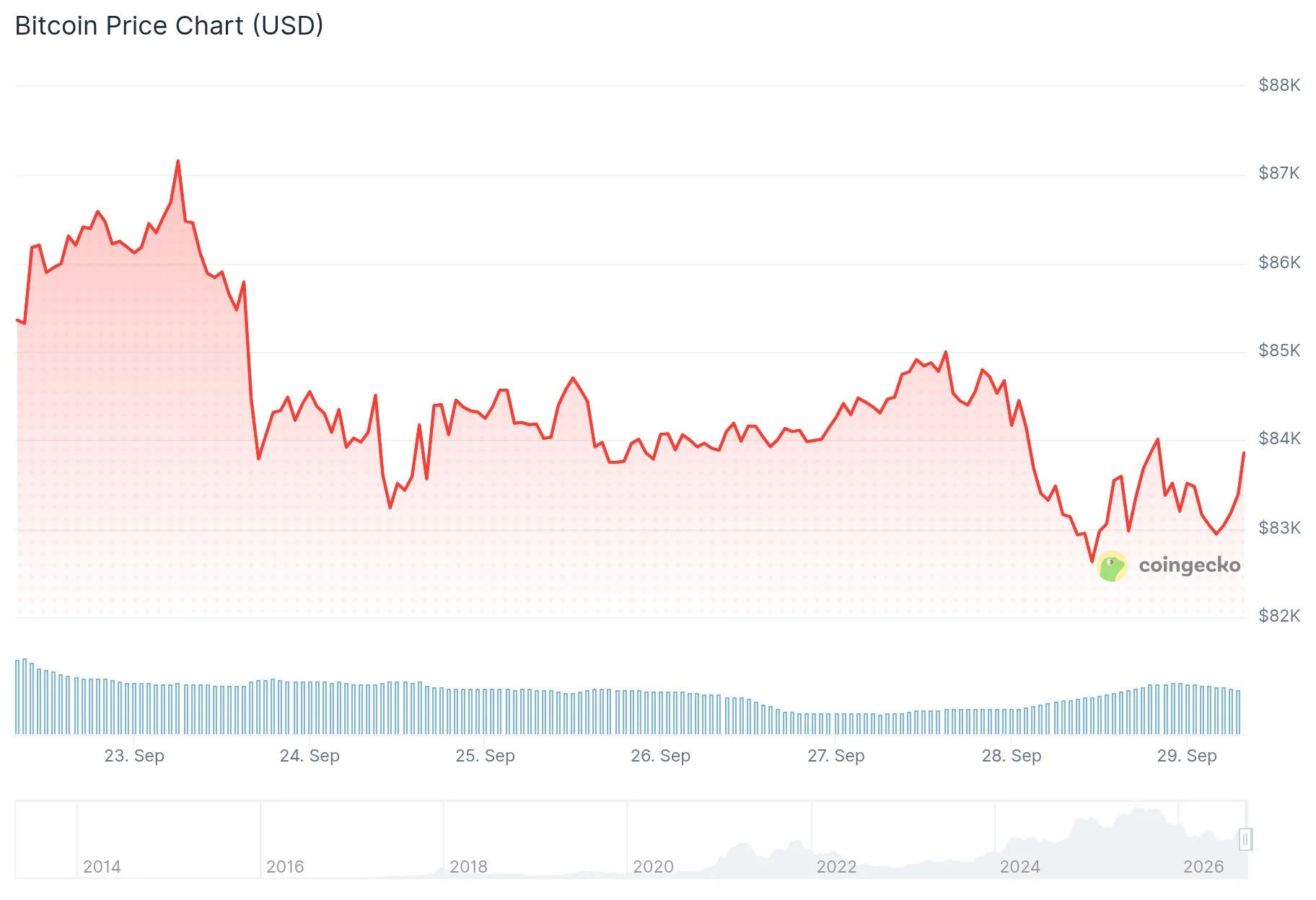
The leading digital currency experienced a modest decline of less than 1%, settling just above $83,100 during Asian trading sessions. BTC is currently probing the lower boundary of its weekly consolidation range.
Last week saw Bitcoin momentarily breach the $87,000 mark before encountering resistance. The subsequent retreat has cascaded through alternative cryptocurrency markets.
Zcash experienced the most severe downturn, plummeting 12% to roughly $1,380, representing the sharpest decline among leading tokens monitored by CoinDesk. Both SOL and HYPE registered losses ranging from 3% to 4%.
Dogecoin shed 3% while Binance Coin retreated 2%. Ripple’s XRP declined close to 2% during the same period.

Both Ethereum and Tron remained relatively unchanged. ETH hovered around $2,670, while Solana maintained its position near $118 following an impressive two-month uptrend.
Smaller-cap cryptocurrencies exhibited mixed performance. The Graph’s GRT token surged 18% and Immutable’s IMX climbed nearly 10%.
Uniswap and Bitcoin Cash each declined approximately 10%, while DASH retreated 7%. The aggregate cryptocurrency market capitalization stood near $2.86 trillion.
A prominent market sentiment gauge registered 74 out of 100 on Monday, approaching the “extreme greed” threshold.
Bond Markets and Energy Costs Weigh on Bitcoin
The primary headwinds confronting cryptocurrencies stem from fixed income markets and energy sector dynamics. The benchmark 10-year Treasury yield advanced to approximately 5.25%, reaching levels not witnessed since 2007.
Elevated risk-free returns on sovereign debt increase the opportunity cost of allocating capital to non-yielding assets like bitcoin.
Brent crude advanced over 1% to approach $107 per barrel, extending gains for a second consecutive session. Diminishing prospects for diplomatic resolution with Iran sustained supply constraints.
Rising energy costs contribute to inflationary pressures. Market participants have increased positions anticipating a Federal Reserve rate hike in October.
Nasdaq 100 futures declined 0.3% following technology sector weakness on Wall Street Monday. Attention now shifts to Wednesday’s PCE inflation release, the Federal Reserve’s preferred measurement tool.
Institutional Appetite Persists Despite Price Weakness
Institutional accumulation of Bitcoin has continued unabated despite recent price softness. U.S. spot Bitcoin exchange-traded funds captured approximately $2.39 billion in net inflows during the previous week, representing the strongest weekly performance since October 2025.
BlackRock’s IBIT product absorbed roughly $1.2 billion of these inflows. The divergence between robust ETF accumulation and declining prices indicates broader market distribution is currently overwhelming institutional purchases.
Solana ETFs similarly achieved record-breaking results. All seven available products attracted new capital, combining for $188 million.
Bitwise’s BSOL commanded the largest share with approximately $128 million. The vehicles added an additional $12.7 million on September 28, perpetuating the momentum.
Market volatility has intensified alongside price fluctuations. Leveraged cryptocurrency positions exceeding $500 million were liquidated within a 24-hour window.
The $83,000 threshold has emerged as a critical near-term reference point for bitcoin. A recovery toward the $85,000 to $87,000 range would restore focus on recent peaks, whereas a breach below $83,000 could intensify downward pressure ahead of Wednesday’s inflation data.
Get 3 Free Stock Ebooks
Discover top-performing stocks in AI, Crypto, and Technology with expert analysis.
- Top 10 AI Stocks - Leading AI companies
- Top 10 Crypto Stocks - Blockchain leaders
- Top 10 Tech Stocks - Tech giants



