



TLDR
- BTC gained 2.3% on Monday, reaching $64,282 after declining nearly 3% during the previous week
- A White House crypto innovation committee meeting is scheduled for Wednesday with President Trump expected to participate
- Bitcoin ETFs experienced approximately $390 million in net outflows last week, marking the worst performance since early July
- Implied volatility for Bitcoin plummeted to the 2nd percentile of its historical distribution
- Critical price levels: upside resistance at $64,700, downside support at $62,200
The world’s leading cryptocurrency staged a Monday recovery, climbing 2.3% to reach $64,282 following a challenging week that saw Bitcoin shed approximately 3% of its value.
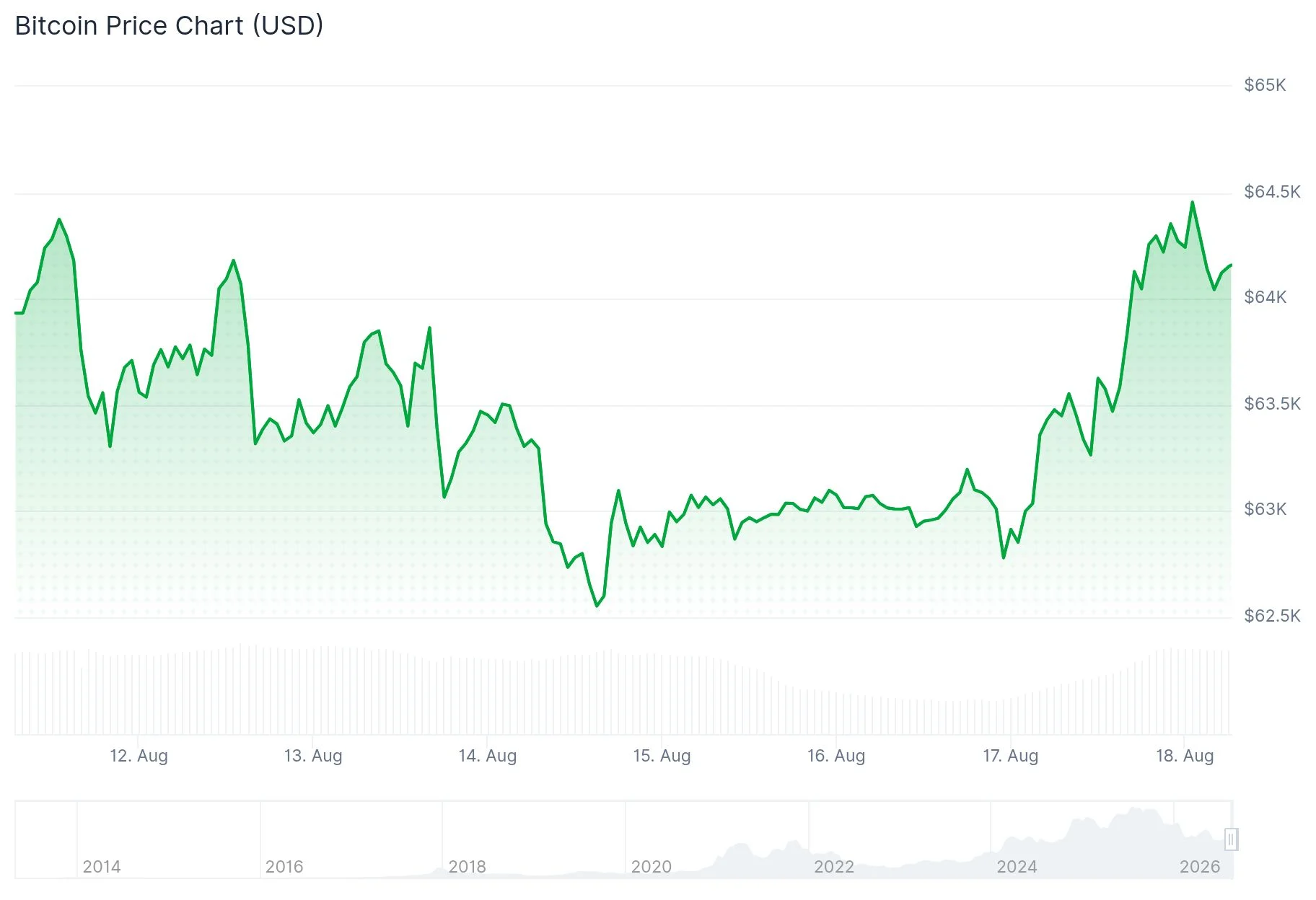
This upward movement occurred as market participants focused their attention on an upcoming Wednesday White House gathering, where President Trump is anticipated to meet with prominent crypto industry executives as part of his administration’s newly established innovation committee.
Attendees at the meeting will include cryptocurrency company CEOs, prediction market executives, and representatives from both traditional financial institutions and artificial intelligence sectors. A follow-up session is planned for Thursday at the Commodities Futures Trading Commission, the committee’s oversight body, where additional cryptocurrency regulatory matters are expected to be addressed.
The previous week’s price decline was attributed to multiple factors, including escalating Middle East geopolitical concerns, regulatory obstacles, and the announcement that Strategy had liquidated $333.7 million in company shares. Between August 10 and 16, the firm sold 3,458,866 shares, allocating the funds toward dividend payments, share buyback programs, and cash reserve strengthening.
Strategy continues to maintain its Bitcoin position at 840,447 tokens, currently valued at roughly $53.4 billion. The firm’s average acquisition cost per Bitcoin is recorded at $75,385.

Last week witnessed spot Bitcoin ETFs experiencing net outflows approaching $390 million, representing the most significant weekly exodus since the beginning of July, based on SoSoValue tracking data.
Monday also delivered a modest encouraging development from the U.S. Treasury Department, which initiated a public consultation process regarding the issuance and distribution of payment stablecoins under the GENIUS Act framework.
Volatility Compressed to Historic Lows
Glassnode co-founder Rafael Schultze-Kraft highlighted an uncommon situation developing in the derivatives market. According to his analysis, Bitcoin’s implied volatility had contracted to the 2nd percentile across its complete historical range. The company’s proprietary “volatility trap” metric registered 91 out of 100, marking its most elevated reading in more than three and a half years.
Schultze-Kraft observed that implied volatility currently remains approximately 1.5 times higher than realized volatility, indicating that options market participants continue paying substantial premiums despite remarkably subdued price movements. Historical instances of comparable volatility compression have frequently preceded significant price swings, though the data provides no directional indication.
Key Levels Traders Are Watching
Market analyst Michael van de Poppe emphasized the significance of the $63,300 price point. He observed that Bitcoin tested this zone and experienced immediate buying interest, suggesting that another retest of this level would indicate underlying weakness. Van de Poppe anticipates a move toward $65,000 if the current upward momentum persists.
CoinGlass liquidation mapping reveals concentrated overhead liquidity positioned at $64,000 and $64,700. Support-side liquidity accumulates around $62,700 and $62,200. Bitcoin has remained confined within the $62,000 to $65,000 corridor since the end of July.
Market commentator Ted (@TedPillows) on X identified the $72,000–$74,000 range as critical territory for Bitcoin’s subsequent major directional movement. He stated that successfully reclaiming this zone would substantially reduce the probability of another decline beneath $60,000. Conversely, failure to recover this range could trigger a potential drop below $58,000.
Bitcoin was last trading around $64,282 as of Monday evening Eastern Time.
Get 3 Free Stock Ebooks
Discover top-performing stocks in AI, Crypto, and Technology with expert analysis.
- Top 10 AI Stocks - Leading AI companies
- Top 10 Crypto Stocks - Blockchain leaders
- Top 10 Tech Stocks - Tech giants



