



Key Takeaways
- Bitcoin briefly touched $77,600 on Tuesday before bouncing back above the $78,000 threshold amid intensifying Middle East turmoil
- WTI crude oil climbed toward $95 per barrel while Brent crude neared the $100 mark, levels not seen since July 24
- Trader Rekt Capital cautions that a weekly close beneath $78,300 may signal a breakdown pattern resembling May’s decline
- Market observer Ted Pillows suggests a weekly close surpassing $83,000 could trigger momentum toward $100,000 in 2026
- Military actions against Iranian oil vessels and Houthi strikes on Saudi territory have expanded the scope of regional hostilities
Bitcoin’s value slipped to $77,600 during Tuesday’s U.S. market opening session, marking its weakest point since early September, before staging a recovery above the $78,000 mark. The decline coincided with broader weakness across American stock indices following reports of renewed military confrontations in the Persian Gulf region.
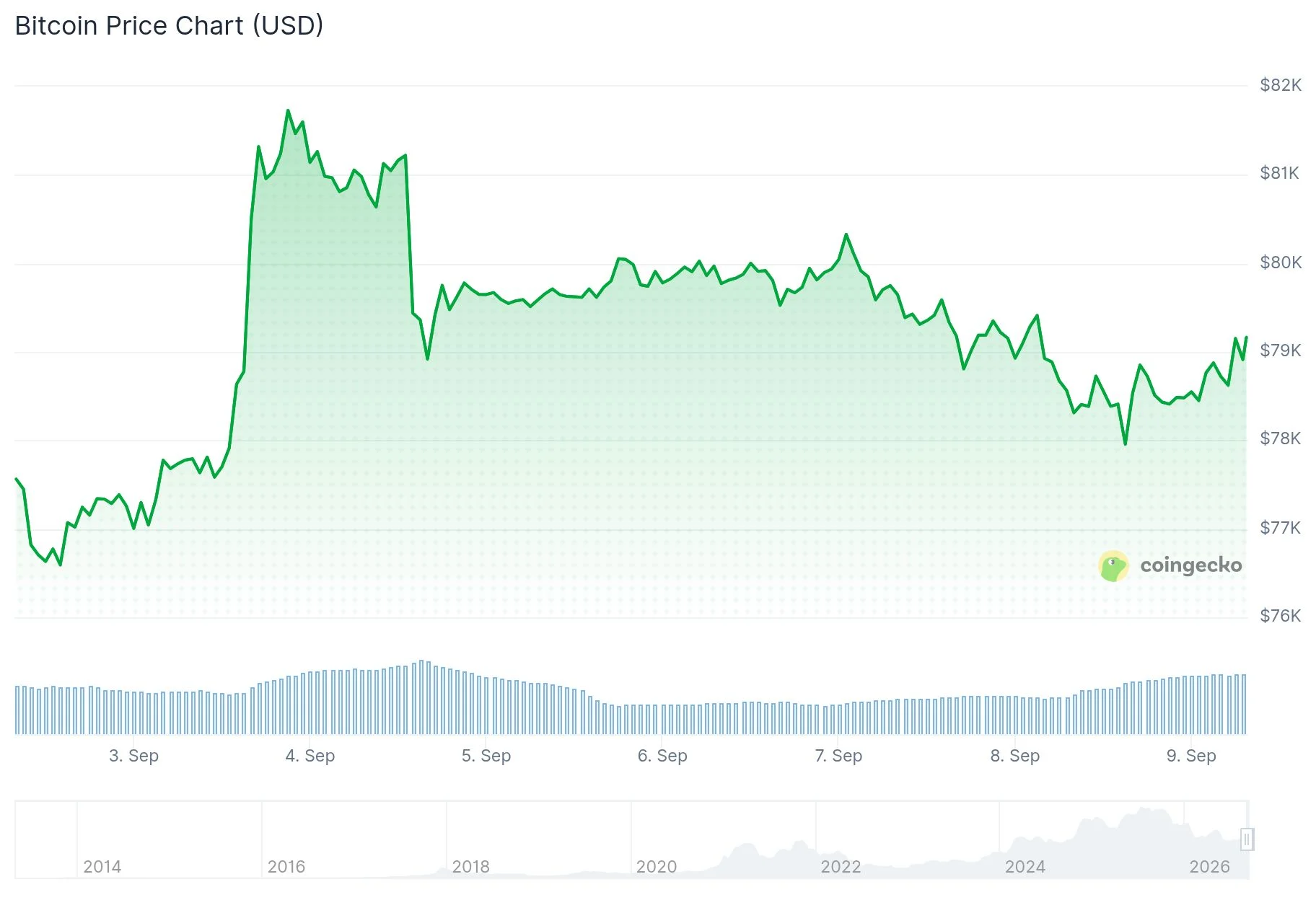
The S&P 500 index shed 0.5% while the Nasdaq composite declined 0.4% during opening trades. Energy markets displayed more pronounced reactions, with West Texas Intermediate crude advancing toward $95 per barrel and Brent crude approaching the psychologically significant $100 threshold—a level last witnessed on July 24.
American military forces conducted operations targeting several Iranian petroleum tankers positioned near Kharg Island and in the Gulf of Oman waters following Iranian attempts to engage a U.S. Navy vessel. Iran’s Revolutionary Guards issued warnings threatening commercial shipping operations near Kuwaiti and Bahraini port facilities.
Iranian leadership is reportedly establishing a maritime exclusion perimeter surrounding the strategically vital Strait of Hormuz. Government representatives in Tehran indicated that additional American military operations could trigger countermeasures directed at energy infrastructure throughout the region.
Houthi forces, aligned with Iranian interests, expanded the conflict’s geographic scope by launching drone and missile strikes against four urban centers in southern Saudi Arabia. Saudi security officials confirmed 73 casualties with injuries, alongside fire incidents at petroleum facilities located in Jazan and Abha provinces.

Critical Support Zone Under Scrutiny
Market analyst Rekt Capital highlighted parallels between current price action and Bitcoin’s unsuccessful May rally attempt, when the cryptocurrency reached $82,800 before reversing course, consolidating around the $78,300 level, and ultimately declining to approximately $57,000.
“The retest of ~$78,300 is now in progress,” the analyst posted on X. A weekly candle closing beneath this threshold, coupled with a bearish retest pattern, “would likely confirm a breakdown,” according to his assessment.
A rejection at the $78,300 level would establish yet another lower peak in a sequence extending back to October 2025, reinforcing Bitcoin’s ongoing bear market trajectory through 2026.
Market Observers Identify Bullish Scenarios
Trading analyst CryptosBatman observed on X that Bitcoin has reclaimed territory above its weekly 200 exponential moving average while confronting resistance zones overhead. The analyst described current price action as retesting a prolonged downtrend line while weekly relative strength index measurements approach descending resistance barriers, emphasizing that a decisive breakout would represent significant trend reversal confirmation.
Market commentator Ted Pillows indicated that a weekly close exceeding $83,000 could establish conditions favorable for advancement toward the $100,000 milestone within the current calendar year. He acknowledged Bitcoin’s recent formation of a daily golden cross technical pattern while expressing concern regarding weakening spot market demand indicators.
Trader Michaël van de Poppe suggested Bitcoin’s recent corrective phase may be nearing exhaustion, pinpointing the $72,000 to $74,000 range as an attractive accumulation zone should prices experience additional downside movement.
Brent crude oil contracts closed Tuesday’s session at $98.63 per barrel as ongoing Gulf region hostilities continued exerting upward pressure on global energy markets.
Get 3 Free Stock Ebooks
Discover top-performing stocks in AI, Crypto, and Technology with expert analysis.
- Top 10 AI Stocks - Leading AI companies
- Top 10 Crypto Stocks - Blockchain leaders
- Top 10 Tech Stocks - Tech giants



