



Key Takeaways
- Major banking institution Standard Chartered has begun tracking ARB with an ambitious $10 valuation target for late 2030
- The projection implies approximately 70-fold appreciation from ARB’s present trading range of $0.13–$0.14
- Integration with Robinhood Chain has already multiplied Arbitrum’s monthly earnings to 5x pre-July figures
- The bank anticipates ARB will deliver stronger returns than both Bitcoin and Ether during this timeframe
- Primary concerns include delayed tokenization adoption and competitive pressure from alternative blockchain networks
In a significant development for the layer-2 ecosystem, Standard Chartered has released its initial analysis of Arbitrum’s native token ARB, projecting a $10 valuation by late 2030. With ARB currently trading between $0.13 and $0.14, this forecast suggests potential gains of approximately 7,000%.
Geoff Kendrick, who leads Standard Chartered’s Global Digital Assets Research division, presented these projections in a client communication. His analysis positions ARB as a superior investment compared to Bitcoin and Ether throughout the decade. The firm’s corresponding forecasts place Bitcoin at $500,000 and Ether at $40,000 by 2030’s conclusion.
Market data from CoinGecko indicates ARB has already appreciated 86% during the previous 30 days.
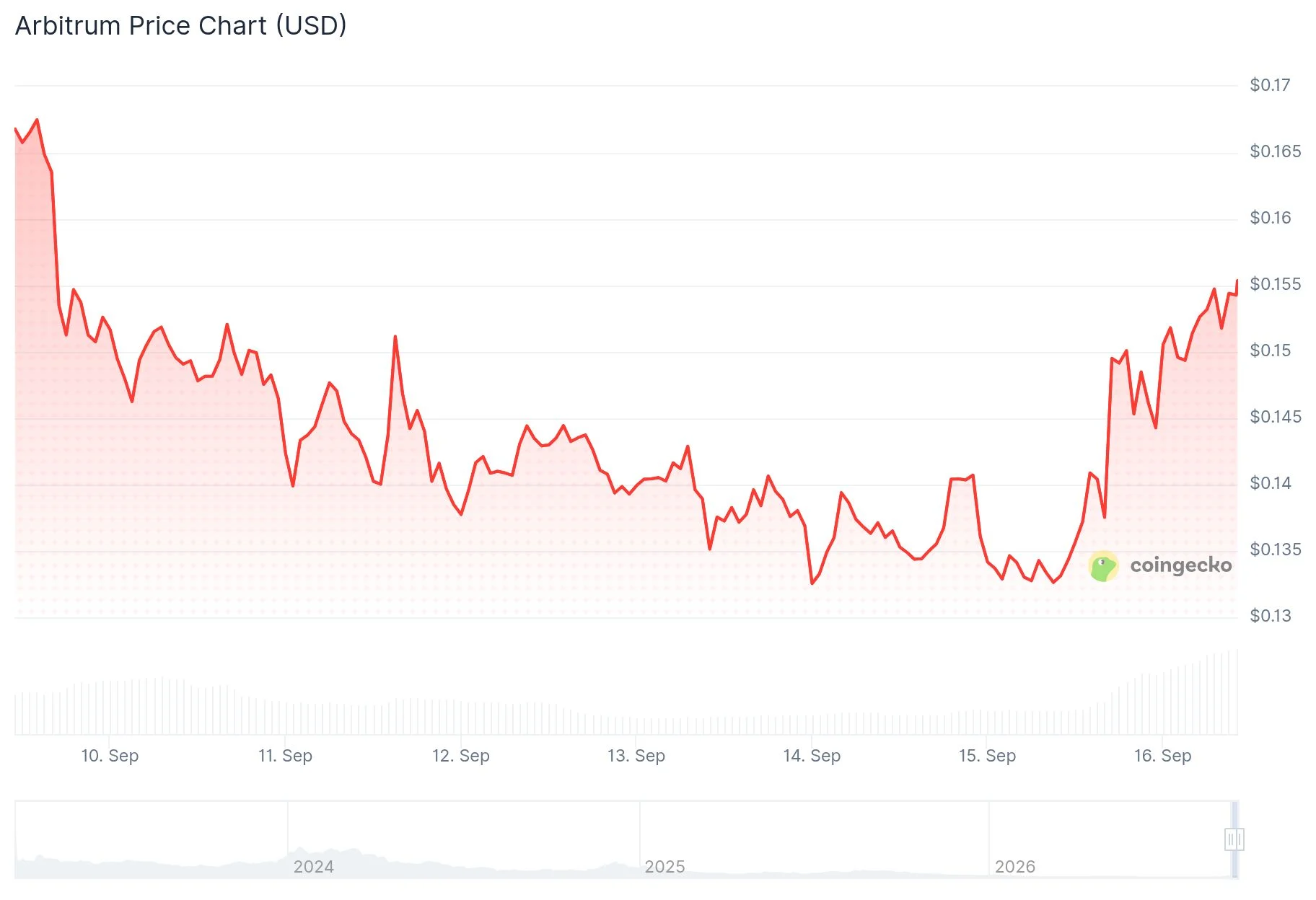
The bank’s roadmap includes progressive milestones: $0.50 by late 2026, $1.50 by late 2027, $3.50 by late 2028, and $6.50 by late 2029.
Robinhood Chain Integration Reshapes Revenue Model
The primary driver behind this optimistic outlook is Robinhood Chain, which went live on July 1, 2026. The popular trading platform constructed its blockchain using Arbitrum’s technological framework.

Through Arbitrum’s Expansion Program framework, the network secures a continuous revenue stream equivalent to 10% of net protocol earnings from third-party chains utilizing its infrastructure.
During September’s first two weeks, Robinhood Chain generated an average of $2.8 million in daily fee revenue. Maintaining this pace, Arbitrum is projected to collect $5 million in AEP fees for September—representing a fivefold increase compared to total monthly revenue prior to Robinhood Chain’s deployment.
According to Kendrick: “The early success of Robinhood Chain increases the probability that similar TradFi chains will also launch via the Arbitrum tech stack.”
Real-World Asset Tokenization Anchors Growth Thesis
The foundation of Standard Chartered’s optimistic projection centers on the expansion of tokenized real-world assets. Their research estimates tokenized assets will balloon to $4 trillion by late 2028, compared to approximately $340 billion presently. Within this category, tokenized equities alone could achieve $750 billion in the same window.
Data from RWA.xyz shows tokenized real-world assets currently total nearly $39 billion in aggregate value.
Arbitrum is strategically positioned as the backbone infrastructure for legacy financial institutions transitioning assets to blockchain rails. Kendrick emphasized that revenue generation is emerging as a crucial metric in digital asset valuation frameworks.
“We see digital assets transitioning from a state where revenue is not yet relevant to one where revenue is critical,” his analysis stated.
Standard Chartered identified three primary risk factors: tokenization adoption falling short of projections, intensifying competition from rival blockchain platforms, and ARB’s indirect value capture mechanism. The analysis also highlighted regulatory developments including the Clarity Act and DTCC initiatives around tokenized equities as variables requiring monitoring.
Current data shows Arbitrum’s monthly revenue running at more than five times its levels before the Robinhood Chain launch.
Get 3 Free Stock Ebooks
Discover top-performing stocks in AI, Crypto, and Technology with expert analysis.
- Top 10 AI Stocks - Leading AI companies
- Top 10 Crypto Stocks - Blockchain leaders
- Top 10 Tech Stocks - Tech giants



