


Key Takeaways
- Spot gold advanced 1.0% to reach $4,385.76 per ounce Friday, positioned for approximately 0.9% weekly increase
- Crude prices declined for third consecutive session following Saudi Arabia’s announcement of imminent pipeline restoration
- Bank of Japan implemented rate increase Friday, following similar monetary tightening by Federal Reserve and European Central Bank
- Weakening dollar, influenced by declining energy costs, provided additional momentum for gold
- ANZ research indicates gold-backed ETFs recorded inflows for eighth consecutive trading session
Gold prices extended their advance Friday, positioning the precious metal for a moderate weekly increase as declining energy costs and diminishing dollar strength provided tailwinds.
Spot gold gained 1.0% to settle at $4,385.76 per ounce during morning hours. Gold futures contracts climbed 0.6% to $4,425.20 per ounce. New York-traded gold futures advanced 0.8% to $4,434.90 during early European market activity.
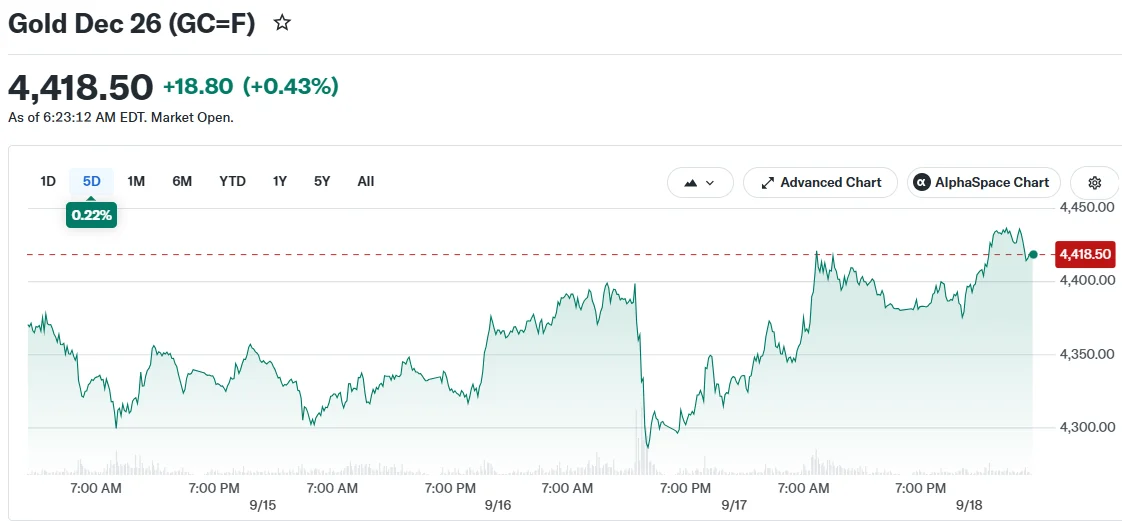
The precious metal is tracking for approximately 0.9% weekly appreciation. Gold surged more than 2% Thursday after touching a nearly six-week trough during the previous session.
Crude markets experienced their third consecutive daily decline. Saudi authorities indicated they anticipate restoring operations through a critical pipeline in coming days. Meanwhile, China intensified diplomatic initiatives aimed at curtailing Houthi militant influence, as the group maintains control over the strategic Bab el-Mandeb Strait.
The retreat in oil prices has alleviated concerns that energy-fueled inflation pressures would compel monetary authorities to accelerate rate normalization schedules.

Monetary Authorities Continue Tightening Campaign
Japan’s central bank implemented a rate increase Friday, citing inflation approaching its 2% annual objective. This action mirrors recent monetary tightening decisions by both the Federal Reserve and European Central Bank.
The Federal Reserve executed its initial rate increase in three years Wednesday. ING economists noted that declining crude prices have relieved some upward pressure on the greenback following that policy shift.
Nevertheless, ING cautioned about potential dollar appreciation scenarios. The Fed’s aggressive policy stance has encouraged markets to fully incorporate expectations for another rate adjustment in October, contingent on inflation metrics and energy market developments.
An appreciating dollar tends to pressure gold by elevating costs for international purchasers. The U.S. dollar index edged 0.1% higher to 100.38 Friday.
Exchange-Traded Fund Activity Signals Persistent Interest
Gold-backed exchange traded products monitored by Bloomberg registered substantial capital inflows in recent trading. ANZ research highlighted that assets in these vehicles expanded for eight consecutive sessions.
ANZ additionally noted robust activity in options contracts for prominent gold-backed funds. This pattern indicates traders maintain active positioning in precious metals despite rising borrowing costs associated with non-yielding assets.
Saxo Bank analysts emphasized gold’s remarkable stability considering the Federal Reserve recently launched a fresh monetary tightening cycle while the dollar maintains relative firmness.
They noted this resilience reflects ongoing demand from market participants who demonstrate reduced sensitivity to conventional correlations between interest rates, currency values, and precious metal valuations.
Elevated interest rates generally amplify the opportunity cost associated with holding gold, which generates no income. This dynamic persists as additional rate increases are anticipated throughout the remainder of the year.
Gold’s capacity to maintain support above the $4,400 threshold despite these countervailing forces has attracted considerable analyst attention entering the weekend period.
Get 3 Free Stock Ebooks
Discover top-performing stocks in AI, Crypto, and Technology with expert analysis.
- Top 10 AI Stocks - Leading AI companies
- Top 10 Crypto Stocks - Blockchain leaders
- Top 10 Tech Stocks - Tech giants



