



Key Takeaways
- Continental equity indices experienced modest Friday declines but secured their first positive weekly performance in three weeks
- The Federal Reserve implemented a 25 basis point increase, lifting rates to 3.75%-4% range in its first adjustment since mid-2023
- Crude oil prices maintained elevated levels around $104 per barrel following an earlier spike beyond $113 triggered by infrastructure attacks
- The Bank of England maintained its 3.75% rate while signaling potential November tightening
- Technology shares led sector gains while energy, telecommunications, and luxury brands underperformed on Friday
European stocks experienced a modest retreat on Friday while preserving weekly advances following a period marked by energy supply concerns and monetary policy decisions from major central banks.
The Stoxx Europe 600 index declined approximately 0.44% during Friday’s session, retreating from the previous day’s one-week-plus high. Germany’s DAX and France’s CAC 40 both registered losses near 0.7%, while the UK’s FTSE 100 decreased 0.6%.
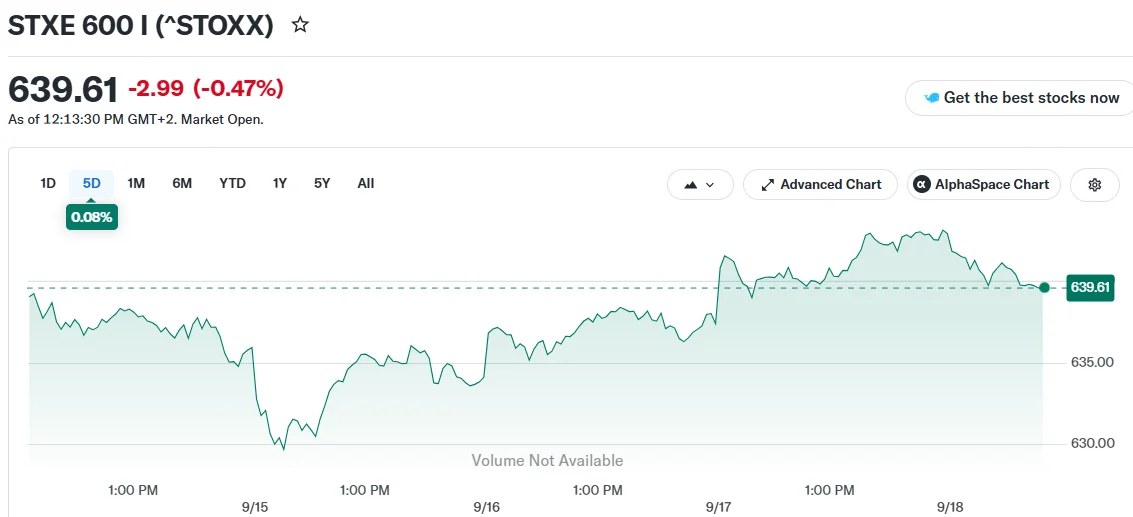
Notwithstanding Friday’s decline, the Stoxx 600 remained positioned to finish the week approximately 0.5% higher, representing its first positive weekly close in a three-week period.
Federal Reserve Policy Decision Stabilizes Investor Sentiment
In a unanimous decision, the Federal Reserve implemented a 25 basis point rate increase, establishing a target range of 3.75% to 4%. The adjustment marked the central bank’s initial rate elevation since the middle of 2023.
Chair Kevin Warsh emphasized the Fed’s commitment to combating inflation regardless of external political pressures. This resolute stance provided confidence to investors and catalyzed Thursday’s strongest single-day Stoxx 600 advance in more than two months.

Meanwhile, the Bank of England maintained its benchmark rate at 3.75% through a 6-3 vote. Policymakers cautioned that ongoing energy cost inflation could necessitate an increase to 4.00% during their November deliberation.
The Bank of Japan elevated rates to levels not seen in 31 years, although two board members dissented, creating uncertainty regarding the sustainability of their tightening trajectory.
Crude Prices Remain High Following Infrastructure Disruption
Brent crude retreated approximately 1.5% on Friday but maintained a nearly 15% weekly gain, trading close to $104 per barrel.
The week saw dramatic volatility when strikes on Saudi Arabia’s East-West pipeline infrastructure endangered roughly 4% of worldwide oil supply. Additional Houthi attacks in the Red Sea region propelled Brent above $113 per barrel and drove the US 10-year Treasury yield beyond 5% for the first occurrence since 2007.
By week’s end, energy corporations and shipping companies had established alternative routing through Oman, alleviating some market tension and contributing to price moderation.
Nestle shares declined between 1% and 1.3% following Russia’s seizure of the Swiss multinational’s domestic operations within Russian territory.
Orange plummeted nearly 4%, emerging as the Stoxx 600’s poorest performer. Shell retreated 1.2% while Allianz shed 1.3%.
Conversely, ASML Holding advanced 2.1% and STMicroelectronics climbed 2.2%, with technology stocks ranking among the week’s strongest sectors.
Polish apparel retailer LPP surged 6% after announcing a 64% second-quarter profit increase.
Interest-rate-sensitive categories including luxury goods experienced modest pressure as elevated bond yields continued constraining valuations.
The trading week concluded with European indices recovering from Tuesday’s pronounced selloff, when the Stoxx 600 reached its lowest point since June.
Get 3 Free Stock Ebooks
Discover top-performing stocks in AI, Crypto, and Technology with expert analysis.
- Top 10 AI Stocks - Leading AI companies
- Top 10 Crypto Stocks - Blockchain leaders
- Top 10 Tech Stocks - Tech giants



