



Key Takeaways
- UBS elevated UK stocks to “attractive” status following recent market correction
- Bank increases UK earnings growth projection to 16% for 2026 from previous 11% estimate
- New FTSE 100 price targets: 11,200 by December 2026 and 11,500 by June 2027
- Barclays highlights FTSE 250 companies trading at 20% price-to-book discount
- BlackRock identifies UK market as compelling diversification play with opportunities in banking and mining sectors
Major investment banks UBS and Barclays have identified British equities as an attractive buying opportunity following recent market weakness. The banks cite compelling valuations, strengthening earnings trajectories, and beneficial commodity sector exposure as key drivers.
UBS Elevates Earnings Projections and Establishes Fresh FTSE 100 Price Objectives
Following a period of stock price weakness, UBS has elevated UK equities to “attractive” status. The Swiss banking giant boosted its 2026 earnings growth projection for British companies to 16%, representing a significant increase from its prior 11% forecast. The revision stems primarily from elevated energy commodity prices.
UBS has established a FTSE 100 price objective of 11,200 for December 2026. Additionally, the bank projects 11,500 for June 2027, marking an increase from the 10,650 level recorded on September 15, 2026.
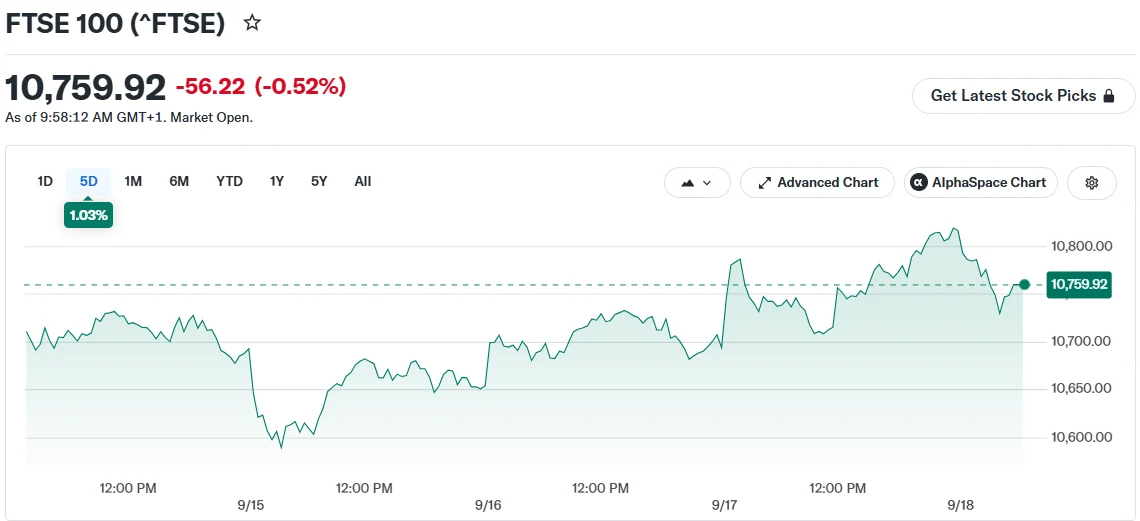
British equities are presently valued at a forward price-to-earnings multiple of 12.4 times. This sits slightly below the long-term median of 12.8 times recorded since 1990.
Energy sector constituents are projected to contribute approximately 18% of MSCI UK earnings during the current year. UBS notes that risks to its earnings projections lean toward the upside given potential further movement in energy commodity prices.

Notwithstanding the upgrade, UBS maintains UK equities as “Least Preferred” relative to other global markets. The institution anticipates earnings growth moderating to approximately 9% in 2027 as commodity-related tailwinds diminish.
UBS expresses preference for Eurozone markets over British equities overall. The bank favors European technology, industrial, banking, discretionary consumer and healthcare sectors.
Barclays and BlackRock Identify Compelling Value in British Markets
Barclays characterized UK equities as “unloved but not a bad place to hide.” The institution suggests that near-term uncertainties surrounding artificial intelligence and petroleum could paradoxically benefit the FTSE 100.
Barclays emphasized that FTSE 250 constituents are currently valued at approximately a 20% discount on a price-to-book metric. This valuation gap persists despite company profitability metrics remaining robust relative to international counterparts.
The bank’s preferred UK equity selections with substantial upside potential include Rentokil, Trustpilot and Shawbrook. Barclays favors UK industrial, financial, utility, real estate and selective consumer sectors.
BlackRock’s Helen Jewell described the UK as “a really interesting diversifier.” She identified dividend-generating sectors, financial institutions and natural resource companies as opportunity areas.
Jewell’s investment team maintains an overweight position in mining companies driven by elevated copper valuations. She also observed that certain UK equities that declined during the “AI loser” selloff continue to present attractive valuations based on fundamental analysis.
Potential Headwinds Persist
UBS outlined a bearish scenario where the FTSE 100 could decline to 7,700 by June 2027. Risk factors include Middle Eastern energy supply disruptions, renewed trade conflict, declining commodity valuations and substantially higher sovereign bond yields.
Elevated interest rates represent a near-term headwind to UK equity valuations, according to UBS. However, the bank maintains that strengthening earnings can more than compensate for higher discount rates.
The UK confronts challenging domestic economic conditions. These include an ongoing cost-of-living squeeze, accelerating inflation and the steepest government borrowing expenses among G7 nations.
The recently elected UK government will unveil its inaugural budget next month. Policymakers face the difficult task of maintaining fiscal responsibility while accommodating increased defense expenditures and household assistance programs.
Get 3 Free Stock Ebooks
Discover top-performing stocks in AI, Crypto, and Technology with expert analysis.
- Top 10 AI Stocks - Leading AI companies
- Top 10 Crypto Stocks - Blockchain leaders
- Top 10 Tech Stocks - Tech giants



