



Key Highlights
- Brent crude climbed 8.8% over the week to reach $95.85 per barrel, with WTI advancing 9.4% to $91.22
- Military confrontations between Washington and Tehran resumed for the first time since July, focusing on Strait of Hormuz installations
- European Union formally aligned with U.S. economic sanctions campaign targeting Iran
- Diesel fuel costs in the United States reached an unprecedented $5.85 per gallon, eclipsing the 2022 high
- OPEC+ anticipated to maintain current October production levels at upcoming Sunday gathering
Energy markets witnessed crude prices climb to their strongest position in approximately three months during the week, fueled by renewed military confrontations between Washington and Tehran that sparked fresh concerns regarding petroleum supply routes through the strategic Strait of Hormuz.
The international Brent benchmark closed at $95.85 per barrel, marking an 8.8% increase across the trading week. Meanwhile, the domestic West Texas Intermediate benchmark finished at $91.22 per barrel, representing a weekly advance of 9.4%.
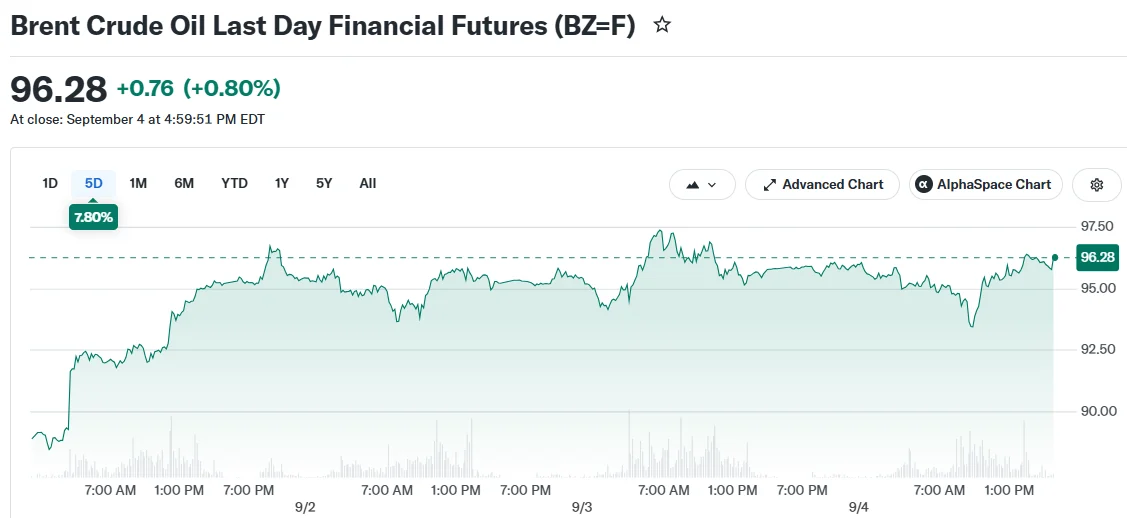
The upward price movement followed the exchange of military strikes between American and Iranian forces, marking the first such engagement since July. President Donald Trump indicated the conflict would be relatively brief and confirmed that American operations focused on Iranian infrastructure being reconstructed near the strategic waterway.
Iranian government-controlled media verified that Tehran responded with counterattacks directed at American military installations throughout the region. Kuwaiti authorities additionally reported successfully intercepting inbound Iranian missiles and unmanned aerial vehicles, with military officials characterizing the incidents as “continuing Iranian aggression.”
European Union Aligns with Anti-Iran Economic Strategy
Treasury Secretary Scott Bessent announced that the European Union had “formally joined” the American initiative to apply economic pressure on Iran, an effort designated as “Operation Economic Outcast.”

European officials validated the implementation of comprehensive sanctions designed to prevent Iranian access to international financial networks. Bessent emphasized that the objective centered on eliminating all remaining financial channels available to Tehran’s government.
Energy Secretary Chris Wright disclosed to CNBC that more than 17 million barrels of petroleum moved through the Strait of Hormuz on Monday under American naval protection. While representing a wartime high, the volume still falls short of the approximately 20 million barrels daily that transited the strait prior to hostilities commencing in February.
Market observers at ING suggested the price rally could weaken if Hormuz shipments maintain steady flow without significant interruptions.
Diesel Costs Surpass 2022 Peak
Domestically, the worldwide oil price increase significantly impacted American consumers. The nationwide diesel average climbed to an unprecedented $5.85 per gallon, exceeding the prior record of $5.82 established in June 2022.
Patrick De Haan from GasBuddy explained that historic diesel costs amplify expenses throughout distribution networks, inflating prices for food products, shipping services, and consumer merchandise.
The national gasoline average registered at $4.1474 per gallon based on AAA tracking data.
Vice President JD Vance attributed elevated gasoline costs to Iranian attacks on commercial maritime vessels. He noted that prices could have escalated far higher without American military involvement, though he stopped short of guaranteeing a return to $3 per gallon pricing.
American commercial petroleum stockpiles decreased to 424.5 million barrels during the week concluded August 28, declining from 428.9 million barrels recorded the previous week.
OPEC+ member nations are projected to preserve existing October production parameters when convening Sunday.
Get 3 Free Stock Ebooks
Discover top-performing stocks in AI, Crypto, and Technology with expert analysis.
- Top 10 AI Stocks - Leading AI companies
- Top 10 Crypto Stocks - Blockchain leaders
- Top 10 Tech Stocks - Tech giants



