


TLDR
- The precious metal remained unchanged near $4,600 per ounce Friday morning before Fed Chair Kevin Warsh’s Jackson Hole address
- Earlier in the week, gold surged to approximately $4,700, marking a three-month peak amid fiscal policy uncertainty
- August is shaping up to be gold’s strongest month since 1999, with prices climbing nearly 14%
- Market expectations show a 34% probability of a September rate increase and 74% likelihood by year-end
- Other precious metals including silver, platinum, and copper posted gains on Friday
The yellow metal maintained its position on Friday as market participants awaited Federal Reserve Chair Kevin Warsh’s keynote address at the Jackson Hole economic policy symposium.
Spot gold prices hovered around the $4,600 mark per ounce, while U.S. Gold Futures dipped modestly by 0.3% to settle at $4,651.41. The precious metal had touched a three-month peak approaching $4,700 during earlier trading sessions this week.
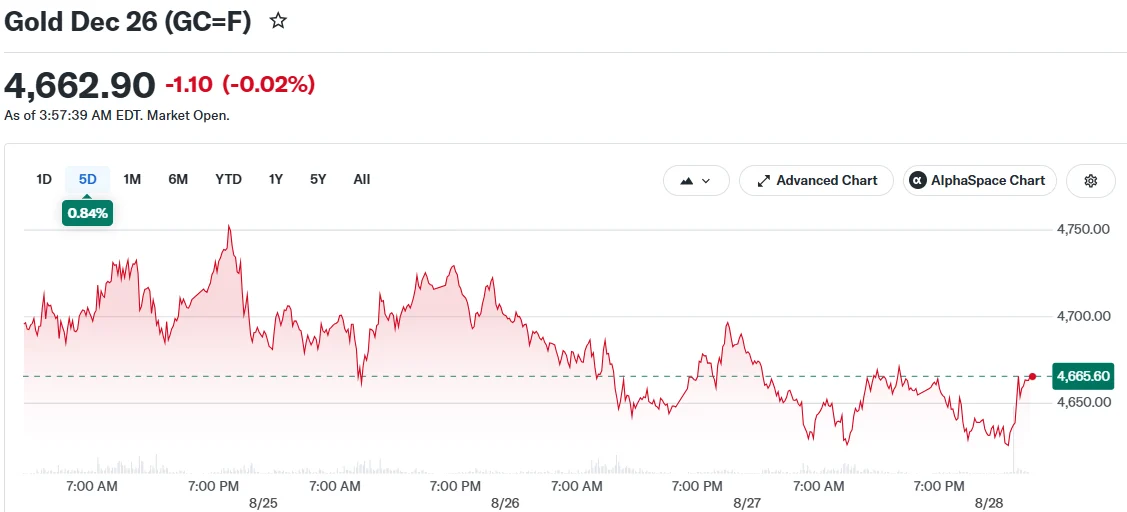
While Friday saw minor downward pressure, gold remains positioned for a slight weekly decline following three consecutive weeks of upward momentum.
Record-Breaking August Performance
The month of August has proven exceptionally favorable for the precious metal. Gold has surged approximately 14% throughout the month, positioning itself for the strongest monthly performance in over two decades—since 1999.
This impressive rally received substantial support from an unexpected U.S. Treasury decision to bolster longer-duration bonds. This strategic move reignited the currency debasement narrative, a key factor that propelled gold to unprecedented peaks in the previous year.

Exchange-traded funds backed by physical bullion, as monitored by Bloomberg, accumulated over 28 tons during the previous week—the largest inflow since January. An additional 20 tons flowed into these funds in subsequent trading days. Meanwhile, central bank gold acquisitions have also accelerated.
The precious metal received additional tailwinds from a weakening U.S. dollar and declining bond yields, both of which diminish the opportunity cost associated with holding non-interest-bearing assets.
Interest Rate Uncertainty Creates Headwinds
While the Federal Reserve maintained its current rate stance at the July meeting, three policymakers advocated for a 25-basis-point increase. This divided decision has maintained elevated market anxiety.
The personal consumption expenditures index—the Fed’s preferred inflation gauge—registered a 3.7% annual increase through July. This elevated reading has intensified speculation that monetary tightening could resume before 2025.
Data from the CME FedWatch tool indicates that traders are assigning a 34% probability to a September rate adjustment and a substantially higher 74% likelihood for action by December.
Rising interest rates typically create unfavorable conditions for gold since the asset generates no yield, diminishing its appeal relative to interest-bearing alternatives.
During Thursday’s Jackson Hole proceedings, two central bank policymakers expressed the view that current rates remain insufficiently restrictive to cool economic activity. However, Fed Bank of Boston President Susan Collins characterized the current policy stance as “mildly restrictive.”
Market attention now centers on Warsh’s scheduled remarks at 10 a.m. ET Friday. As his inaugural major policy address since assuming the Fed chair position, investors are scrutinizing it for directional guidance on monetary policy.
Industrial and Precious Metals Roundup
Silver advanced 1.3% to reach $70.11 per ounce. Platinum posted a 1.8% gain to $1,882.60 per ounce. Copper futures traded on the London Metal Exchange climbed 0.4% to $14,338.15 per ton.
The yellow metal continues to trade in the vicinity of $4,600 as market participants await clarity from Warsh regarding the central bank’s approach to managing inflation pressures and interest rate policy through the remainder of the year.
Get 3 Free Stock Ebooks
Discover top-performing stocks in AI, Crypto, and Technology with expert analysis.
- Top 10 AI Stocks - Leading AI companies
- Top 10 Crypto Stocks - Blockchain leaders
- Top 10 Tech Stocks - Tech giants



