


TLDR
- Skyloom, IonQ’s subsidiary, successfully placed additional optical communication terminals on defense satellites, expanding its orbital presence to 84 total terminals.
- Launch took place on July 16, 2026, using a SpaceX Falcon 9 rocket departing from Vandenberg Space Force Base.
- IONQ shares decreased approximately 8% following the announcement, primarily due to the absence of disclosed contract values or revenue projections.
- Second quarter revenue reached $80.1 million for IonQ, representing a 287% increase from the previous year, with updated annual guidance of $280-$290 million.
- The company’s scheduled Investor Day on September 8, 2026, may provide additional insights into Skyloom’s financial contribution.
Shares of IonQ declined approximately 8% Monday following an announcement from its Skyloom division regarding the successful deployment of additional optical communication terminals on defense satellites. The market response appeared counterintuitive given the achievement represented a significant operational advancement.
The optical terminals manufactured by Skyloom were integrated onto York Space Systems satellites that support the Proliferated Warfighter Space Architecture managed by the Space Development Agency. A SpaceX Falcon 9 rocket carried the satellites into orbit from California’s Vandenberg Space Force Base on July 16, 2026.
This marks the company’s second successful satellite deployment featuring Skyloom technology, with the inaugural launch occurring during the SDA’s Tranche 1 mission in September 2025. The company now operates 84 optical communication terminals in active orbit.
These terminals contribute to the SDA’s Transport Layer Tranche 1 constellation, which provides critical communications capabilities for national defense operations. The spacecraft meet interoperability requirements with SDA’s established optical communication terminal specifications.

According to Jordan Shapiro, President of Quantum Platform at IonQ, this achievement “reflects years of focused industrialization” and demonstrates the company’s dedication to advancing space-based communications infrastructure.
Multiple successful operational deployments typically carry more commercial weight than single experimental launches. However, market sentiment failed to reflect this positive development.
Market Reaction Explained
The negative market response appears linked to what IonQ chose not to reveal. The announcement included no information regarding contract valuation, backlog modifications, or financial guidance adjustments related to the Skyloom deployment.
Absent clarity on potential recurring revenue streams from the defense satellite operations, market participants lack the information needed to properly value the milestone. This information gap likely contributed to the share price decline.
The company has been aggressively diversifying beyond its original quantum computing focus. Strategic acquisitions have extended its reach into quantum networking, sensing technologies, security solutions, semiconductor production, and space-based communication systems.
While this expansion strategy creates multiple potential revenue channels, it simultaneously increases operational expenses. The company posted an adjusted EBITDA loss of $120.3 million during Q2, highlighting the substantial costs associated with this growth phase.
Financial Results and Growth Trajectory
Despite profitability challenges, revenue growth remains robust. IonQ delivered Q2 2026 revenue of $80.1 million, representing a substantial 287% increase compared to the same period last year.
Management also elevated its full-year revenue projections to a range of $280 million to $290 million. This significant upward revision suggests strong internal conviction regarding near-term revenue acceleration.
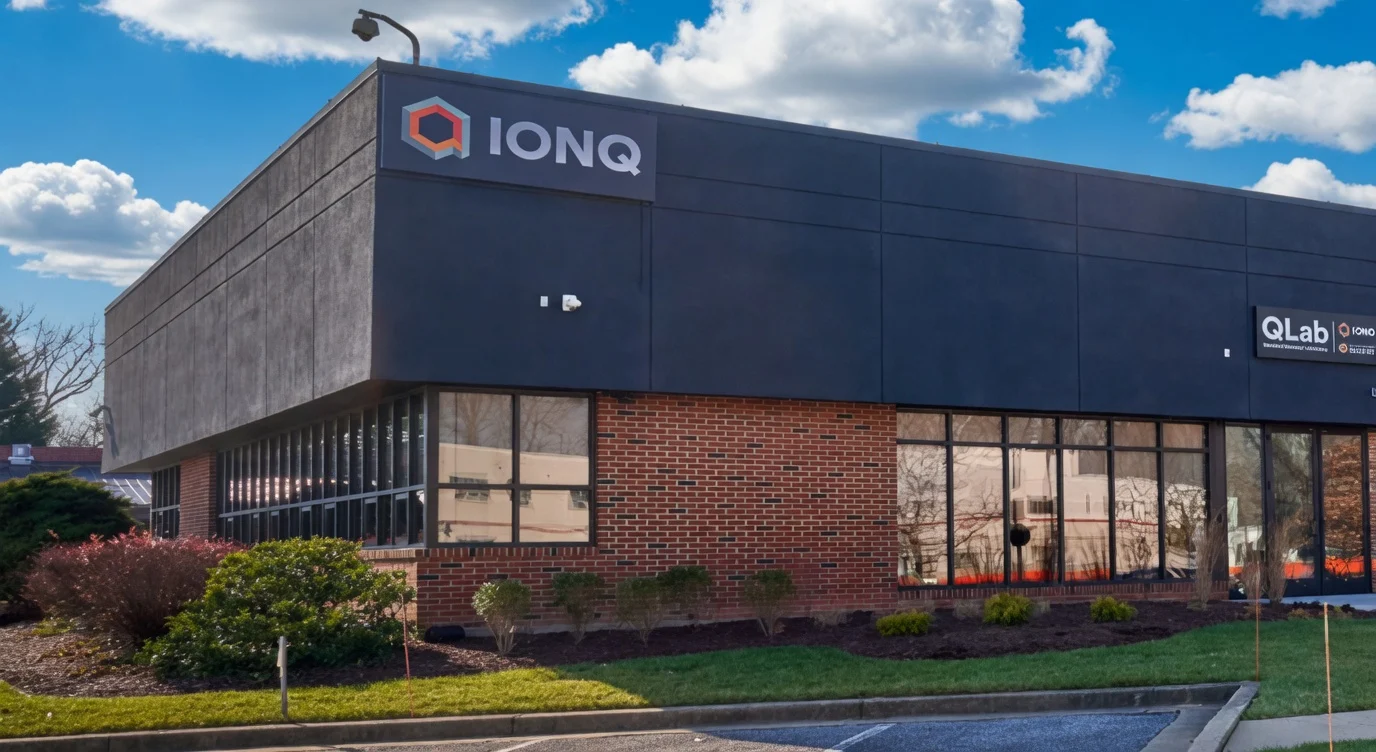
The company maintains its reputation primarily through trapped-ion quantum computing systems, which customers can access directly or through leading cloud service providers. IonQ operates from its College Park, Maryland headquarters, with additional facilities distributed across multiple U.S. locations and international markets including Italy, South Korea, Sweden, Switzerland, Canada, and the United Kingdom.
During 2025, the company announced it had reached 99.99% two-qubit gate fidelity, a critical performance metric that reflects the quality and reliability of its quantum computing technology.
Market attention now turns to IonQ’s upcoming Investor Day scheduled for September 8, 2026. This event may provide the financial transparency investors seek regarding Skyloom’s business contribution and the revenue potential of the space communications segment.
The company’s optical communication terminal network now spans 84 units distributed across two separate SDA Tranche 1 deployment missions.
Get 3 Free Stock Ebooks
Discover top-performing stocks in AI, Crypto, and Technology with expert analysis.
- Top 10 AI Stocks - Leading AI companies
- Top 10 Crypto Stocks - Blockchain leaders
- Top 10 Tech Stocks - Tech giants



