


Key Takeaways
- US equity futures retreated Monday following the collapse of weekend trade discussions with Canada
- Washington implemented a 50% levy on approximately $20 billion in Canadian goods, taking immediate effect
- Canadian Prime Minister Mark Carney pledged reciprocal tariffs matching the US measures, commencing September 8
- Wednesday’s Nvidia earnings report represents a critical bellwether for artificial intelligence equities
- Escalating US-Iran tensions are elevating energy costs, compounding inflation concerns already at 3.4%
Equity markets opened the trading week under pressure as participants digested an escalating Canadian trade confrontation, climbing energy costs, and anticipation surrounding Nvidia’s upcoming financial disclosure.
Monday morning saw US stock futures display mixed performance. Dow Jones futures retreated modestly, while S&P 500 and Nasdaq futures declined 0.1% and 0.3% respectively.
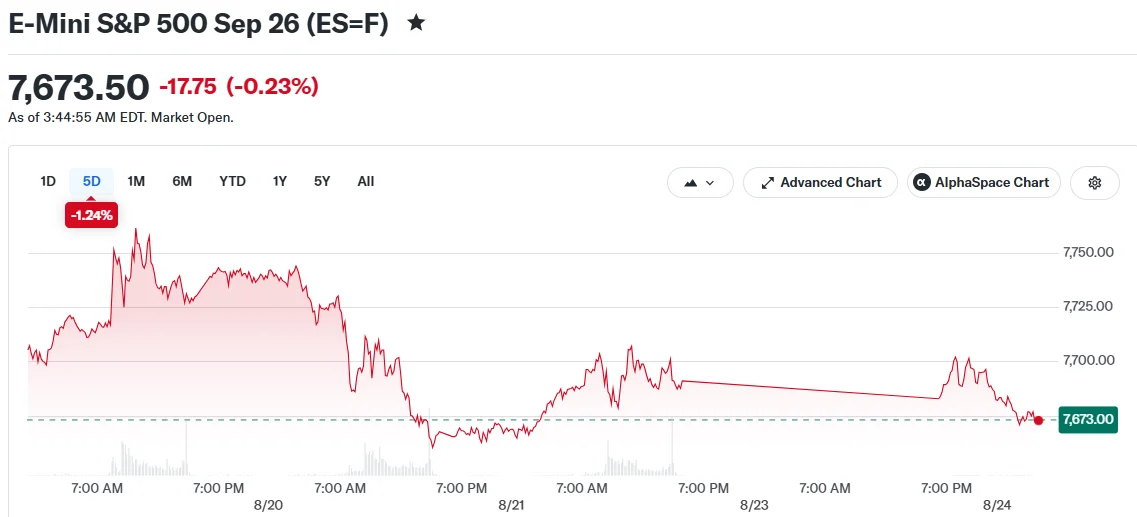
The previous week concluded with losses across all three benchmark indices. The Dow surrendered 0.85%, the S&P 500 retreated 1.4%, and the Nasdaq tumbled 2.1%.
Breakdown in US-Canada Trade Negotiations
Diplomatic trade discussions between Washington and Ottawa disintegrated late Friday evening. In response, the United States imposed a 50% import duty on roughly $20 billion in Canadian merchandise, effective from 12:01 a.m. Saturday morning.
The sweeping tariffs encompass numerous product categories, spanning dairy products and alcoholic beverages to lumber materials and apparel.

Prime Minister Mark Carney characterized the action as an “attack” and a “miscalculation.” He committed to implementing matching tariffs beginning September 8 to safeguard Canadian laborers, agricultural producers, and enterprises.
President Trump took to social media, declaring that “Canada wants the benefits of being a State, without being one!!!”
Iran Standoff Elevates Oil Prices and Inflation Concerns
Simultaneously, Washington finds itself embroiled in a military confrontation with Iran, centered around strategic control of the Strait of Hormuz shipping corridor.
Minneapolis Federal Reserve President Neel Kashkari cautioned that the ongoing conflict is propelling energy prices upward and intensifying inflationary pressures.
“The longer it goes on, the bigger effect it ends up having on the US economy and on inflation,” Kashkari stated during a CBS News interview.
Brent crude surged 6.63% during the previous week, reaching $94.39 per barrel. Retail gasoline prices averaged $4.099 per gallon on Sunday, representing a significant increase from $3.150 twelve months prior.
July’s inflation reading registered at 3.4%. Kashkari expressed skepticism about inflation returning to the Federal Reserve’s 2% objective in the near term.
Treasury Secretary Scott Bessent is scheduled to unveil comprehensive economic sanctions targeting Iran on Monday. He characterized the forthcoming measures as “an economic D-Day.”
Market attention then pivots to Nvidia midweek. The semiconductor giant releases second-quarter financial results Wednesday, with outcomes anticipated to serve as a critical barometer for the sustainability of AI-related investment trends.
Wednesday also brings the July personal consumption expenditures data and an updated second-quarter GDP revision.
The Federal Reserve’s annual Jackson Hole Economic Symposium unfolds this week as well, contributing additional significance to an already eventful period for financial markets.
Get 3 Free Stock Ebooks
Discover top-performing stocks in AI, Crypto, and Technology with expert analysis.
- Top 10 AI Stocks - Leading AI companies
- Top 10 Crypto Stocks - Blockchain leaders
- Top 10 Tech Stocks - Tech giants



