


Key Highlights
- US Dollar Index experiences modest Friday decline yet maintains weekly positive trajectory
- July wholesale inflation figures showed zero movement, dampening Federal Reserve tightening expectations
- Trader sentiment now reflects merely 35% probability of September Fed rate increase, declining from 55%
- Japanese currency prepares for 1% weekly decline notwithstanding intervention efforts
- Crude markets position for 4% weekly advancement following Iranian port blockade announcements
America’s currency experienced modest weakness Friday, though it preserved its trajectory toward a positive weekly performance following consecutive benign inflation reports that diminished prospects for imminent Federal Reserve monetary tightening.
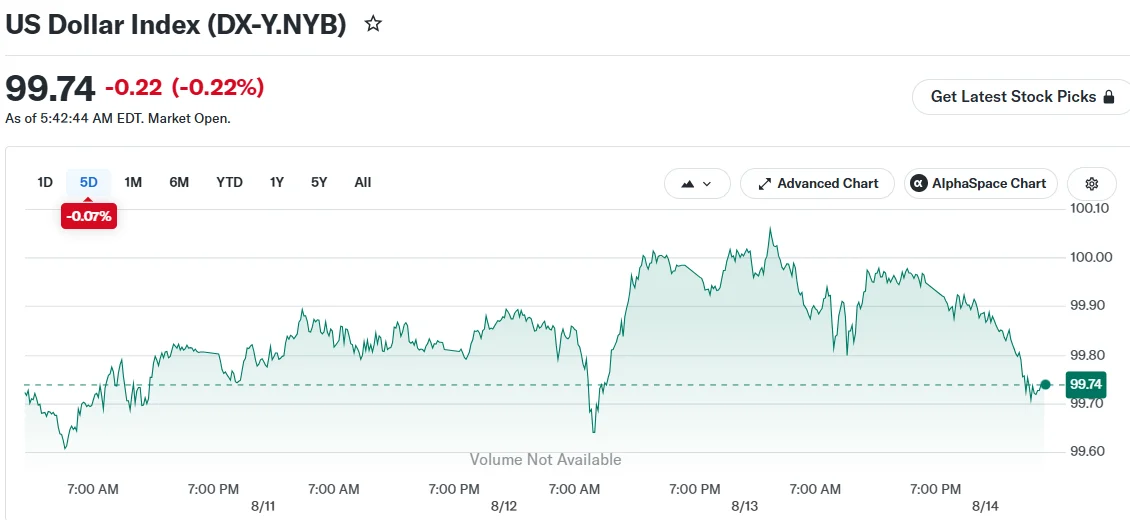
The benchmark US Dollar Index retreated 0.1% to approximately 99.82 during Friday’s morning session. Notwithstanding this minor intraday pullback, the gauge demonstrated resilience throughout the trading week.
Thursday’s wholesale price metrics revealed stagnant conditions within America’s producer price landscape during July. This followed consumer inflation registering 3.4% annual growth, while the core measure moderated to 2.5%.
Collectively, these statistics have diminished monetary tightening projections. Financial markets currently assign only 35% likelihood to a Federal Reserve rate adjustment at the forthcoming September policy gathering, representing a significant decrease from the 55% probability assessed one week earlier, per CME FedWatch data.
Disappointing employment statistics from the preceding week reinforced this narrative. The cumulative evidence has prompted market participants to reduce their expectations for additional Fed policy tightening.

Crude Price Strength Cushions Greenback Decline
Oil prices experienced substantial weekly appreciation, climbing approximately 4%, following Defense Secretary Pete Hegseth’s statement that American military forces possess the capability to maintain an Iranian port naval blockade without time constraints.
This initiative represents a component of President Donald Trump’s approach to sustaining economic leverage against Iran amid stagnant diplomatic negotiations.
Maritime traffic traversing the Strait of Hormuz, a critical conduit for international petroleum and natural gas transportation, continues experiencing significant disruption. Elevated crude prices sustain inflationary anxieties despite benign domestic economic indicators.
The crude rally simultaneously elevated Treasury bond yields. Thursday’s 30-year Treasury auction generated the strongest yield since 2001. The 30-year maturity advanced to 5.228%, while the 10-year benchmark climbed to 4.659%.
Elevated yields signal mounting apprehension regarding American fiscal sustainability, introducing additional complexity into foreign exchange market dynamics.
Japanese Currency Weakens Despite Official Market Action
Japan’s currency experienced modest Friday depreciation, with the dollar commanding approximately 159.20 yen. The yen trajectories toward a 1% weekly depreciation.
The currency had appreciated following coordinated US-Japan foreign exchange intervention during late July through early August, though those advances have subsequently evaporated.
Market participants monitor the 160 yen threshold attentively. Breaching this psychological level might catalyze renewed intervention from Japanese monetary officials.
Projections for a Bank of Japan rate adjustment in September have intensified, yet market observers suggest the central bank would require unambiguously hawkish communication to provide the yen with sustainable momentum.
In other currency movements, China’s yuan remained unchanged, while Australia’s dollar advanced 0.2%.
The dollar’s weekly appreciation illustrates the equilibrium between diminishing Fed tightening expectations exerting downward pressure, counterbalanced by ascending crude prices and fiscal uncertainty providing foundational support.
Get 3 Free Stock Ebooks
Discover top-performing stocks in AI, Crypto, and Technology with expert analysis.
- Top 10 AI Stocks - Leading AI companies
- Top 10 Crypto Stocks - Blockchain leaders
- Top 10 Tech Stocks - Tech giants



