


Key Highlights
- Shares of Maersk $MAERSK B rallied more than 5% following a Q2 profit that surged past $1.31 billion, exceeding market forecasts.
- Quarterly revenue increased 20% year-over-year to reach $15.76 billion; EBITDA of $2.99 billion surpassed analyst estimates by 44%.
- The company’s Ocean segment delivered exceptional performance, with EBIT climbing to $935 million from $229 million in the prior-year period.
- Management upgraded full-year EBITDA projections to a range of $10.5B-$12.5B, up from the previous $8B-$10B forecast.
- Despite strong results, Morgan Stanley maintains an “underweight” stance with a price target suggesting approximately 43% potential decline.
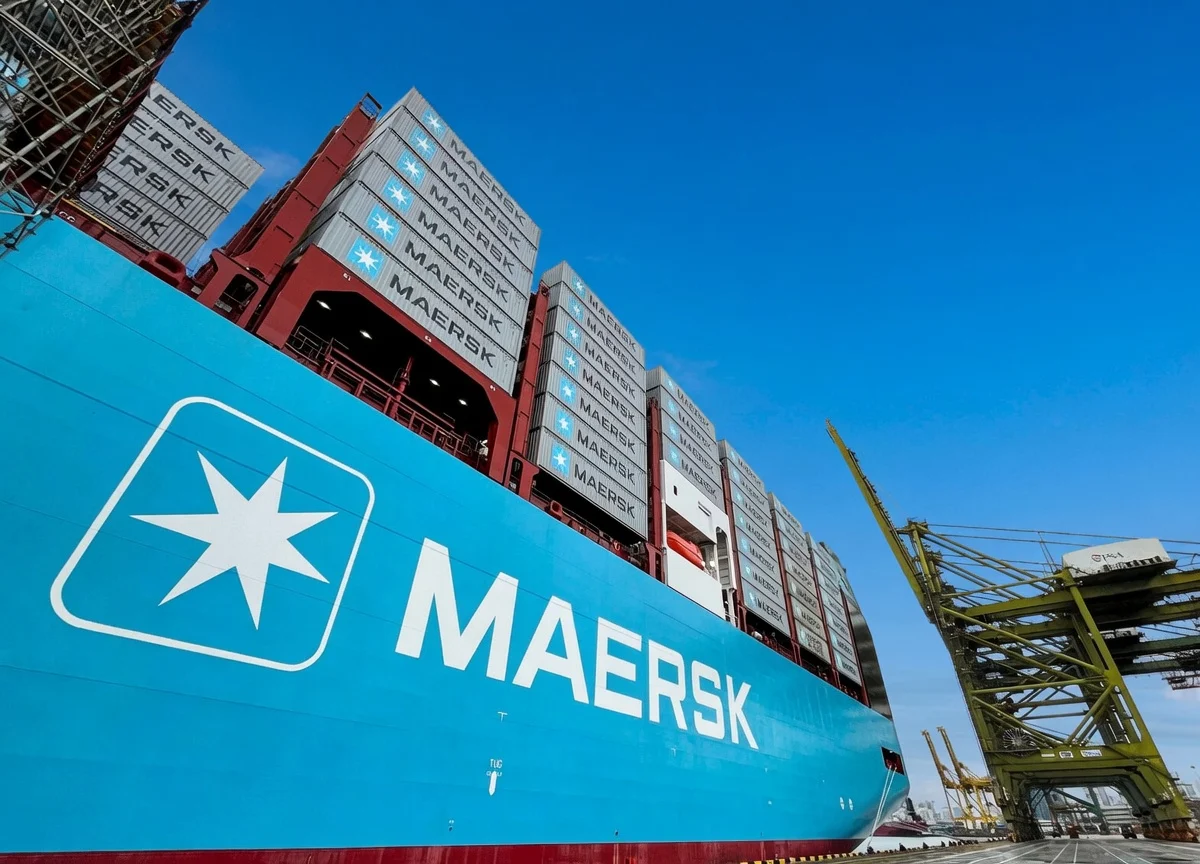
The shipping giant delivered second-quarter earnings of $1.31 billion, representing more than a twofold increase from the $639 million reported during the corresponding quarter last year. Shares rallied over 5% on Thursday in response to these impressive figures.
A.P. Møller – Mærsk A/S, AMKAF
Quarterly revenues totaled $15.76 billion, marking a 20% year-over-year expansion. The company’s EBITDA reached $2.99 billion, up from $2.30 billion in the same quarter of 2025, outperforming analyst projections by 44% based on Morgan Stanley Research data.
The Ocean segment emerged as the star performer. Operating profit in this division jumped to $935 million from a modest $229 million twelve months earlier, propelled by strengthening freight rates and robust shipping volumes.
Average loaded freight rates reached $2,746 per forty-foot equivalent unit, exceeding analyst projections by 15%. Meanwhile, loaded container volumes came in approximately as the market had anticipated.

The Logistics and Services division also posted improvements throughout the quarter, while performance in the Terminals segment remained relatively stable.
Second Guidance Upgrade of the Year
Maersk increased its full-year underlying EBITDA projection to between $10.5 billion and $12.5 billion. This represents a significant upgrade from the earlier forecast range of $8 billion to $10 billion, and constitutes the company’s second outlook revision upward in 2026.
The underlying EBIT forecast was similarly elevated, now targeting $4.5 billion to $6.5 billion compared to the previous expectation of $2 billion to $4 billion.
Capital expenditure projections remained stable at $10 billion to $11 billion. The company now anticipates global container volume growth of approximately 4% for the current year.
Wall Street Maintains Skepticism
Notwithstanding the earnings beat, Morgan Stanley maintained its “underweight” recommendation on Maersk shares. The firm’s 10,000 crown price target suggests potential downside of roughly 43% from Wednesday’s closing price.
Morgan Stanley characterized the strong results as “primarily a rate story rather than a volume surprise,” emphasizing that freight rate strength drove the outperformance rather than increased shipping volumes.
The bank’s analysts noted that market discussion now focuses on the sustainability of elevated freight rates. Maersk has argued for a structurally constrained market environment, citing factors including demand expansion, trade-lane imbalances, and insufficient port infrastructure investment.
The maritime transport company has capitalized on various disruptions that elevated freight rates, including the US-Iran conflict that impacted traffic through the Strait of Hormuz, and persistent Houthi militant attacks affecting Red Sea shipping lanes.
Following the Houthi attacks, most major shipping companies ceased using the Asia-Europe route via the Suez Canal, instead redirecting vessels around Africa’s Cape of Good Hope. These extended voyages contributed to higher freight costs.
In recent months, both Maersk and Hapag-Lloyd have announced intentions to gradually restore certain services through the Suez Canal.
Several market analysts have warned that any return to normal Red Sea shipping patterns could exert downward pressure on freight rates. Morgan Stanley’s cautious rating reflects this potential headwind.
The company’s 44% EBITDA consensus beat stood out as the quarter’s most notable achievement, alongside the $2,746 per FEU freight rate that exceeded market expectations by 15%.
Get 3 Free Stock Ebooks
Discover top-performing stocks in AI, Crypto, and Technology with expert analysis.
- Top 10 AI Stocks - Leading AI companies
- Top 10 Crypto Stocks - Blockchain leaders
- Top 10 Tech Stocks - Tech giants



