



Key Takeaways
- July CPI increased 0.1% monthly, with yearly inflation declining to 3.4%, in line with expectations
- Federal Reserve September rate hike probability decreased from 54% to approximately 40% following the report
- Dollar Index maintained stability around 100.03 during Thursday trading
- Brent crude held near $89 per barrel as Iran-U.S. diplomatic efforts remain stalled
- Japanese yen remained weak, with USD/JPY hovering around 159.40, near two-week highs
The dollar demonstrated resilience on Thursday following the release of July’s inflation figures, which aligned precisely with market predictions and offered little impetus for significant market repositioning.
The Consumer Price Index in the United States advanced 0.1% during July on a month-over-month basis. Year-over-year inflation moderated to 3.4%, representing a decline from June’s 3.5% reading. The core inflation measure, excluding volatile food and energy components, climbed 0.2% monthly and 2.5% on an annual basis.
Each metric aligned with consensus estimates from analysts. Market participants responded with limited volatility, though expectations for monetary tightening saw a moderate decline.
Trading on Thursday morning saw the U.S. Dollar Index essentially unchanged at approximately 100.03. The benchmark index had appreciated 0.2% during the previous session and continued to oscillate within a tight trading band.
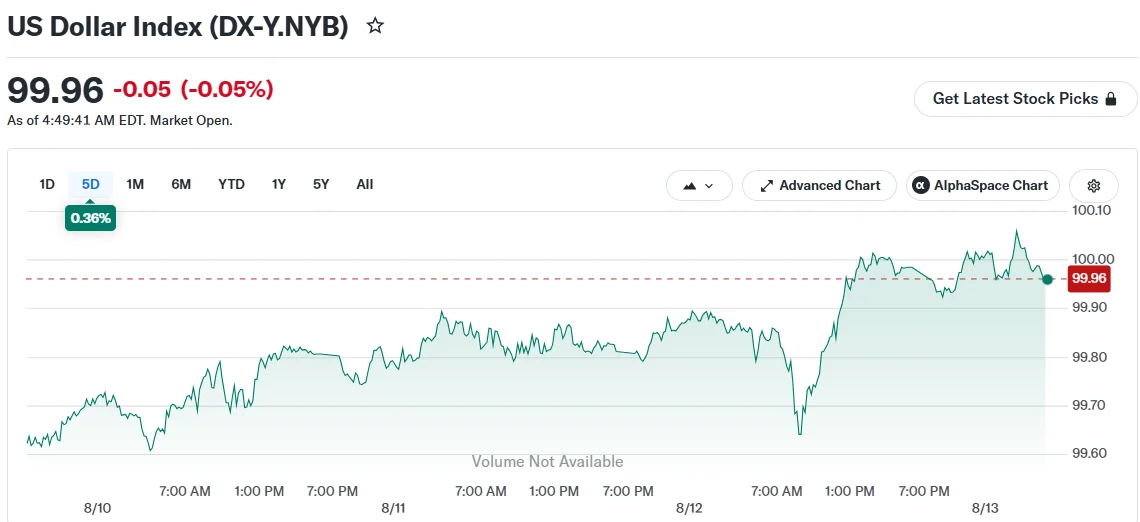
September Rate Hike Probability Declines but Remains Possible
Market pricing for a Federal Reserve interest rate increase at the upcoming September policy meeting declined to roughly 40%, compared to 54% prior to the inflation release. MUFG analysts indicated the report should enable the central bank to maintain current policy settings temporarily, though substantial strategic shifts appear unlikely at this juncture.

Deutsche Bank highlighted that September hike pricing reached its lowest point since the Federal Reserve’s June gathering. Nevertheless, the institution’s economists maintain their projection for a September increase, arguing the CPI figures diminished immediate pressure without eliminating the scenario entirely.
The bank further emphasized that despite short-term relief, the report failed to address persistent structural challenges including fiscal deficits, supply constraints, and term premium considerations.
Attention now shifts to forthcoming U.S. producer price statistics and weekly unemployment claims scheduled for release later Thursday. Retail sales data also remains under scrutiny as market participants search for additional signals regarding Federal Reserve intentions.
Yen Weakness Persists While Crude Prices Hold Firm
The Japanese currency continued facing downward pressure. USD/JPY exchanged hands near 159.40, approaching levels last seen two weeks prior. Authorities in Tokyo and Washington acknowledged synchronized intervention operations to support the yen earlier this month following its descent to four-decade lows.
Geopolitical uncertainty contributed additional market strain. Iranian officials reported no advancement in diplomatic initiatives aimed at restoring an interim agreement with the United States. The U.S. administration criticized Tehran for not fulfilling pledges to reopen a critical maritime corridor. Iran counters that American commitments remain unfulfilled.
Brent crude maintained levels near $89 per barrel. TD Securities analysts reiterated expectations for continued upward oil price movement, potentially elevating headline inflation later this year and sustaining the possibility of a December rate adjustment.
Gold experienced modest retreat, changing hands near $4,370 during European hours after sustaining levels above $4,400 on Wednesday. The Australian currency weakened 0.2% versus the dollar.
British economic growth data revealed second-quarter expansion of 1.2% annually, marginally exceeding projections, although industrial and manufacturing production contracted during July.
Get 3 Free Stock Ebooks
Discover top-performing stocks in AI, Crypto, and Technology with expert analysis.
- Top 10 AI Stocks - Leading AI companies
- Top 10 Crypto Stocks - Blockchain leaders
- Top 10 Tech Stocks - Tech giants



