



Key Highlights
- The Kospi benchmark index plummeted 10.8% on Tuesday, marking its weakest closing level since April
- Shares of Samsung Electronics tumbled 13.4% while SK Hynix declined 14.7% amid intense selling pressure
- News emerged that China has commenced large-scale production of domestically developed chipmaking equipment
- Chinese memory chip manufacturer CXMT surged 466% on its trading debut before retreating 4% in the following session
- Morningstar researchers characterized the market reaction as an excessive “knee-jerk” response
Asian markets experienced significant turbulence on Tuesday as investor anxiety over China’s advancing semiconductor capabilities sent shockwaves through the technology sector, with South Korea’s exchanges bearing the brunt of the selloff.
The benchmark Kospi index plummeted 10.8% to finish at 6,023.66, representing its lowest closing value since April. Circuit breakers were triggered several times throughout the trading day as the rapid descent in prices activated automatic trading pauses.
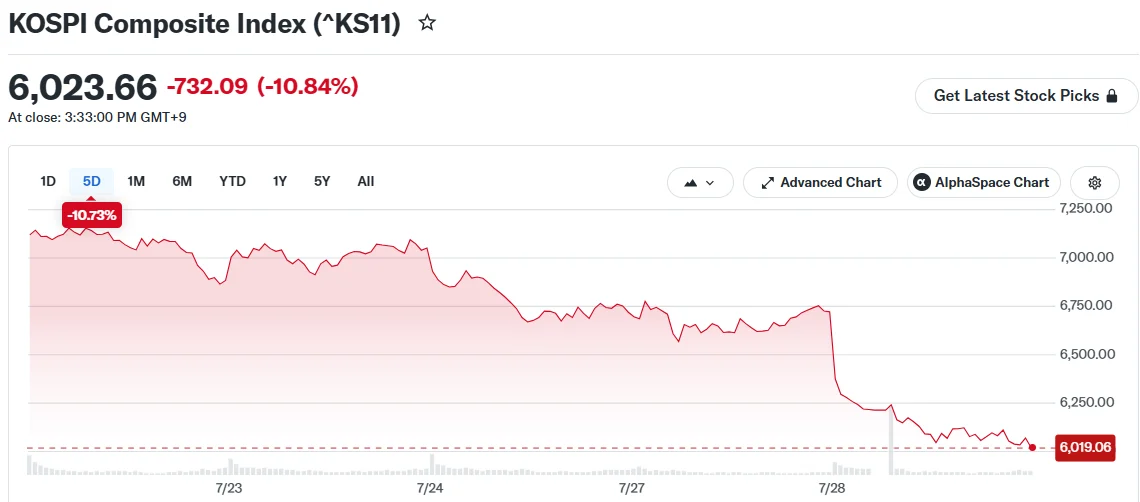
Korean Chip Giants Experience Sharp Declines
Shares of Samsung Electronics plunged 13.4% during the session, while SK Hynix experienced a 14.7% decline. The latter’s recent Wall Street listing, which priced at $149 per American depositary receipt, saw its U.S.-traded shares close at $143 on Monday, already trading beneath the offering price.
The dramatic market downturn was triggered by a report published by technology news outlet The Information, which revealed that China has initiated mass-scale manufacturing of domestically produced deep ultraviolet (DUV) lithography equipment. These tools are critical for etching intricate circuit designs onto semiconductor wafers.
The development intensified concerns that Chinese semiconductor manufacturers might narrow the technological divide with international industry giants more rapidly than market participants had anticipated.

Compounding investor anxiety, ChangXin Memory Technologies (CXMT), a Chinese memory chip producer, launched its Shanghai stock exchange debut on Monday with an extraordinary 466% price jump. The initial public offering generated approximately $8.6 billion in proceeds. However, CXMT shares retreated 4% during Tuesday’s trading session.
Morningstar’s research team indicated that markets were clearly “spooked” by evidence of China’s semiconductor manufacturing advancement. According to equity analyst Jing Jie Yu, the market response represented “largely a knee-jerk reaction and overdone,” emphasizing that established global semiconductor leaders maintain competitive positions unlikely to face significant near-term threats.
Regional Markets Experience Widespread Declines
The selloff reverberated throughout Asian trading venues. Japan’s Nikkei 225 index descended 4% to settle at 62,364.92. Taiwan’s Taiex benchmark declined 4.7%, with Taiwan Semiconductor Manufacturing Company shares falling 3%.
Hong Kong’s Hang Seng index diverged from regional peers, posting a 0.3% gain. Meanwhile, Shanghai’s Composite index retreated 1.2%.
Across the Pacific, U.S. semiconductor equities had already faced selling pressure during Monday’s session. Nvidia shares declined 5%, Advanced Micro Devices fell 5.2%, and Micron Technology dropped 2.3%.
Crude oil prices also experienced declines exceeding 2% as diplomatic tensions between Washington and Tehran appeared to moderate. Brent crude descended to $84.07 per barrel, while West Texas Intermediate crude fell to $80.99.
The S&P 500 concluded Monday’s session essentially unchanged, while the Dow Jones Industrial Average advanced 0.5%. The technology-heavy Nasdaq Composite slipped 0.2%.
Market analysts suggested that portions of the selling activity reflect profit-taking behavior following an extended rally in artificial intelligence-related equities. Questions regarding whether the AI sector’s momentum can support prevailing stock valuations have intensified in recent months.
Tuesday’s steep Kospi decline represents one of the most significant single-day percentage movements the index has recorded in several years.
Get 3 Free Stock Ebooks
Discover top-performing stocks in AI, Crypto, and Technology with expert analysis.
- Top 10 AI Stocks - Leading AI companies
- Top 10 Crypto Stocks - Blockchain leaders
- Top 10 Tech Stocks - Tech giants



