


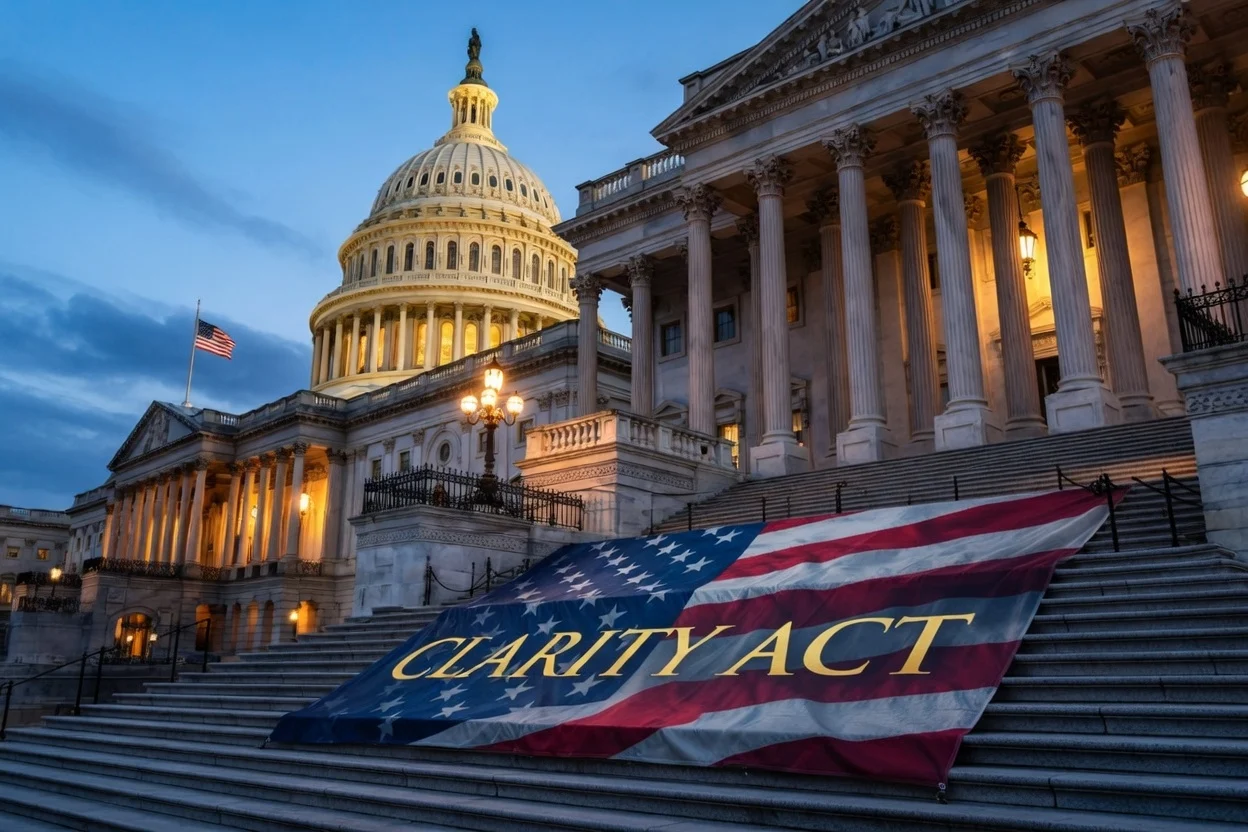
Key Takeaways
- SkyBridge Capital’s Anthony Scaramucci endorsed the Clarity Act as superior to the existing regulatory void in cryptocurrency markets.
- The revised legislation incorporates ethics provisions preventing federal officials from gaining financially through digital asset launches or endorsements.
- Multiple Democratic senators contend that consumer safeguards and ethics provisions within the proposal lack sufficient strength.
- Senate passage requires bipartisan backing and a minimum of 60 votes to avoid procedural obstruction.
- Prediction markets on Polymarket show passage odds for 2026 at 38%, a significant decline from 78% recorded in May.
Anthony Scaramucci, who founded SkyBridge Capital, has expressed strong support for the Clarity Act as a meaningful advancement toward establishing definitive cryptocurrency regulations across the United States. While acknowledging the legislation’s shortcomings, he emphasized that it represents a superior alternative to maintaining the current environment of regulatory ambiguity and inconsistent enforcement.
Scaramucci emphasized that legislators and cryptocurrency organizations should recognize the achievements secured through extensive negotiation processes. He highlighted how representatives from both major political parties modified their stances and encouraged industry participants to embrace the negotiated framework rather than dismissing it for failing to satisfy every requirement.
Industry Leader Views Clarity Act as Progress
Through a statement on X, Scaramucci acknowledged the Clarity Act could strengthen ethics standards, while maintaining his position that it substantially improves upon the existing unregulated environment. He challenged legislators who advocate for negotiation and compromise during discussions, only to reject outcomes when those outcomes involve mutual concessions.
His statements aligned with perspectives shared by various cryptocurrency industry leaders who advocate for congressional action on the Clarity Act. Proponents believe the legislation would establish more transparent operational guidelines for digital asset companies while clarifying regulatory responsibilities among federal financial oversight agencies.
Senate Democrats Challenge Ethics Provisions
The most recent Clarity Act version contains restrictions preventing government officials from exploiting digital assets for personal enrichment during their tenure. These provisions would prohibit designated officials, including the nation’s president and vice president, from launching or promoting digital assets to generate personal income.
Multiple Democratic senators have expressed dissatisfaction with these measures. Senator Elizabeth Warren maintained that the legislation inadequately addresses President Donald Trump’s involvement in cryptocurrency ventures. Seven Democratic senators collectively voiced apprehension regarding inadequate consumer protections, insufficient controls against illegal financial activities, weak ethics guidelines, and unresolved conflicts of interest.

Bipartisan Agreement Remains Uncertain
The Clarity Act requires a minimum of 60 affirmative Senate votes to bypass procedural obstacles, necessitating cooperation across party lines. While negotiators have achieved convergence on certain elements, significant disagreements persist concerning enforcement authority, investor protections, and conduct standards for government officials.
Senate Majority Leader John Thune has suggested that approval before the August congressional break appears unlikely during the current year. This postponement has diminished expectations among prediction platforms and analytical organizations monitoring the legislation’s prospects for enactment throughout 2026.
Prediction Markets Show Declining Passage Probability
Polymarket participants currently estimate the Clarity Act’s likelihood of enactment in 2026 at 38%. These projections previously reached approximately 78% during May, demonstrating weakened optimism as negotiation progress stalled and additional conflicts surfaced.
Galaxy Research director Alex Thorn reduced his projection to 30%. Scaramucci, meanwhile, maintains his position that the Clarity Act deserves congressional approval because it establishes a more definitive foundation for subsequent cryptocurrency policy development.
Get 3 Free Stock Ebooks
Discover top-performing stocks in AI, Crypto, and Technology with expert analysis.
- Top 10 AI Stocks - Leading AI companies
- Top 10 Crypto Stocks - Blockchain leaders
- Top 10 Tech Stocks - Tech giants



