



Key Highlights
- Alphabet stock dropped 3.5% during premarket hours, marking a potential third consecutive session of losses.
- Second-quarter revenue climbed 24% to reach $119.8 billion, surpassing the analyst consensus of $116.93 billion.
- Cloud division delivered 82% revenue expansion, with contracted backlog rising five times year-over-year.
- The company increased its 2026 capital expenditure outlook to a range of $195 billion to $205 billion.
- Capital spending for the June quarter hit $44.92 billion, approximately double the prior year’s amount.
Alphabet (GOOGL) shares tumbled 3.5% Thursday morning following the company’s announcement of significantly higher infrastructure spending plans through 2026. The selloff positioned the stock for its third consecutive daily loss, even as quarterly results demonstrated robust revenue performance and accelerating cloud momentum. Retail investors showed continued buying interest, though elevated capital expenditure projections overshadowed the company’s artificial intelligence expansion.
Alphabet Shares Head Toward Third Session Loss
Alphabet delivered second-quarter revenue totaling $119.8 billion, marking 24% year-over-year growth and topping Wall Street’s $116.93 billion projection. Yet Google stock retreated following management’s decision to raise annual capital expenditure projections to between $195 billion and $205 billion. The revised outlook exceeded the prior range of $180 billion to $190 billion, signaling accelerated deployment in data infrastructure and computational resources.
Capital investments during the June period totaled $44.92 billion, approximately twice the figure from the same quarter last year. This spending level generated negative free cash flow of $5.9 billion, marking the first time since the company’s 2004 public debut that cash flow turned negative. Google stock weakened as investors assessed immediate capital outflows against future artificial intelligence revenue streams.
Alphabet shares already declined nearly 3% combined through Tuesday and Wednesday sessions before Thursday’s premarket action deepened the retreat. Class A shares finished Wednesday at $342.09, down 1.46%, then traded around $327.20 in early Thursday activity. The move positioned Google stock for a third weekly downturn as infrastructure spending remained the primary concern among market participants.

Cloud Division Demonstrates AI Traction
Google Cloud revenue expanded 82%, while contracted backlog multiplied fivefold, indicating strengthening demand from corporate clients. Morningstar noted Alphabet displayed “real progress in artificial intelligence monetization” throughout cloud, search, and core business units. Despite this progress, Google stock maintained its downward trajectory as robust operational metrics failed to counterbalance concerns surrounding the expanded investment plan.
Chief Executive Sundar Pichai disclosed that Gemini achieved 950 million monthly active users during the quarter. He noted Alphabet’s model interfaces handled 22 billion tokens per minute, advancing from the previous 16 billion level. Pichai further revealed Gemini Enterprise reached 90% of Fortune 100 companies, demonstrating widespread commercial acceptance among major enterprises.
Search revenue advanced 17%, while Alphabet disclosed over one billion monthly users for its AI Mode offering. Benchmark partner Chetan Puttagunta observed Google Cloud nearing a $100 billion annual revenue run rate while sustaining growth exceeding 80%. He suggested cloud revenue might rival search revenue in coming years, though Google stock remained pressured by spending considerations.
Individual Investors Accumulate During Weakness
One market participant attributed the selloff to management commentary regarding currency challenges, capacity investments, and additional cost pressures. This trader also emphasized expansion across search, cloud, artificial intelligence, YouTube, supercomputing, and Waymo’s self-driving vehicle operations.
Tesla Chief Executive Elon Musk called Alphabet’s results “impressive” in a brief social media post following the earnings release. That positive assessment stood in contrast to the stock’s decline, while Google shares remained positioned below multiple near-term technical markers. The stock traded beneath its 20-day, 50-day, and 100-day exponential moving averages during Thursday’s early premarket activity.
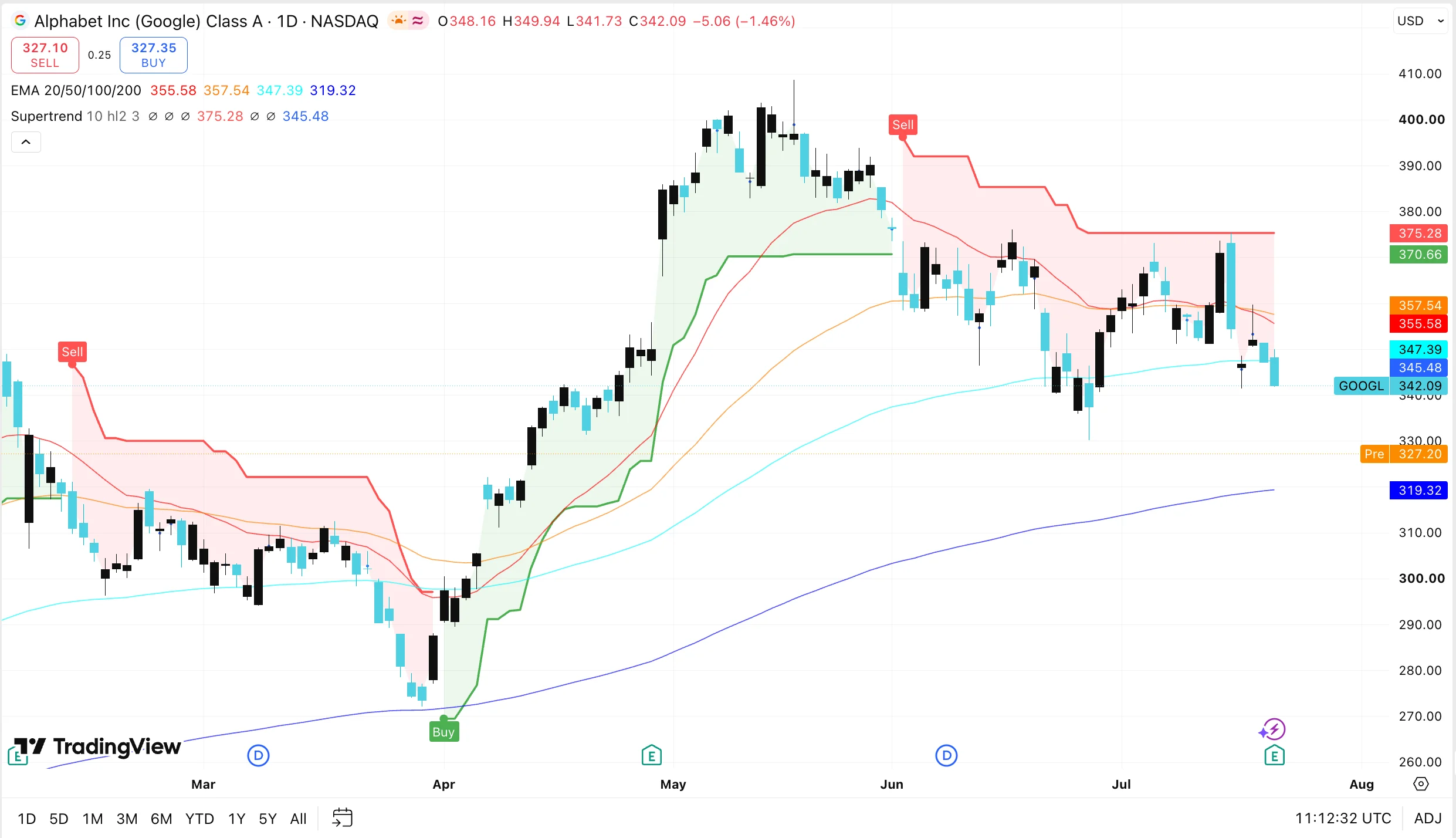
Source: TradingView
The 200-day exponential moving average around $319.32 represented the broader support zone visible on technical charts. Meanwhile, the $345 level marked near-term resistance, with the $355 to $358 zone forming a more significant recovery hurdle. Google stock moved toward a third consecutive decline as individual investors purchased shares during the dip and spending concerns drove market sentiment.
Get 3 Free Stock Ebooks
Discover top-performing stocks in AI, Crypto, and Technology with expert analysis.
- Top 10 AI Stocks - Leading AI companies
- Top 10 Crypto Stocks - Blockchain leaders
- Top 10 Tech Stocks - Tech giants



