


TLDR
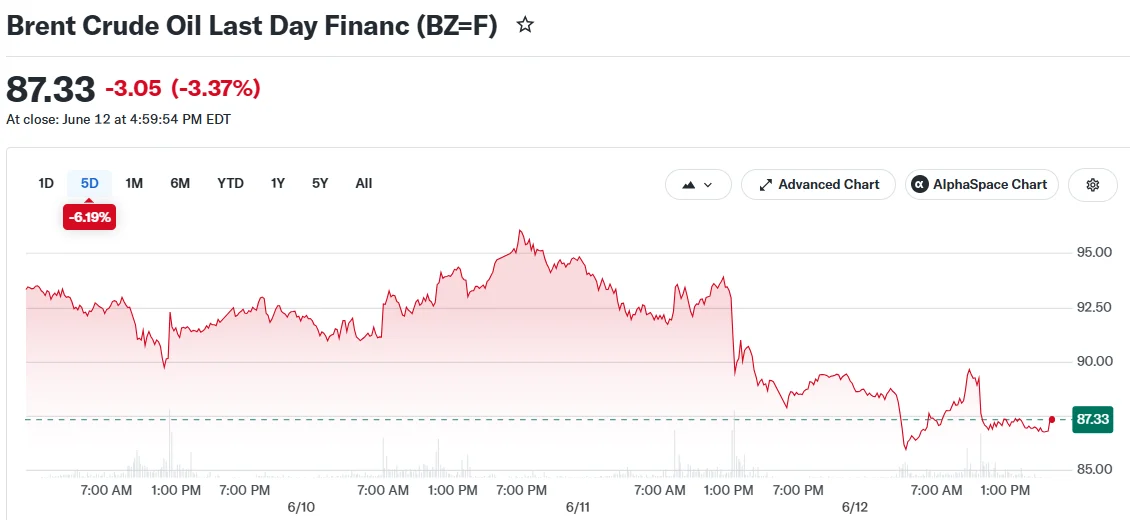
- Brent crude tumbled 3.4% to reach $87.33 per barrel, marking its weakest point since March 5, with a weekly decline of 6.2%
- Diplomatic negotiations between Washington and Tehran show signs of breakthrough that could unlock the Strait of Hormuz
- Pakistan’s mediators confirmed both nations have finalized an agreed text and are coordinating implementation steps
- Tehran’s Foreign Minister indicated a memorandum of understanding has reached unprecedented proximity to completion
- OPEC revised downward its 2026 demand growth projection from 1.2 million to 1 million barrels daily
Crude oil markets experienced significant downward pressure on Friday, with Brent benchmark prices reaching their weakest point in over four months. The decline accelerated on mounting speculation that Washington and Tehran are approaching a diplomatic resolution that would restore access to the Strait of Hormuz.
Brent futures concluded trading at $87.33 per barrel, representing a 3.4% daily decline and a substantial 6.2% weekly loss. West Texas Intermediate experienced a comparable 3.2% decrease. European natural gas markets saw prices retreat as much as 8.4%.
The strategically vital Strait of Hormuz has remained largely inaccessible since hostilities between Washington and Tehran erupted in late February. Prior to the confrontation, this critical maritime passage facilitated approximately one-fifth of global petroleum and natural gas shipments.
President Trump announced Thursday that negotiators had finalized an agreement anticipated to receive formal signatures imminently. According to his statements, the arrangement would restore strait navigation, terminate the American naval embargo against Iran, and guarantee Tehran abandons nuclear weapons development.
Nevertheless, Trump adopted a more critical stance Friday, asserting that Iranian public declarations bore “no resemblance to the provisions mutually accepted in documented form.” He emphasized the impossibility of “authentic good faith negotiations” with Tehran.
Diplomatic Momentum Building
Iranian Foreign Minister Abbas Araghchi countered the escalating rhetoric, declaring that a memorandum of understanding between the nations had approached “unprecedented proximity” to finalization. He urged media outlets to refrain from speculating regarding specific provisions until official completion.
Pakistan, serving in its capacity as primary mediator, provided the most concrete confirmation to date. Prime Minister Shehbaz Sharif announced that negotiators had finalized an agreed framework and that Islamabad was coordinating with both governments on subsequent implementation phases. He characterized the current moment as the closest “peace has ever come.”
Despite encouraging diplomatic signals, financial markets maintain a cautious outlook. Multiple previous announcements of supposed breakthroughs ultimately failed to materialize, and the ongoing rhetorical exchanges between Washington and Tehran continue generating uncertainty.

Supply Constraints Persist
Oil valuations remain approximately 30% below conflict-peak levels. However, market analysts caution that prices face a natural floor given persistent supply limitations.
Chevron CEO Mike Wirth cautioned Friday that petroleum inventories are approaching “concerning” thresholds. The United States continues exporting crude from strategic emergency stockpiles at unprecedented rates.
Macquarie energy strategist Vikas Dwivedi attributed the recent $11-per-barrel correction to growing optimism surrounding a diplomatic resolution. He emphasized that crude valuations maintain downside protection as long as strait access remains restricted.
Certain vessels have navigated the strait with positioning transponders deactivated, and markets have developed alternative mechanisms to circumvent the supply disruption. Nonetheless, analysts suggest that even following strait reopening, purchasers may demonstrate preference for American crude over Persian Gulf supplies for an extended period.
Rob Haworth of U.S. Bank noted that tanker vessels making the strait-to-Asia journey require two months for complete round-trip voyages. Scott Shelton of ICAP predicted markets would likely “redistribute procurement” away from Persian Gulf sources in the immediate term.
OPEC reduced its 2026 petroleum demand growth projection to 1 million barrels daily, down from the previous 1.2 million estimate. The cartel simultaneously elevated its 2027 forecast. Alternative forecasting organizations, including the IEA and EIA, maintain more conservative outlooks, with both agencies projecting demand contractions in 2026.
The European Central Bank identified the Iran-related petroleum price surge as a primary factor influencing its decision to implement interest rate increases this week.
Get 3 Free Stock Ebooks
Discover top-performing stocks in AI, Crypto, and Technology with expert analysis.
- Top 10 AI Stocks - Leading AI companies
- Top 10 Crypto Stocks - Blockchain leaders
- Top 10 Tech Stocks - Tech giants



