



Key Highlights
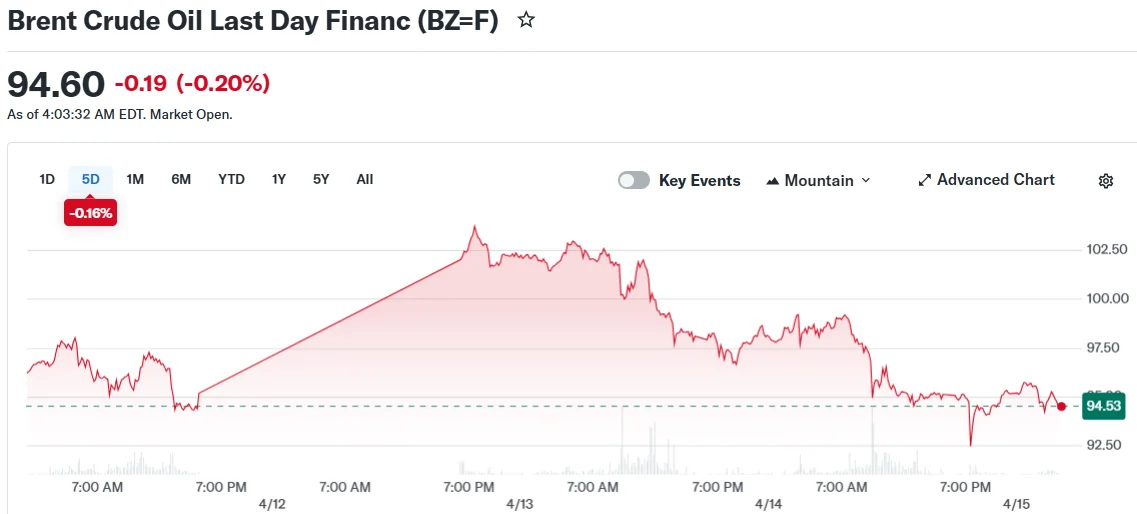
- Brent crude slipped beneath $95 following Tuesday’s 4.6% decline; WTI hovers around $91
- U.S. Central Command confirms Iranian naval blockade has reached full operational status
- President Trump declares Iran conflict “very close to over,” anticipates fresh negotiations imminently
- Tehran reportedly weighing voluntary suspension of Hormuz transit to sidestep U.S. naval presence
- International Energy Agency and OPEC revise demand projections downward; Tokyo preparing May emergency reserve releases
Crude oil markets experienced dramatic volatility throughout the week as market participants attempted to balance two contradictory developments: the complete enforcement of a U.S. maritime blockade surrounding Iran and mounting indications that diplomatic negotiations may soon resume.
Brent crude experienced a 4.6% decline on Tuesday, settling beneath the $95 per barrel threshold. West Texas Intermediate similarly descended to approximately $91. Markets staged a partial rebound during Wednesday’s Asian session following U.S. Central Command’s confirmation that the blockade had achieved full implementation.
Admiral Brad Cooper announced that American military forces have “completely halted economic trade going into and out of Iran by sea.” President Trump subsequently posted on social media platforms, asserting the United States had placed Iran in a “chokehold” and suggesting the nation might exhaust its storage capabilities.
The maritime cordon was established merely 48 hours following the conclusion of ceasefire discussions in Pakistan, which failed to produce an agreement. The White House is now urgently working to arrange a second negotiation round before the existing ceasefire arrangement lapses next week.
Speaking with the New York Post, Trump indicated that renewed discussions could materialize “over the next two days.” He further conveyed to Fox Business presenter Maria Bartiromo his assessment that the conflict was “very close to over.”
One diplomatic option under consideration involves returning to Pakistan for subsequent negotiations, though alternative venues are being evaluated.

Meanwhile, Iranian officials are reportedly contemplating a voluntary halt to shipments traversing the Strait of Hormuz to prevent direct confrontation with the American naval deployment, according to sources with knowledge of internal deliberations.
Asian Markets Face Severe Supply Constraints
The Strait of Hormuz facilitates the passage of approximately 20% of global oil supply. Since hostilities commenced in late February, Iran has effectively blocked virtually all commercial shipping through this critical waterway.
Analysts at ANZ calculated that no fewer than 10 million barrels daily have been removed from global markets due to the ongoing conflict. They observed that even absent worst-case military escalation scenarios, supply constraints alone justify sustained elevated Brent pricing.
Japan is organizing a second wave of strategic petroleum reserve releases scheduled to begin in early May. Refineries throughout the Asia-Pacific region may face forced operational reductions, diminishing available supplies of aviation fuel and diesel.
Both the International Energy Agency and OPEC have adjusted their consumption projections downward, attributing the revisions to demand destruction caused by elevated prices.
Market Expert Perspectives
Dilin Wu of Pepperstone Group predicted oil markets would likely exhibit sideways movement with a “softer bias” in the immediate term as traders digest the diplomatic pivot. He emphasized that even under de-escalation scenarios, physical supply restoration would lag considerably due to logistical constraints in the Hormuz vicinity.
ANZ projected that should confrontation risks diminish, Middle Eastern crude output could experience a phased recovery, with 2 to 3 million barrels daily potentially restored during the initial four-week period.
Rebecca Babin, senior energy trader at CIBC Private Wealth Group, indicated markets are “leaning toward a normalization of flows by the end of April.”
The American Petroleum Institute documented a 6.1 million barrel increase in U.S. crude stockpiles for the previous week, representing what would constitute the eighth consecutive weekly accumulation pending official Energy Information Administration confirmation Wednesday.
The Trump administration has additionally verified its decision to allow the expiration of a waiver permitting limited Iranian crude purchases, with termination scheduled for this weekend.
Get 3 Free Stock Ebooks
Discover top-performing stocks in AI, Crypto, and Technology with expert analysis.
- Top 10 AI Stocks - Leading AI companies
- Top 10 Crypto Stocks - Blockchain leaders
- Top 10 Tech Stocks - Tech giants



