


TLDR
- JPMorgan’s global market intelligence chief adopted a “tactically bearish” stance on U.S. equities Monday
- The S&P 500 could retreat to approximately 6,270 points in a 10% correction from recent highs
- Crude oil prices have surpassed the $100 per barrel threshold amid escalating Iran conflict and attacks on energy facilities
- Morgan Stanley maintains a contrarian view, suggesting markets are approaching the conclusion of a “rolling correction” beginning in October
- JPMorgan’s commodities analysts indicate the recent surge in oil product prices is merely the beginning
JPMorgan Chase has issued a cautionary outlook suggesting the S&P 500 may decline by 10% from its recent high as escalating Iran conflict drives crude oil prices beyond the $100 per barrel mark.
Andrew Tyler, who leads global market intelligence at JPMorgan, shifted to a “tactically bearish” position on American equities Monday. The escalating Middle East crisis serves as the primary catalyst for this stance.
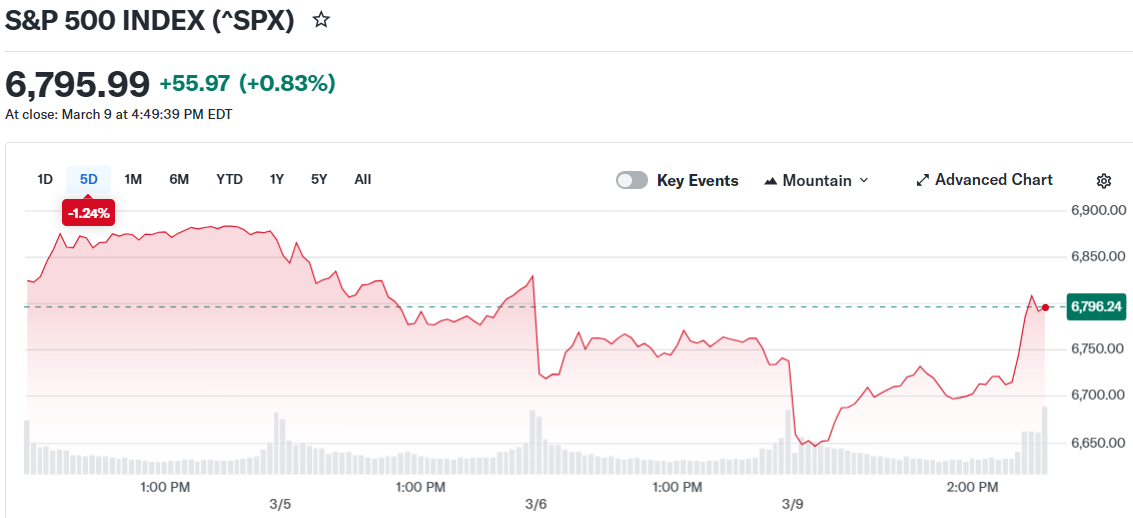
Should the index experience a 10% pullback from its peak, the S&P 500 would settle near 6,270 points. This represents approximately 7% beneath Friday’s closing level.
JPMorgan’s commodities analysts report that energy infrastructure on both sides of the conflict has sustained damage. The team indicates this establishes a concerning new pattern and cautions that the recent upward movement in oil product pricing is merely beginning.
“The precedent of oil infrastructure under attack has officially begun,” the desk wrote.
Oil breaching the $100 per barrel level represents a critical threshold for the wider economy. Elevated energy expenses ripple through multiple industries, potentially dampening corporate profitability.

Where Morgan Stanley Stands
Not all Wall Street institutions align with JPMorgan’s perspective. Mike Wilson, Morgan Stanley’s chief investment officer, maintains the firm’s optimistic stance on equities for the coming six to twelve months.
Wilson characterizes the market as experiencing a “rolling correction” since October, with performance remaining relatively stagnant despite robust earnings reports. His assessment suggests this corrective phase is nearing completion.
The divergent viewpoints stem from different interpretations of identical market data. JPMorgan identifies immediate downside risks, whereas Morgan Stanley anticipates the market stabilizing soon.
What a 10% Drop Would Mean
A 10% decline in the S&P 500 qualifies as a conventional market correction. Such events occur periodically and were observed in 2018, 2020, and 2022, with markets subsequently rebounding.
For retirement portfolios and mutual funds tracking the index, a correction of this magnitude would temporarily diminish account balances. Financial professionals typically advise maintaining positions and resisting impulse selling.
JPMorgan’s cautionary stance specifically links to the intensifying Iran conflict and assaults on oil infrastructure. The institution hasn’t identified any particular domestic economic catalyst.
Crude oil exceeding $100 creates headwinds for consumer expenditure and business operational expenses. Energy sector companies may profit from elevated pricing, while industries including aviation and manufacturing could encounter challenges.
The S&P 500 encompasses 500 of America’s largest publicly traded corporations. It stands among the most extensively monitored indexes worldwide.
JPMorgan manages $4.8 trillion in assets and ranks among the world’s largest financial institutions. Its market perspectives receive significant attention from both institutional and individual investors.
As of Monday, the bank’s equity outlook transitioned from neutral to tactically bearish, prompted by the deteriorating Middle East situation.
Get 3 Free Stock Ebooks
Discover top-performing stocks in AI, Crypto, and Technology with expert analysis.
- Top 10 AI Stocks - Leading AI companies
- Top 10 Crypto Stocks - Blockchain leaders
- Top 10 Tech Stocks - Tech giants



