
Build something brilliant in DeFi, NFTs or Web3 and the market will find you. That is the myth. The reality is that the market does not find anyone. The market pays attention to whatever shows up in its search results, its news feeds and its social timelines. Everything else — no matter how well-engineered, how innovative, how genuinely useful — gets overlooked.
This is not a fringe problem affecting a few unlucky projects. It is the default outcome for the overwhelming majority of DeFi protocols, NFT platforms and Web3 infrastructure companies operating today. They build. They ship. They iterate. And they remain functionally invisible to everyone outside a small circle of existing users and supporters.
Kooc Media, a PR distribution agency specialising in crypto, fintech, technology and iGaming since 2017, works with DeFi, NFT and Web3 projects to break this pattern. The agency provides guaranteed media placements across its own network of established news publications and distributes content through major business and finance newswire services. Articles go live within hours. Every placement is confirmed before the campaign begins. And the coverage reaches the specific audiences that decentralised technology projects need to grow.
“We talk to DeFi, NFT and Web3 founders every week who are genuinely puzzled about why more people do not know about their project,” said Michelle De Gouveia, spokesperson for Kooc Media. “The answer is almost always the same. They assumed the product would speak for itself. It does not. Not in a market this crowded.”
Good Technology Is Not a Marketing Strategy
The crypto industry is full of technically excellent projects with tiny user bases. A DeFi lending protocol with a novel approach to risk isolation that has 200 users. An NFT platform with creator tools that are genuinely better than anything else on the market that processes a few dozen trades a day. A Web3 storage network that outperforms its competitors on speed, cost and reliability that most developers have never heard of.
In each case, the project works. In each case, the team has built something that solves a real problem. And in each case, the project’s growth is bottlenecked not by product quality but by the simple fact that not enough potential users know it exists.
The assumption that quality products attract users organically is borrowed from a different era of technology. It barely worked in Web2, where network effects and app store discovery provided at least some mechanism for organic growth. It does not work at all in the DeFi, NFT and Web3 space, where applications are accessed through blockchain wallets rather than app stores, where discoverability mechanisms are primitive at best and where the sheer number of competing projects makes it impossible for users to evaluate more than a tiny fraction of what is available.

Getting found requires being present in the places where potential users look for information. For DeFi users, that means crypto news sites and finance publications. For NFT collectors and creators, that means art, gaming and crypto media. For Web3 developers and enterprise buyers, that means technology and business publications. In every case, it means appearing in search engine results when someone looks for the type of product the project offers.
PR coverage on established publications is the most direct route to all of these. Kooc Media’s crypto PR services provide DeFi, NFT and Web3 projects with guaranteed access to that coverage.
Guaranteed Results on Named Publications
Every PR agency claims to deliver media coverage. Kooc Media actually delivers it, and the difference is structural rather than aspirational.
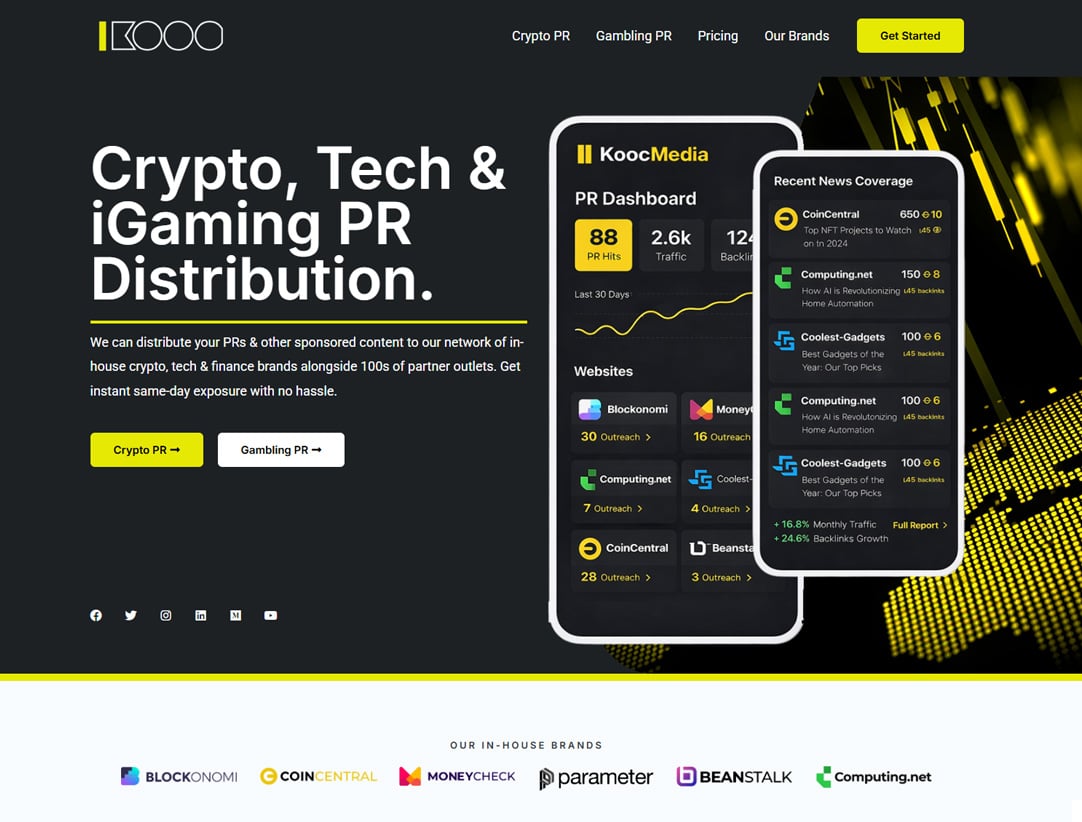
The agency owns and operates Blockonomi, CoinCentral, MoneyCheck, Parameter, Beanstalk and Computing. These in-house publications have been built over years of daily publishing. They have genuine audiences. They carry real domain authority. They rank well in search engines across a broad range of crypto, finance and technology keywords. They are the sites that show up when people search for information about DeFi protocols, NFT platforms, Web3 tools and the broader crypto market.
When a project books a campaign, Kooc Media names the publications upfront. The article is produced by the agency’s specialist editorial team and published the same day in most cases. The client gets live links to every placement. There are no pitches to external journalists. No editorial review by someone who may not understand the technology. No risk of paying for a service that produces nothing.
This model eliminates the single biggest frustration in crypto PR: the gap between what agencies promise and what they deliver. With Kooc Media, the deliverable is not a list of journalists who were contacted. It is a published article on a named, established publication that the client can click and read.
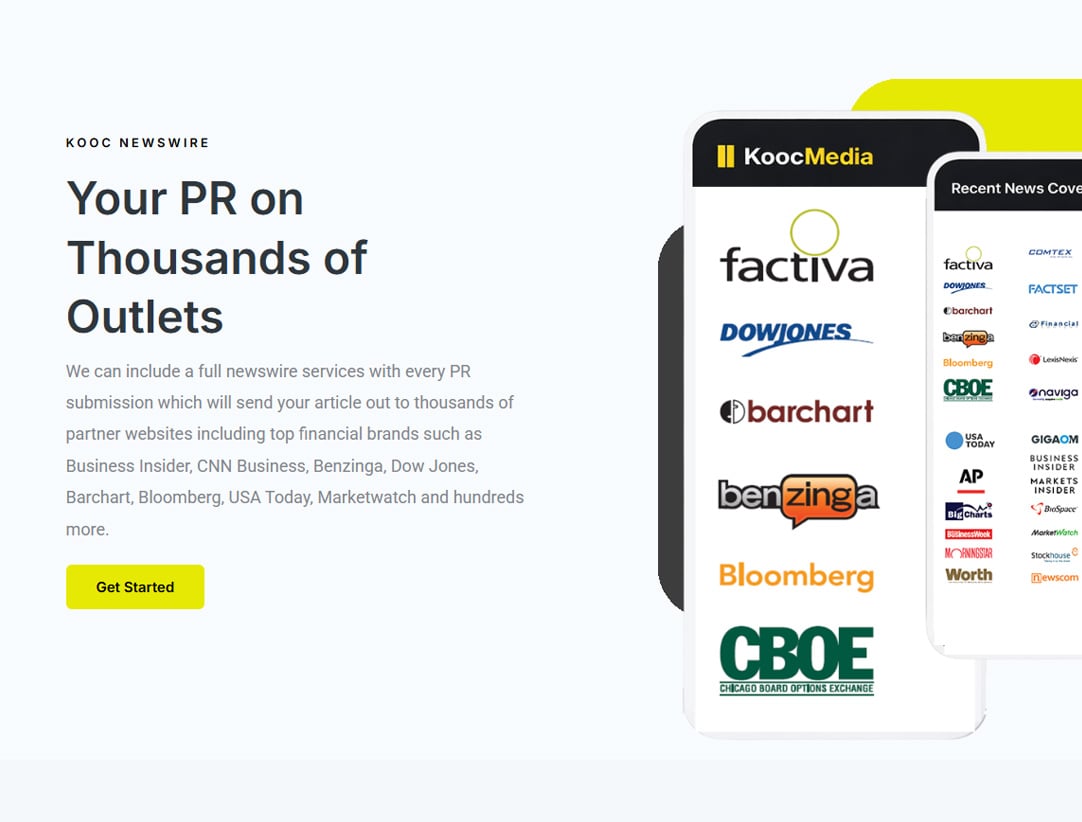
Newswire distribution broadens the reach for projects that need exposure beyond crypto-native media. Depending on the package, press releases land on mainstream outlets including Business Insider, Bloomberg, Benzinga, MarketWatch, USA Today and Dow Jones feeds. A DeFi protocol pursuing institutional liquidity providers, an NFT platform negotiating brand collaborations or a Web3 project pitching enterprise clients can use this mainstream coverage to appear credible in conversations where crypto-only media presence is not enough.
Every campaign includes complete, transparent reporting. Live links to real articles on real publications.
Sector-Specific Campaigns That Actually Connect
Kooc Media has learned through years of working with crypto clients that treating DeFi, NFT and Web3 as a single category is a mistake. The audiences barely overlap. The priorities are entirely different. The language that resonates with a DeFi liquidity provider will confuse an NFT collector. The messaging that excites a Web3 developer will bore an NFT gamer. Effective PR requires treating each sector — and often each project within a sector — as its own distinct brief.
DeFi campaigns are built around precision and credibility with a financially sophisticated audience. Coverage for a decentralised exchange leads with trading volume, chain support, fee structures and security audit results. Coverage for a lending protocol details interest rate models, collateral frameworks, liquidation parameters and total value locked. Coverage for a derivatives platform explains the instruments available, the margin system and the settlement mechanism. The DeFi audience makes allocation decisions based on technical and financial fundamentals. The content serves that decision-making process.
NFT campaigns are built around story and experience. Coverage for a digital art marketplace focuses on what makes it different for creators — minting experience, royalty models, curation philosophy, community tools. Coverage for a gaming NFT platform highlights what players actually do — gameplay mechanics, asset utility, earning potential, cross-game portability. Coverage for a collectibles platform describes the collection experience — rarity mechanics, trading features, community events. The NFT audience engages emotionally before they engage technically. The content meets them there.
Web3 campaigns are built around practical utility. Coverage for a decentralised storage project explains what it makes possible — cheaper hosting, censorship-resistant publishing, verifiable data integrity — in terms that both developers and business decision-makers understand. Coverage for an identity protocol describes real applications — passwordless login, verifiable credentials, privacy-preserving age verification, portable professional reputation. Coverage for a computing network explains the performance and cost advantages over centralised alternatives. The Web3 audience needs to understand why they should care before they will evaluate how it works.
“We have been writing about these sectors for years,” said De Gouveia. “We know that a DeFi founder and an NFT artist have completely different reasons for needing PR and completely different audiences they need to reach. Treating them the same would be doing both a disservice.”
In-House Writers Who Speak the Language
Content credibility is everything in DeFi, NFT and Web3. These audiences are deeply technical, highly sceptical and connected through communities that amplify both praise and criticism at remarkable speed. A single inaccurate claim in a press release can generate more negative attention than no press release at all.
Kooc Media’s managed PR creation service exists specifically to prevent this. The editorial team writes about DeFi mechanisms, NFT standards and Web3 architecture every day. They can describe a concentrated liquidity position accurately. They know why ERC-6551 matters for NFT utility. They understand the difference between data availability sampling and data availability committees. This is not surface-level familiarity. It is working knowledge earned through daily coverage.
The production process is built for project teams whose time is consumed by building rather than marketing. The project provides documentation, announcement details and core messaging. Kooc Media’s writers produce a finished article that is technically sound, editorially appropriate for the target publication and ready for same-day release.
For the many DeFi, NFT and Web3 teams operating without any dedicated marketing or communications staff — which remains the norm across all three sectors — this managed service is the practical difference between having a professional media presence and having no media presence at all.
Building Search Dominance One Article at a Time
Each article published on one of Kooc Media’s high-authority sites creates an indexed page in search engine results. For DeFi projects, those pages rank for decentralised lending, yield farming, DEX, liquidity protocol and DeFi platform. For NFT projects, they rank for NFT marketplace, digital art platform, gaming NFTs, music NFTs and NFT creator tools. For Web3 projects, they rank for decentralised storage, blockchain identity, Web3 infrastructure and decentralised computing.
A single article provides one entry point. Consistent monthly placements across multiple trusted publications build a network of entry points that grows with every campaign. After six months, the project appears across a dozen or more high-authority domains. After a year, the search footprint is substantial enough that the project shows up organically for a wide range of relevant queries.
This compounding effect is one of the most valuable long-term outcomes of sustained PR. The articles published this month will still be driving traffic and discovery three years from now. Each new article reinforces the search signals created by the ones before it. The cumulative result is an organic visibility channel that operates independently of any paid marketing spend and grows stronger with time.
The DeFi, NFT and Web3 projects that recognise this and start building their media presence now will have an advantage that compounds every month. The ones that wait will eventually need to start — but they will start further behind.
About Kooc Media
Kooc Media was founded in 2017 as a specialist PR distribution agency for the crypto, fintech, technology and iGaming industries. The company operates its own network of in-house news websites and a large partner distribution network, delivering guaranteed media coverage across high-authority publications. Services include press release writing, sponsored articles, newswire distribution, homepage placements and full campaign reporting. Kooc Media serves clients across the crypto, fintech and gambling sectors.
Kooc Media’s Crypto PR packages are available now through the company’s website at https://kooc.co.uk.
Disclaimer: This is a Press Release provided by a third party who is responsible for the content. Please conduct your own research before taking any action based on the content.
Get 3 Free Stock Ebooks
Discover top-performing stocks in AI, Crypto, and Technology with expert analysis.
- Top 10 AI Stocks - Leading AI companies
- Top 10 Crypto Stocks - Blockchain leaders
- Top 10 Tech Stocks - Tech giants