


Key Takeaways
- A major security vulnerability caused Zcash (ZEC) to plummet approximately 40% following public disclosure
- The flaw affected the Orchard shielded pool’s zero-knowledge proof circuit and may have existed since May 2022
- Taylor Hornby, a security expert, identified the vulnerability with assistance from Anthropic’s Claude Opus 4.8 AI model
- Network safeguards prevented any unauthorized token creation, with no evidence of exploitation discovered
- Emergency protocol upgrades, including a soft fork and NU6.2 hard fork, were rapidly implemented to resolve the issue
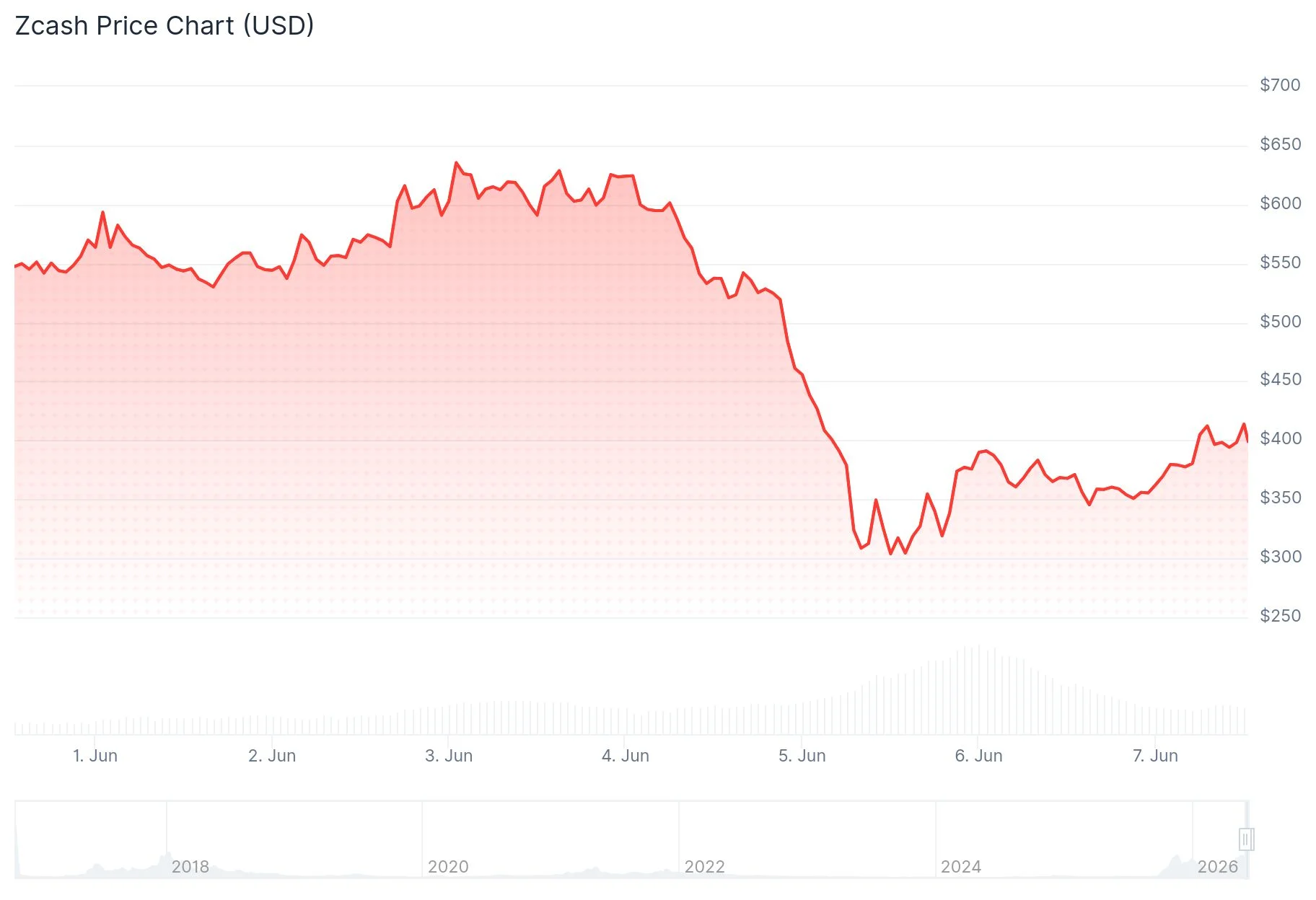
In early June 2026, Zcash (ZEC) experienced a dramatic price decline of approximately 40% following the revelation and repair of a significant security vulnerability within its Orchard shielded pool. The steep drop wiped out over $3 billion in market value, sending prices tumbling beneath the $350 threshold.
The identified weakness was classified as a “soundness” defect within Zcash’s zero-knowledge proof architecture. Evidence suggests the vulnerability could have been present from the moment the Orchard pool went live in May 2022, evading detection through numerous professional security reviews.
The breakthrough came on May 29, 2026, when security specialist Taylor Hornby uncovered the flaw during research funded by Shielded Labs. Hornby employed Anthropic’s advanced Claude Opus 4.8 AI system combined with specialized analytical tools to identify the problem.
Working with the AI platform, Hornby successfully created a functional demonstration showing how counterfeit ZEC tokens could theoretically be generated within a controlled testing environment. Critically, Zcash’s built-in turnstile security mechanisms would have blocked any real-world attempts at unlimited token inflation.
Emergency Response and Technical Remediation
The Zcash developer community executed a swift response protocol. On June 2, an emergency soft fork delivered through Zebra version 4.5.3 temporarily disabled Orchard transactions, effectively closing the vulnerability window.

A comprehensive solution arrived June 3 with the NU6.2 hard fork activation at block height 3,364,600. This upgrade incorporated a corrected circuit design and fresh verification parameters. Full Orchard capabilities were subsequently reinstated.
On June 4, Zcash co-creator Zooko Wilcox joined Jason McGee and Taylor Hornby in publishing comprehensive incident documentation. Their assessment confirmed zero evidence of active exploitation and verified the total ZEC supply remained accurate and unchanged.
Cryptocurrency analyst Ardi (@ArdiNSC) provided his technical assessment of the price movement following the collapse. He observed that ZEC surrendered nearly its entire multi-month gain—approximately 250%—within just days. His outlook anticipates a temporary recovery bounce toward the $430–$480 zone, potentially followed by further downside if that range cannot establish support. His bearish thesis would only reverse with consecutive daily closes surpassing $520.
Investor Response and Lingering Questions
ZEC had momentarily climbed above $600 before market sentiment deteriorated once vulnerability specifics became public knowledge. The slide beneath $350 accelerated following reports that prominent investor Arthur Hayes had completely exited his ZEC holdings.
A primary anxiety among market participants centered on Zcash’s privacy architecture, which prevents complete verification of whether the vulnerability was exploited prior to its discovery. Unlike transparent blockchains such as Bitcoin, the shielded pool’s internal transactions remain cryptographically hidden from public view.
Shielded Labs announced intentions to expand AI-powered security auditing, initiate formal mathematical verification of the Orchard circuit, and potentially develop an enhanced shielded pool with strengthened supply transparency features.
Cameron Winklevoss characterized the situation as evidence of robust project fundamentals, noting that top-tier security researchers continuously probe and strengthen the protocol.
Current status reports confirm no exploitation evidence has surfaced, the NU6.2 upgrade is operational across the network, and ZEC continues trading under the $400 mark.
Get 3 Free Stock Ebooks
Discover top-performing stocks in AI, Crypto, and Technology with expert analysis.
- Top 10 AI Stocks - Leading AI companies
- Top 10 Crypto Stocks - Blockchain leaders
- Top 10 Tech Stocks - Tech giants



