


Key Takeaways
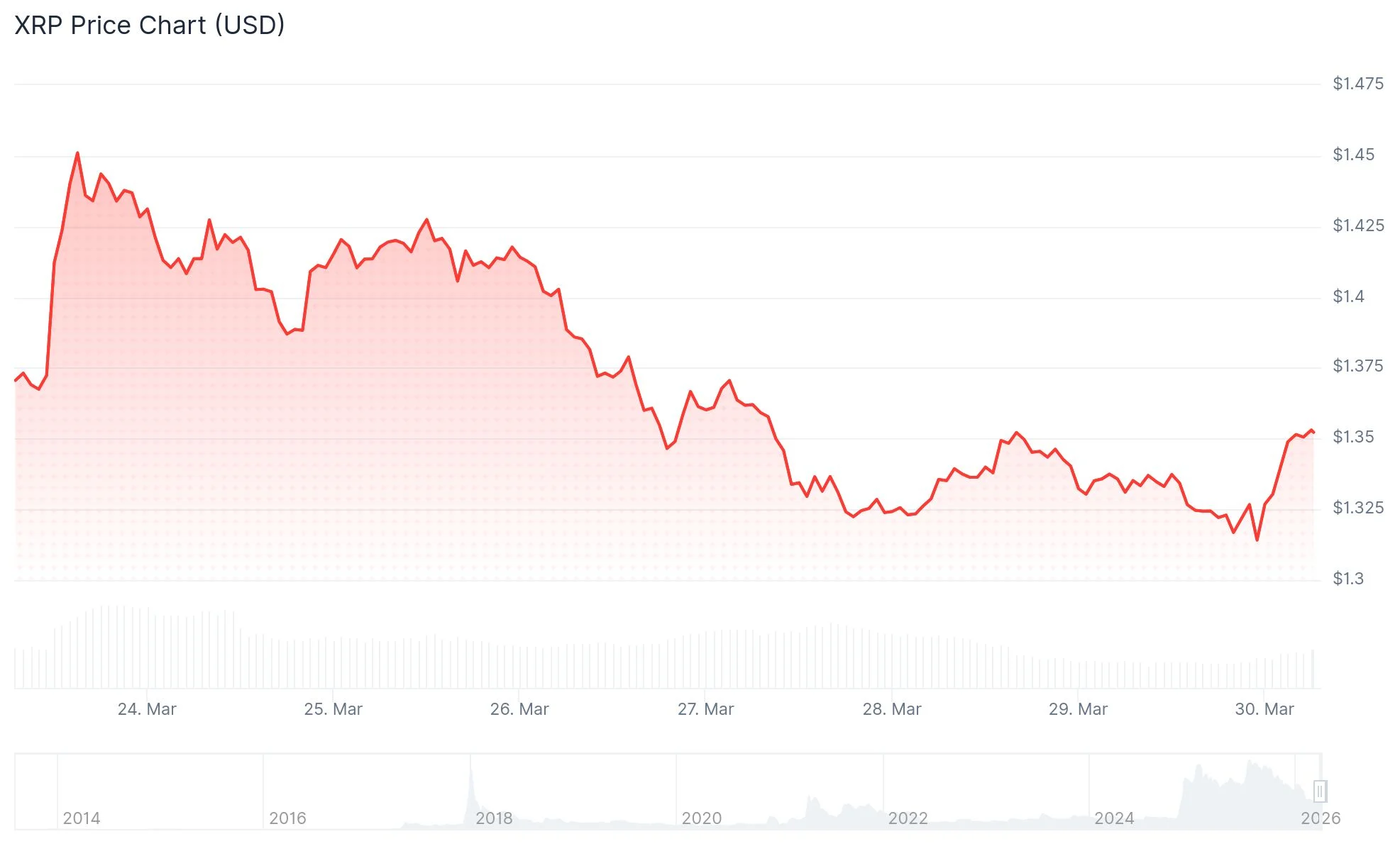
- XRP maintains its position around $1.32, defending a crucial support range from $1.30 to $1.32.
- Weekly momentum indicators have declined to 32 on the RSI, matching levels historically seen during previous market cycle bottoms.
- The daily timeframe reveals a bearish pattern with consecutive lower peaks following the climb to $2.416.
- Network activity on the XRP Ledger has contracted to under 1 million daily transactions after a temporary surge.
- Should the $1.30 threshold fail, XRP faces potential drops toward $1.24, $1.20, or the February bottom at $1.118.
As late March 2026 approaches, XRP continues to hover around the $1.32 price point, positioned at a critical technical juncture. While the asset maintains its presence above a tight support corridor, technical momentum signals remain subdued throughout multiple timeframes.
The weekly Relative Strength Index has descended to approximately 32, entering territory typically associated with oversold conditions on extended timeframes. Historical XRP market cycles have witnessed comparable RSI values during the final stages of prolonged corrections. That said, oversold RSI readings don’t guarantee an immediate reversal. Markets can maintain depressed price levels while momentum indicators remain subdued for extended periods.
Analyzing the daily timeframe provides additional context regarding the prevailing trend. Following XRP’s advance to $2.416, the asset has established a sequence of declining peaks. This formation indicates seller dominance over buyer interest in recent sessions. Since reaching that high, XRP has retraced and consolidated within a compressed trading corridor.
Critical Price Zones to Monitor
The active support region extends from $1.30 through $1.32, with XRP currently trading within this boundary. A confirmed daily candle close beneath $1.30 would likely trigger additional downside pressure, potentially targeting $1.24 and $1.20. The February 2026 trough near $1.118 represents the most significant lower support benchmark on the chart.
Regarding resistance, initial barriers emerge around $1.42 and $1.43, which coincides with the 23.6% Fibonacci retracement level at $1.4247. Beyond this zone, market participants are monitoring $1.50, $1.614, and $1.767 as subsequent targets. Breaking decisively above $1.42 with volume would be necessary to alter the current momentum structure.

The MACD indicator remains positioned below neutral territory on the daily chart, suggesting buyers haven’t regained market control. The Chaikin Money Flow indicator registers approximately -0.17, signaling persistent net distribution pressure. Multiple short-duration rally efforts have stalled near the $1.45 level, demonstrating that sellers remain active during price bounces.
Market analyst CW shared insights on X indicating that XRP whale addresses have been steadily accumulating holdings throughout the past year. The analysis identifies a broad whale accumulation range stretching from $1.20 to $3.00, with significant buying activity also documented previously within the $0.30 to $1.30 corridor. According to this assessment, large holders have maintained their buying stance and haven’t begun distributing to retail participants.
Network Transactions Contract After Recent Spike
XRP Ledger daily transaction volumes have receded below the 1 million mark, a metric frequently referenced when evaluating network vitality. This decline follows a temporary elevation in on-chain activity. Market observers suggest this pullback may simply represent normalization after a period of heightened institutional or large-volume transfers, rather than indicating structural weakness.
Given the compressed trading range and reduced activity levels, certain analysts propose that XRP may be experiencing a liquidity drought. During periods of limited market depth, even moderate buying pressure can generate disproportionately strong price reactions.
XRP currently trades near $1.32, with the $1.30 threshold serving as the final prominent support before potentially testing the lower 2026 price levels.
Get 3 Free Stock Ebooks
Discover top-performing stocks in AI, Crypto, and Technology with expert analysis.
- Top 10 AI Stocks - Leading AI companies
- Top 10 Crypto Stocks - Blockchain leaders
- Top 10 Tech Stocks - Tech giants



