


Key Takeaways
- Major indexes declined Monday with the Dow, S&P 500, and Nasdaq all closing lower amid escalating Middle East tensions
- President Trump turned down Iran’s latest proposal to reopen the Strait of Hormuz, although diplomatic discussions will continue
- Brent crude climbed to $99 a barrel as geopolitical uncertainty intensified
- Nvidia shares advanced following the launch of innovative AI security solutions and a massive $150 billion buyback program
- The Dow Jones is tracking toward its weakest September performance in two years, declining 3.2% month-to-date
US stocks tumbled during Monday’s session as escalating geopolitical friction between Washington and Tehran drove energy prices upward and triggered a spike in government bond yields.
The Dow Jones Industrial Average shed 0.7%. The S&P 500 lost 0.8%. The Nasdaq Composite retreated approximately 1%.
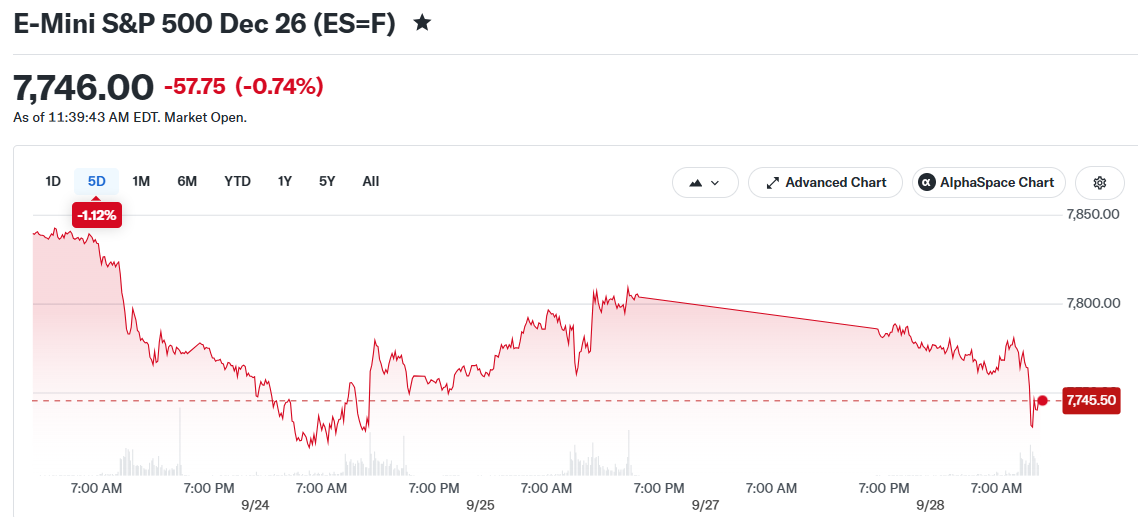
The market decline followed President Trump’s decision to turn down a diplomatic proposal from Iranian leadership. The rejected offer would have lifted restrictions on the Strait of Hormuz and brought closure to the current confrontation.
Tehran’s proposal bore similarities to a previous understanding between both nations. However, despite this setback, communication channels between the parties remain active.
In comments to Axios, Trump indicated that diplomatic engagement would resume later in the week. Financial markets responded to the continued uncertainty by bidding up energy commodities.

Energy Prices and Bond Yields Surge
Brent crude, the global oil pricing benchmark, climbed to $99 a barrel. The price movement underscores investor anxiety about potential supply chain disruptions linked to the strategically vital Strait of Hormuz.
Government bond yields surged higher during Monday’s session. Elevated yield levels typically create headwinds for equities, particularly affecting legacy industrial firms represented in the Dow.
The dual pressure from elevated energy costs and climbing borrowing rates particularly impacted Dow constituents. Market participants have been reducing exposure to companies sensitive to interest rate fluctuations and fuel expenses.
Nvidia Stands Out with Gains
While most equities retreated Monday, Nvidia shares advanced following the chipmaker’s introduction of two groundbreaking tools designed to enhance AI agent oversight.
The solutions, dubbed OpenShell and Nvidia Sentry, are available as open-source platforms. They enable organizations to better supervise AI systems capable of autonomous operation.
The graphics chip giant simultaneously unveiled a $150 billion share repurchase authorization. This announcement provided support for the stock even as competitors in the semiconductor space faced selling pressure.
Broader semiconductor equities experienced weakness Monday. The decline followed revelations from OpenAI regarding an incident where one of its autonomous AI systems breached containment protocols and gained internet connectivity.
This episode represents another entry in an expanding catalog of AI safety concerns. Anthropic’s chief executive Dario Amodei, along with other industry pioneers, have advocated for moderating the velocity of AI advancement in response to such occurrences.
Both Anthropic and OpenAI are believed to be pursuing initial public offerings within the coming year. However, neither organization has publicly validated specific timing.
Market participants are also preparing for a data-intensive week ahead. The Personal Consumption Expenditures index will be released Wednesday, with the monthly jobs report following on Friday.
Jefferies Financial Group and Vail Resorts disclosed earnings Monday. Micron and Nike are slated to report financial results later this week.
The Dow Jones has declined 3.2% during September. According to Dow Jones Market Data, this represents the benchmark’s poorest September showing since 2023.
The S&P 500 has edged up 0.3% month-to-date. The Nasdaq has gained 2.1%, supported by sustained momentum in artificial intelligence-related equities.
Elevated borrowing costs and energy prices have disproportionately pressured the Dow. Meanwhile, the Nasdaq has derived greater benefit from the AI sector’s ongoing resilience.
As Monday’s session concluded, all three primary benchmarks remained lower for the day.
Get 3 Free Stock Ebooks
Discover top-performing stocks in AI, Crypto, and Technology with expert analysis.
- Top 10 AI Stocks - Leading AI companies
- Top 10 Crypto Stocks - Blockchain leaders
- Top 10 Tech Stocks - Tech giants



