


Key Points
- Military exchanges between Washington and Tehran continued for a consecutive day, with Trump threatening additional strikes unless Iran agrees to peace terms.
- Equity futures showed modest recovery Thursday following overnight military action, bouncing back from Wednesday’s sharp selloff.
- Tehran launched attacks on American military installations and partner nations in Kuwait, Bahrain, and Jordan, while asserting control over Strait of Hormuz shipping routes.
- Crude prices surged amid concerns over potential prolonged closure of the Strait of Hormuz, fueling inflationary pressures.
- SpaceX’s highly anticipated public offering, projected to be record-breaking, approaches its Friday launch date.
Washington executed another wave of military strikes targeting Iran during the late Wednesday to early Thursday timeframe, representing the most recent intensification in hostilities that have sent shockwaves through international financial systems. Military officials from US Central Command verified the operations, characterizing them as defensive measures following Iran’s downing of an American Apache helicopter over the Strait of Hormuz.
During a Fox News appearance, President Trump issued a stern warning that Washington stood ready to intensify military operations should Tehran refuse immediate acceptance of peace negotiations. Earlier that same day, he had declared Iran’s negotiation delays unacceptable and promised consequences.
Tehran responded with its own military operations, targeting American bases and coalition facilities throughout Kuwait, Bahrain, and Jordan. Reports confirmed explosions at multiple locations across these nations. Iranian authorities additionally asserted they had successfully halted maritime traffic through the Strait of Hormuz, a claim that CENTCOM contradicted.
Financial Markets Experience Volatility Amid Conflict
Equity futures showed slight upward movement Thursday morning following the nighttime strikes, with Dow contracts advancing 0.3%, S&P 500 contracts climbing 0.4%, and Nasdaq contracts gaining 0.3%. These moderate improvements followed Wednesday’s punishing trading session.
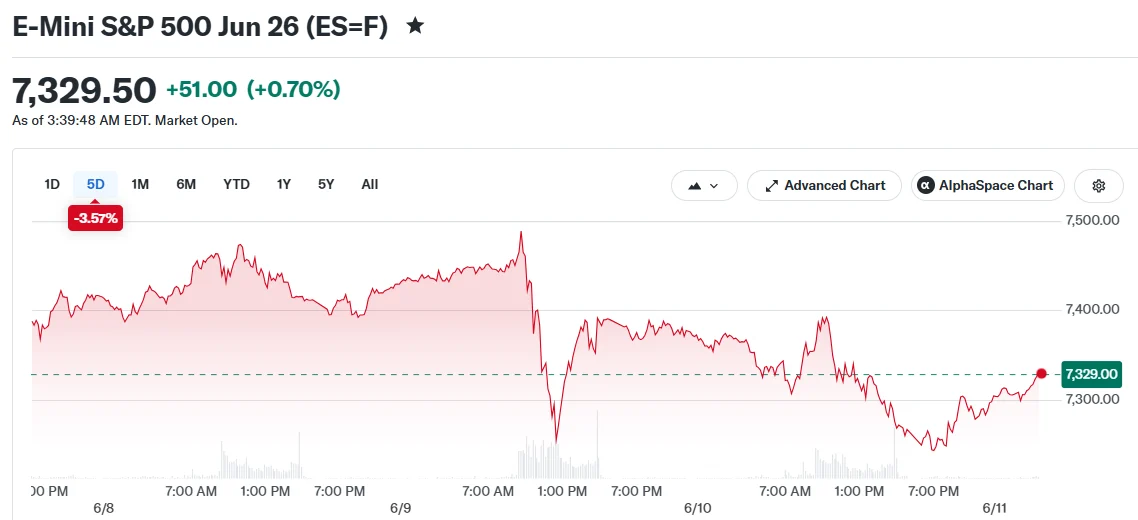
During Wednesday’s session, equities experienced significant declines as the military situation deteriorated. The S&P 500 tumbled 1.62%, while the Dow Jones plummeted 1.87%, and the Nasdaq declined 1.98%. Trading sentiment was further damaged by fresh economic data revealing accelerating consumer prices.

Crude markets rallied Thursday on mounting anxiety that the Strait of Hormuz, an essential conduit for international petroleum transport, might face extended disruption. Rising energy costs compounded existing inflation worries already pressuring market participants.
Trump directly commented on petroleum market developments, expressing approval of inflationary trends while asserting that America had covertly maintained oil transit through Hormuz, claiming approximately 100 million barrels had moved through the waterway.
SpaceX Public Debut and Oracle Results Complicate Market Picture
Oracle delivered quarterly financial results exceeding analyst projections after Wednesday’s closing bell, though shares declined as cloud computing revenue disappointed investor expectations.
Markets awaited Thursday’s Producer Price Index release, which would provide additional insight into wholesale-level price acceleration following May’s concerning inflation figures.
Market attention remains focused on Friday’s anticipated SpaceX stock market entrance. The public offering is broadly projected to establish historical records, potentially offering markets a positive development during an otherwise challenging trading week.
Tensions involving Israel, Lebanon, and Hezbollah also persisted as background concerns. Israeli defense forces issued early Thursday warnings regarding new projectile activity originating from Lebanese territory, contributing additional uncertainty to an already volatile geopolitical environment.
With Washington and Tehran maintaining substantial disagreements on critical matters—including Tehran’s nuclear ambitions and strait governance—prospects for near-term diplomatic resolution remain unclear.
Get 3 Free Stock Ebooks
Discover top-performing stocks in AI, Crypto, and Technology with expert analysis.
- Top 10 AI Stocks - Leading AI companies
- Top 10 Crypto Stocks - Blockchain leaders
- Top 10 Tech Stocks - Tech giants



