



Key Highlights
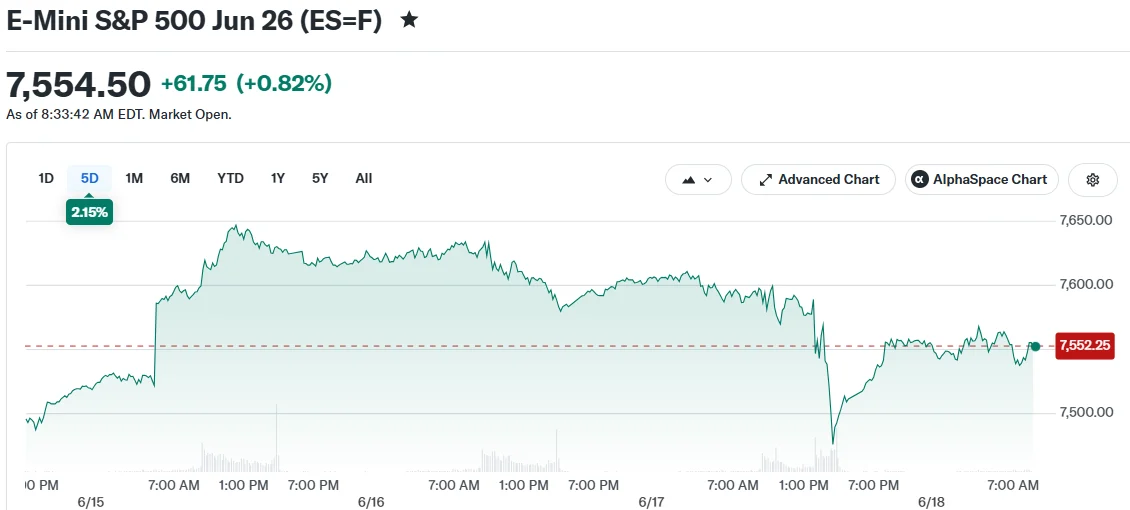
- Nasdaq 100 futures surged 1.3% in Thursday’s pre-market trading, while S&P 500 futures gained 0.7%
- Trump unexpectedly signed the US-Iran peace framework on Wednesday, moving up the timeline from Friday
- The agreement could facilitate reopening of the Strait of Hormuz, potentially pressuring oil prices downward
- Brent crude tumbled approximately 3% following the announcement, briefly trading under $78 per barrel
- Federal Reserve kept rates unchanged Wednesday but indicated a potential increase before year-end, with markets anticipating an October adjustment
Thursday’s pre-market session brought renewed optimism to US equity futures as traders digested a surprise Iran peace framework and the Federal Reserve’s latest policy stance on inflation and interest rates.
The tech-heavy Nasdaq 100 futures posted the strongest performance, advancing 1.3%. S&P 500 futures climbed 0.7%, while Dow Jones futures showed a modest 0.2% increase. This rebound came after Wednesday’s session saw all three benchmarks close significantly lower.
Unexpected Iran Agreement Announcement
In a development that caught markets off guard, President Trump executed a memorandum of understanding with Iranian officials on Wednesday. The signing came days ahead of the anticipated Friday ceremony. This 14-point diplomatic framework establishes groundwork for normalized relations between Washington and Tehran.
Market participants are particularly focused on implications for the Strait of Hormuz, a critical oil shipping channel. The potential reopening could enable Iranian crude exports to resume normal levels, adding supply to global energy markets and applying downward pressure on prices.
Brent crude futures responded immediately, plunging as much as 3% and dipping below the $78 per barrel threshold. West Texas Intermediate similarly declined roughly 2% to approximately $74.57. Both benchmarks later pared some losses amid ongoing uncertainty about when actual commercial transit through the strait might resume.

Diplomatic talks addressing Iran’s nuclear ambitions and other contentious matters will proceed during a 60-day negotiation window.
Central Bank Maintains Hawkish Tone
The Federal Reserve opted to maintain its current interest rate policy during Wednesday’s meeting, yet Chairman Kevin Warsh delivered language suggesting a potential rate increase remains under consideration for later in 2024. Persistent inflation readings and robust employment figures continue influencing the central bank’s calculus.
According to Deutsche Bank economist Peter Sidorov, financial markets now fully expect a Fed rate adjustment by October.
This hawkish messaging triggered Wednesday’s sharp selloff, with the Dow shedding over 500 points. However, overnight optimism surrounding the Iran diplomatic breakthrough helped equity futures recover those losses heading into Thursday’s opening bell.
The benchmark 10-year Treasury yield declined 5 basis points to 4.45%. Meanwhile, the US dollar index strengthened 0.3% versus major global currencies.
Bitcoin retreated 1.7% during the trailing 24-hour period, trading around $64,347. The cryptocurrency’s decline reflected broader risk-off sentiment triggered by the Federal Reserve’s inflation-fighting posture.
Investors awaited Thursday’s weekly jobless claims report, which would provide additional insight into labor market conditions.
With markets scheduled to close Friday for the Juneteenth federal holiday, Thursday represents the final trading session of the week.
Overseas, Japan’s Nikkei index achieved a historic milestone by breaking above 70,000 for the first time, contributing to positive momentum in global equity markets ahead of the US trading day.
Get 3 Free Stock Ebooks
Discover top-performing stocks in AI, Crypto, and Technology with expert analysis.
- Top 10 AI Stocks - Leading AI companies
- Top 10 Crypto Stocks - Blockchain leaders
- Top 10 Tech Stocks - Tech giants



