


TLDR
- Solana (SOL) hovers around $119.54, repeatedly challenging the $120 resistance zone.
- Spot Solana ETFs in the U.S. recorded an all-time weekly inflow of $188 million before a minor outflow on Sept. 30.
- The price chart reveals a consistent upward trajectory from August lows, with key support established between $105-$110.
- The Relative Strength Index stands at 63.22 as MACD indicators show slight deceleration in momentum.
- Solana’s Alpenglow upgrade has entered public testing phases, designed to slash transaction finality times dramatically.
Solana continues to trade in the vicinity of $120 as bullish participants work to extend the token’s rally from its summer lows.
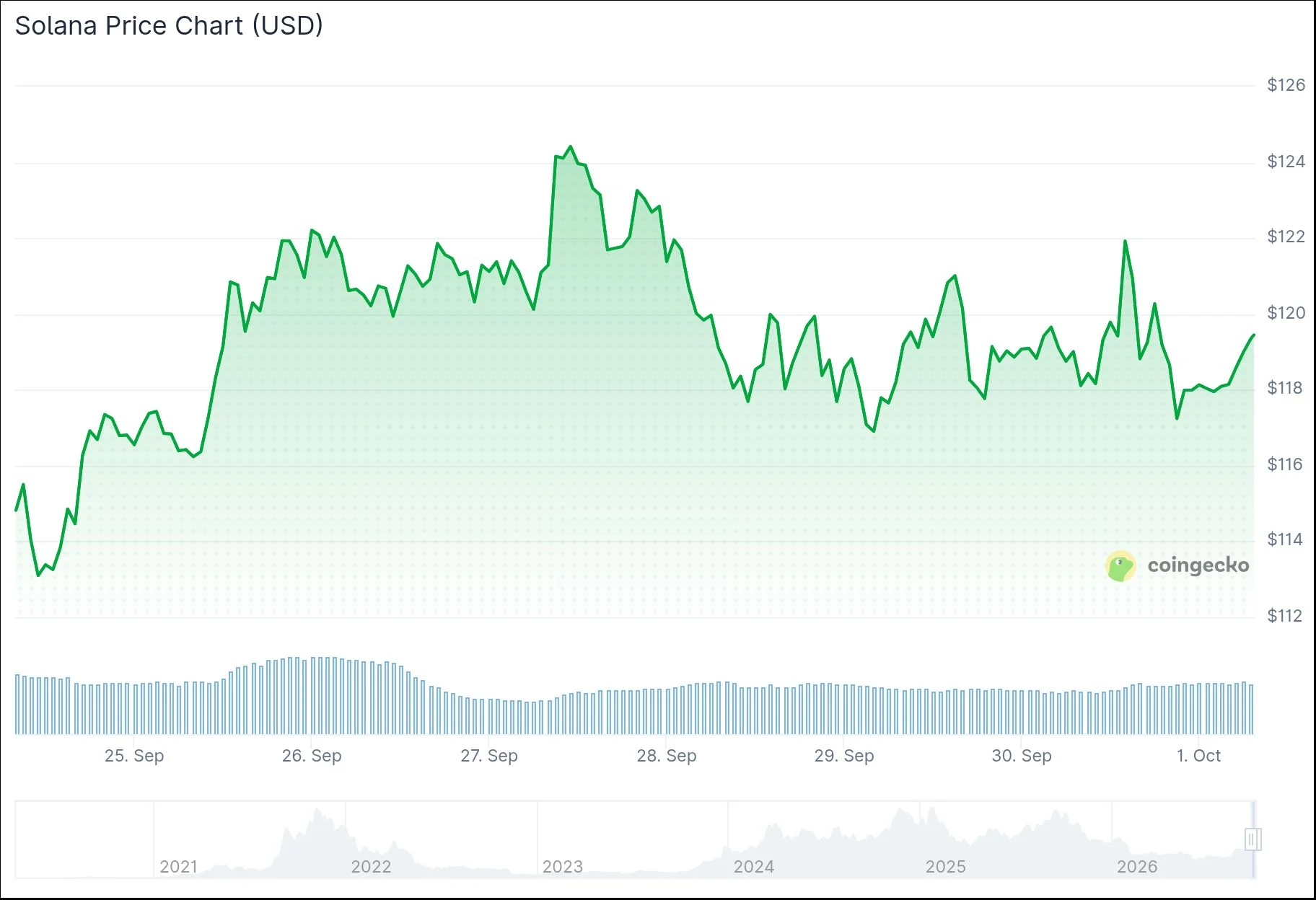
On October 1, SOL started the session around $118.04. The token pushed toward $119.55 during intraday trading before closing near $119.54, marking a daily gain of approximately 1.25%.
The larger market structure continues to show strength. Since bottoming around $75 in August, Solana has consistently established higher lows throughout September.
The token has successfully breached the $95-$100 band that served as a stubborn ceiling for the majority of 2026. This former resistance zone now functions as a support floor.
Repeated Attempts to Break Above $120
Throughout the past week, SOL has made multiple efforts to decisively breach the $120 threshold. Each attempt has yet to produce a confirmed daily close above this level.

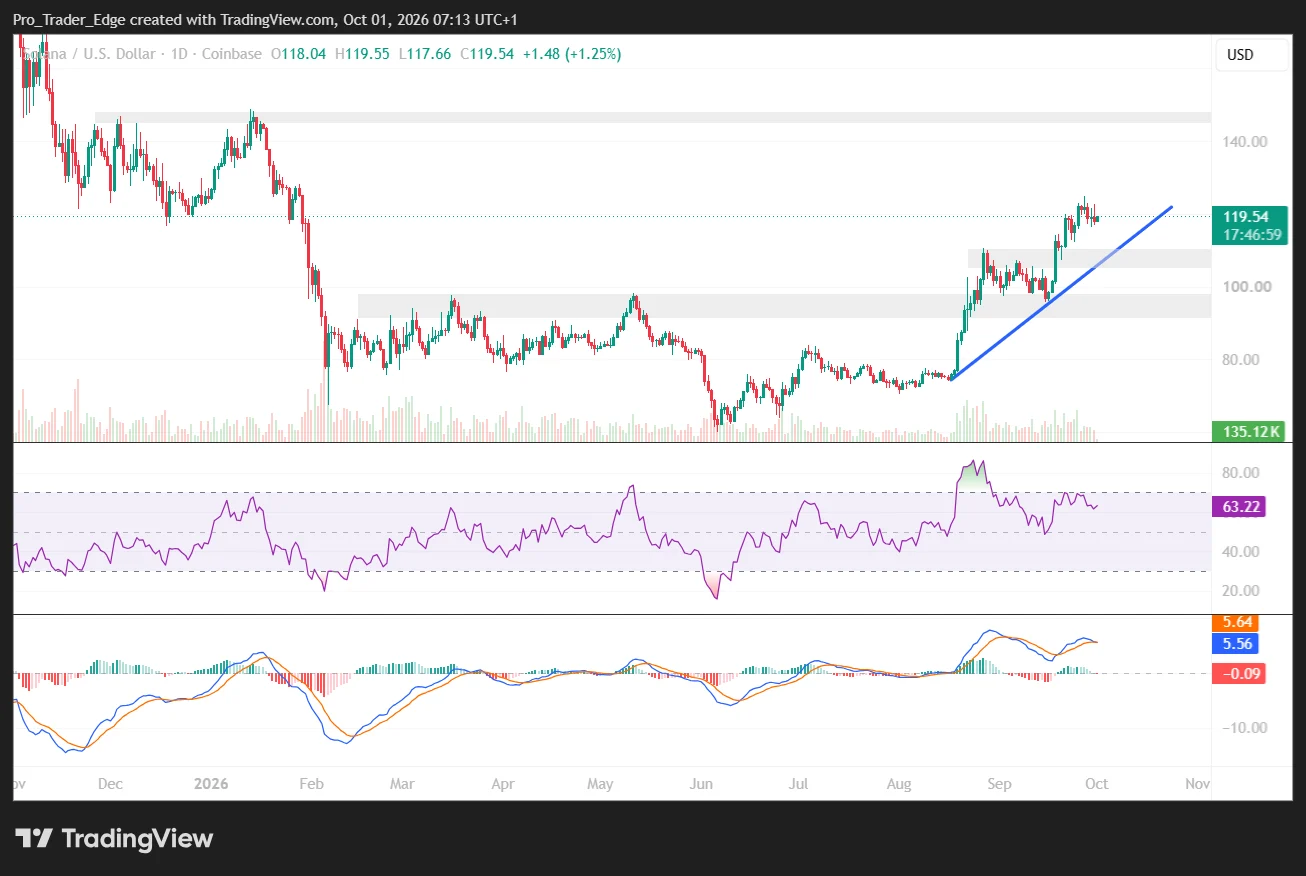
Should price action manage to clear the $120-$122 resistance band, the next logical target zone sits between $140-$145, representing levels where SOL traded before its earlier pullback this year.
Looking at downside risks, immediate support rests in the $105-$110 region. This area corresponds with the ascending trend line that has provided stability since August.
Further down, the $94-$100 zone represents a critical support foundation, particularly significant given its previous role as a resistance barrier.
While momentum indicators remain constructive, there are signs of deceleration. The daily RSI currently registers 63.22, positioned above the neutral threshold of 50 but comfortably below the overbought territory at 70.
The MACD presents a nuanced picture. With the MACD line at 5.56 versus the signal line at 5.64, and the histogram marginally negative at -0.09, the data points to an ongoing uptrend that’s experiencing some loss of momentum near the $120 barrier.
This configuration indicates the bull trend remains alive, though buying pressure has moderated around current price levels.
Institutional Demand Continues Despite Brief Reversal
Professional capital allocation continues to drive a significant portion of Solana’s narrative. During the Sept. 21-25 trading week, U.S. spot Solana ETFs attracted approximately $188 million, establishing a new weekly record for the products.
The Bitwise BSOL fund captured around $128 million of that total, representing roughly 68% of aggregate inflows for the period.
On Friday of that same week, inflows reached nearly $87 million in a single session. The momentum extended through Sept. 28 and Sept. 29, which contributed an additional $12.7 million and $5.4 million respectively.
This positive streak ended on Sept. 30, when the ETF complex experienced approximately $12.5 million in net withdrawals. BSOL accounted for the bulk of outflows at $8.9 million, though Fidelity’s FSOL bucked the trend by attracting $2.8 million.
Cumulative net inflows across all Solana exchange-traded funds stand at approximately $1.6 billion since their market debut.
Parallel to market developments, technical upgrades are advancing. The Alpenglow consensus mechanism upgrade is currently operational on both devnet and testnet environments, with the goal of reducing transaction finality to around 150 milliseconds from the current 12.8 seconds.
Additionally, Solana has reduced its target slot time from 400 milliseconds down to 250 milliseconds, representing another component of the network’s broader performance enhancement initiative.
SOL maintains its ascending daily price structure near $119.50, with market participants attempting to establish the frequently challenged $120-$122 zone as a new foundational support level.
Get 3 Free Stock Ebooks
Discover top-performing stocks in AI, Crypto, and Technology with expert analysis.
- Top 10 AI Stocks - Leading AI companies
- Top 10 Crypto Stocks - Blockchain leaders
- Top 10 Tech Stocks - Tech giants



