


Key Takeaways
- SK hynix and NVIDIA have formed a strategic multiyear alliance to develop advanced memory solutions for artificial intelligence infrastructure.
- The collaboration spans NVIDIA’s Vera Rubin supercomputing systems, Vera CPUs, RTX Spark consumer devices, and Jetson Thor robotics technology.
- Both firms are leveraging artificial intelligence tools to streamline chip architecture development and production processes.
- SK hynix plans to implement virtual factory replicas powered by NVIDIA Omniverse and cuOpt technologies, advancing toward fully automated manufacturing facilities.
- This strategic alliance positions SK hynix at the intersection of three emerging NVIDIA-driven sectors: enterprise AI infrastructure, consumer AI computing, and robotics applications.
A comprehensive multiyear technology alliance between NVIDIA and SK hynix was unveiled on June 7, 2026, establishing a framework for joint development of advanced memory architectures tailored for global AI computing facilities.
This strategic agreement encompasses memory provisioning, chip architecture innovation, and production capabilities — effectively integrating SK hynix into NVIDIA’s broader artificial intelligence ecosystem strategy.
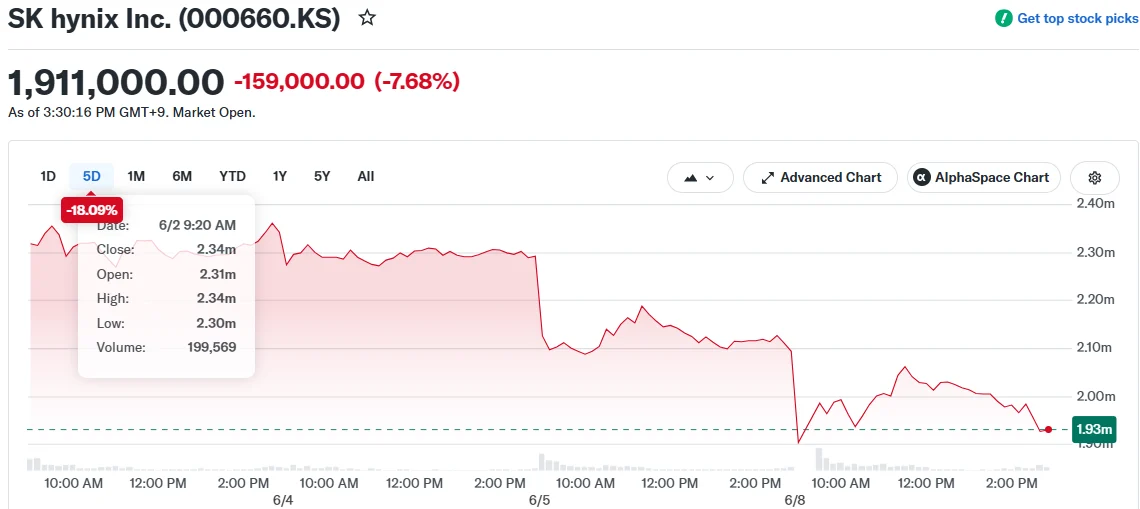
Shares of SK hynix (KRX: 000660) were hovering near the ₩238,000 mark in trading sessions immediately preceding the partnership disclosure.
The alliance addresses critical challenges in advanced memory production, particularly the extended development timelines and substantial capital investments required for cutting-edge fabrication at commercial scale.
With AI computing centers proliferating worldwide, NVIDIA requires memory manufacturing capacity that can match its expansion velocity. This partnership framework establishes that capability.

The Korean memory giant will jointly engineer memory solutions across NVIDIA’s product portfolio — spanning Vera Rubin AI supercomputing infrastructure, Vera central processing units, RTX Spark-enabled consumer computing devices, and the Jetson Thor platform for robotic applications.
This final component deserves special emphasis. The arrangement effectively positions SK hynix across three separate NVIDIA-anchored market segments: enterprise AI infrastructure, personal artificial intelligence computing, and physical AI embodied in robotics.
Artificial Intelligence Transforms Semiconductor Development
The partnership extends beyond conventional supply relationships into the fundamental processes of semiconductor creation.
SK hynix is implementing NVIDIA’s CUDA-X software libraries alongside the PhysicsNeMo computational framework to accelerate semiconductor modeling — encompassing technology computer-aided design systems and computational lithography operations.
This cooperation creates potential for triangular partnerships linking memory manufacturers, NVIDIA’s platform, and electronic design automation software providers.
The implication reaches beyond a simple two-party supply arrangement into broader industry ecosystem development.
Virtual Manufacturing and Autonomous Production Facilities
SK hynix is constructing sophisticated digital replicas of its production facilities — comprehensive three-dimensional virtual models — leveraging NVIDIA Omniverse technology and OpenUSD development pipelines.
These digital environments enable simulation and refinement of intricate manufacturing operations, including the coordination of autonomous mobile robots operating within fabrication facilities.
The open-source NVIDIA cuOpt optimization engine combined with the NVIDIA Metropolis platform provides operational efficiency tools within these simulated environments.
The companies are simultaneously working to integrate these virtual factory systems with established legacy manufacturing software and agentic AI systems — enabling artificial intelligence to interpret fabrication data and automate production management decisions.
NVIDIA CEO Jensen Huang characterized advanced memory technology as “essential” for AI factory capabilities and recognized SK hynix as having fulfilled a “central role” in providing memory solutions for NVIDIA’s technology platforms.
SK Group Chairman Chey Tae-won characterized the partnership as demonstrating “the depth” of their ongoing collaboration history and noted that both organizations are now deploying AI throughout semiconductor design and manufacturing operations.
In a concurrent announcement released the same day, NVIDIA disclosed that South Korea’s Naver Corporation will utilize its DSX platform for designing and deploying comprehensive AI infrastructure solutions targeting enterprise and government customers.
Get 3 Free Stock Ebooks
Discover top-performing stocks in AI, Crypto, and Technology with expert analysis.
- Top 10 AI Stocks - Leading AI companies
- Top 10 Crypto Stocks - Blockchain leaders
- Top 10 Tech Stocks - Tech giants



