



Key Highlights
- First quarter 2026 revenue reached €847 million for SES, marking an 80% increase year-over-year at constant currency
- Intelsat appears in quarterly financials for the first time since the July 2025 merger completion
- Japan Airlines committed to equipping over 40 long-haul aircraft with SES connectivity solutions
- Boeing and SES achieved a key milestone for factory-installed connectivity across Boeing’s entire aircraft lineup
- Company maintains 2026 full-year outlook, projecting stable revenue and EBITDA on a like-for-like comparison
Luxembourg’s SES, a leading satellite communications provider, unveiled its first-quarter 2026 financial performance on Tuesday, delivering revenue of €847 million. This represents an 80% year-over-year jump when calculated at constant currency rates.
The quarterly report marks the first time Intelsat’s operations are fully reflected in SES’s consolidated results following the acquisition’s closure in July 2025. The transformative deal has significantly enhanced the company’s revenue base.
Adjusted EBITDA reached €404 million for the period, climbing 44.2% at reported rates. However, the adjusted EBITDA margin compressed to 47.7% from 55.1% in the prior-year quarter, a reflection of increased operational costs associated with the expanded combined entity.
When examining like-for-like performance—which excludes Intelsat’s contribution—revenue increased 3.1% while adjusted EBITDA advanced 5% at constant currency. These figures indicate healthy organic momentum in the core operations.
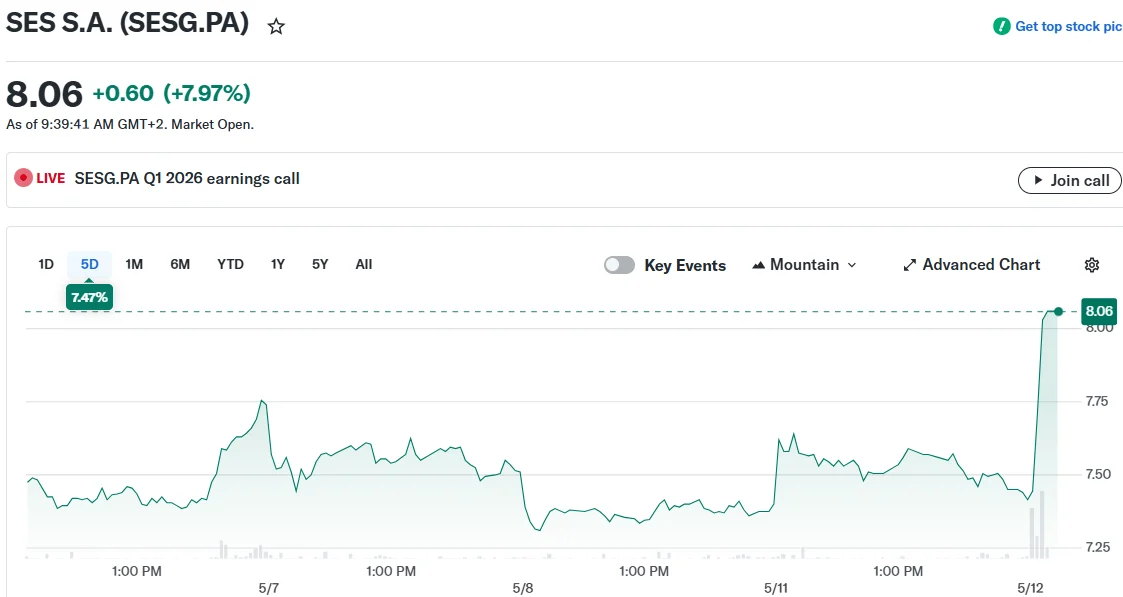
Investor sentiment was positive, with SES shares climbing over 6% on Tuesday to reach 2026’s peak level. The stock settled near €8.17 at market close.

Inflight Connectivity Drives Performance
The aviation division emerged as the quarter’s star performer. Chief Executive Adel Al-Saleh highlighted that approximately 600 aircraft now operate with the SES multi-orbit inflight connectivity platform.
A significant win came from Japan Airlines, which committed to installing the system on more than 40 of its long-range aircraft during the three-month period. Across all business lines, SES captured €306 million in fresh contracts and renewals.
SES and Boeing achieved an important milestone in their collaboration to develop a factory line-fit configuration for the multi-orbit connectivity platform applicable to Boeing’s complete aircraft portfolio. This advancement would enable the system to be integrated during manufacturing rather than through post-delivery retrofits.
European Space Agreements Strengthened
In Europe, SES and the EU Agency for the Space Programme successfully negotiated an extension of the EGNOS GEO-1 satellite service contract through 2030. This service delivers precision navigation capabilities essential for aviation and additional sectors throughout European airspace.
The company continues its involvement in IRIS², the European Commission’s strategic program for independent space-based communications infrastructure. SES anticipates capital expenditures of approximately €700 million for 2026, encompassing investments in both IRIS² and the initial deployment phase of its meoSphere initiative.
The Networks division, accounting for 66% of consolidated revenue, generated €556 million. Within this segment, Mobility revenue totaled €259 million, surging 207.8% at constant exchange rates, although this figure incorporated a deliberate contract restructuring in the Aviation vertical valued at €81 million.
Media revenue contributed €285 million, representing a 42.9% increase at constant currency but declining 11% on a like-for-like basis.
Net results showed a loss of €16 million, contrasting with a €29 million profit in the corresponding quarter last year. Elevated depreciation expenses of €108 million and higher financing charges stemming from the Intelsat transaction pressured profitability.
Adjusted net debt to EBITDA reached 4.1 times, up substantially from 1.2 times in the year-ago period, attributable to debt assumed for the acquisition financing.
Employee compensation decreased 20% while total operating expenses declined 9% year-over-year at constant currency on a like-for-like basis, demonstrating early success in achieving integration synergies.
SES confirmed its full-year 2026 financial outlook, anticipating revenue and adjusted EBITDA to remain flat year-over-year when measured on a like-for-like basis at constant exchange rates.
Get 3 Free Stock Ebooks
Discover top-performing stocks in AI, Crypto, and Technology with expert analysis.
- Top 10 AI Stocks - Leading AI companies
- Top 10 Crypto Stocks - Blockchain leaders
- Top 10 Tech Stocks - Tech giants



