


Key Takeaways
- SNDK shares have climbed approximately 700% during 2026, breaking above $2,100 following a 4,000%+ surge since separating from Western Digital in 2025
- Quarterly revenue exploded 251% compared to the prior year, while the company maintains a debt-free balance sheet and unprecedented free cash flow generation
- Manufacturing capacity is completely sold out through 2026 as artificial intelligence infrastructure creates unprecedented demand for enterprise solid-state drives
- Mizuho Securities increased its target to $2,200, while Cantor Fitzgerald pushed to $2,900, emphasizing an “AI-driven memory paradigm shift”
- Current trailing price-to-earnings ratio stands at approximately 67x — significantly above the 36x sector average — though forward P/E contracts to roughly 30x based on projected earnings
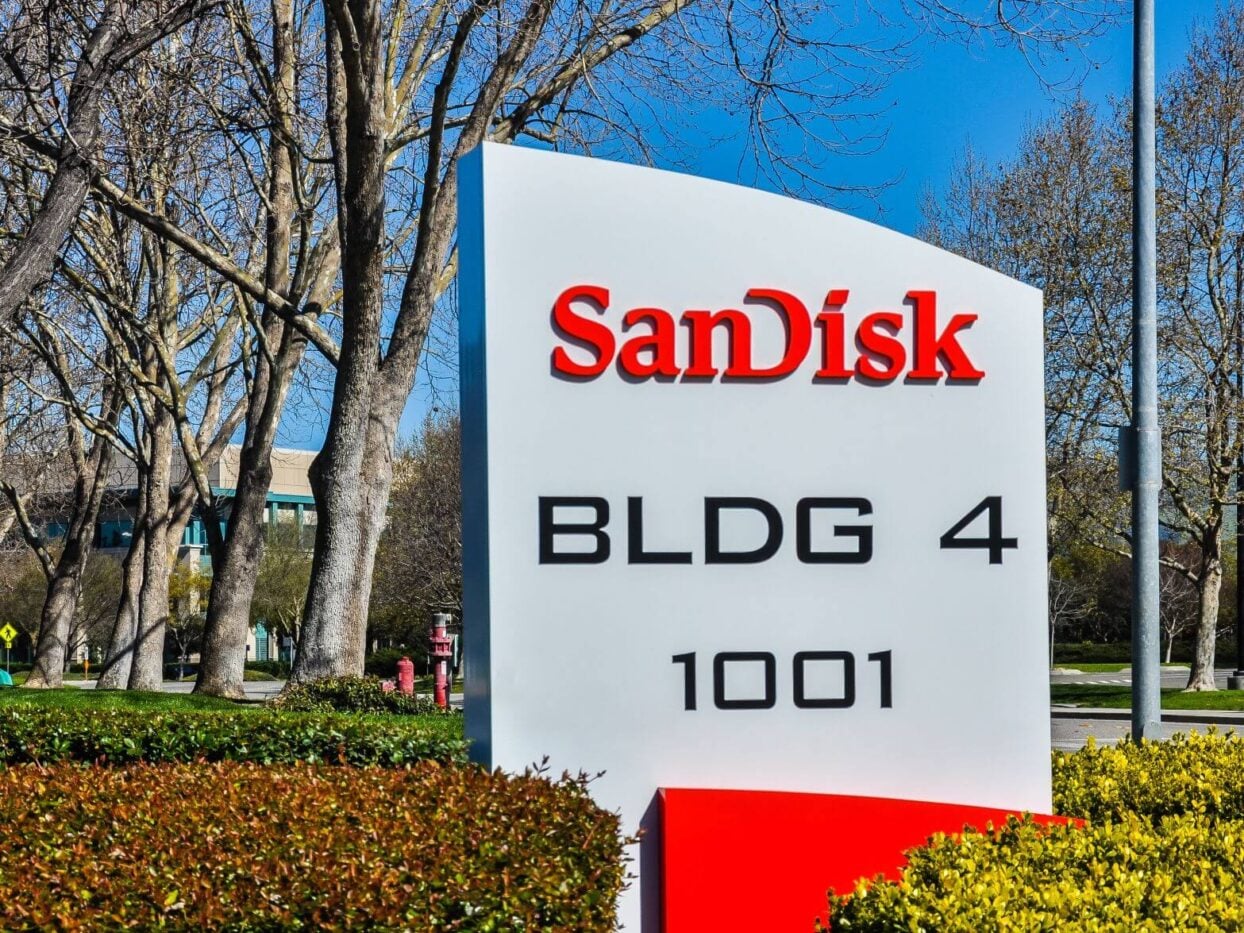
SanDisk (SNDK) shares are changing hands above $2,100, marking an extraordinary surge of nearly 700% year-to-date in 2026 and an astonishing 4,000%+ appreciation since emerging as an independent entity from Western Digital in the opening months of 2025. The velocity of this advance has outpaced nearly every Wall Street forecast.
The corporate separation marked a watershed moment. While SanDisk remained embedded within Western Digital’s structure, market participants lacked a transparent mechanism to assess the NAND flash segment independently. The standalone listing immediately unlocked that transparency, catalyzing a swift valuation transformation.
The fundamental business performance justifies much of the enthusiasm. SanDisk manufactures enterprise-grade solid-state storage solutions — precisely the technology artificial intelligence infrastructure requires. Conventional spinning disk drives cannot deliver the performance characteristics that contemporary AI applications demand.
Customer appetite has proven insatiable. The manufacturer’s entire production output is committed through 2026, effectively operating at full capacity with every unit pre-sold.

Nvidia chief executive Jensen Huang articulated the situation plainly during CES 2026, characterizing the data storage sector as “completely unserved.” Such validation from artificial intelligence’s most prominent figure provided additional momentum for SNDK.
Financial performance substantiates the narrative. SanDisk’s most recent quarterly report revealed revenue advancing 251% on a year-over-year basis. Perhaps more significantly: the company operates with zero financial leverage while producing record-setting free cash generation — a notable departure from the traditional cyclical volatility characteristic of memory semiconductor businesses.
Wall Street Revisions Trail Stock Performance
On June 8th, Vijay Rakesh at Mizuho Securities elevated his price objective to $2,200 from a prior $1,825, reiterating an Outperform recommendation. His analysis projects tensor processing unit deployments reaching 35 million units by 2028, representing approximately eight times present volumes.
Cantor Fitzgerald adopted an even more aggressive stance, advancing its target to $2,900 from $1,800, arguing that markets have transitioned into a “new AI-driven memory paradigm” with the investment opportunity still in intermediate stages.
BofA’s Wamsi Mohan boosted his objective to $2,100 from $1,550, sustaining a Buy recommendation while revising fiscal 2027 revenue projections to $44 billion and earnings per share to $188.
Notwithstanding these optimistic revisions, the consensus analyst price target hovers around $1,843 — beneath current trading levels. This represents an atypical dynamic for an equity carrying a Strong Buy rating across the analyst community.
Valuation Metrics Present The Central Debate
The trailing price-to-earnings multiple of approximately 67x substantially exceeds the semiconductor sector median of roughly 36x. Evaluated through that framework alone, valuation appears elevated.
However, the forward-looking assessment tells a different story. Given that profitability transformed from losses just twelve months prior to robust earnings currently, the forward P/E compresses to approximately 30x — considerably more defensible should estimates materialize.
The complication lies in NAND market history, which demonstrates significant volatility, and current pricing embeds an assumption that demand conditions persist without material disruption.
Cantor Fitzgerald’s $2,900 projection presently represents the Street’s most optimistic outlook. Mizuho’s updated $2,200 target positions marginally above present trading levels.
Get 3 Free Stock Ebooks
Discover top-performing stocks in AI, Crypto, and Technology with expert analysis.
- Top 10 AI Stocks - Leading AI companies
- Top 10 Crypto Stocks - Blockchain leaders
- Top 10 Tech Stocks - Tech giants



