


Key Takeaways
- Micron shares reached a record $472.02, climbing approximately 4.7% in a single session, marking a 540% surge over 12 months
- Key driver included Micron’s advocacy for the MATCH Act in Congress, aimed at restricting semiconductor sales to Chinese competitors
- Goldman Sachs boosted Micron’s 2026 earnings projection to roughly 19% above market expectations; Wall Street forecasts 605% EPS expansion for 2026
- Morgan Stanley selected Micron as a premier investment for AI memory growth, emphasizing supply limitations extending to 2027
- SK Hynix initiated construction on a $12.86 billion packaging facility in South Korea, though experts see minimal immediate impact on Micron’s position
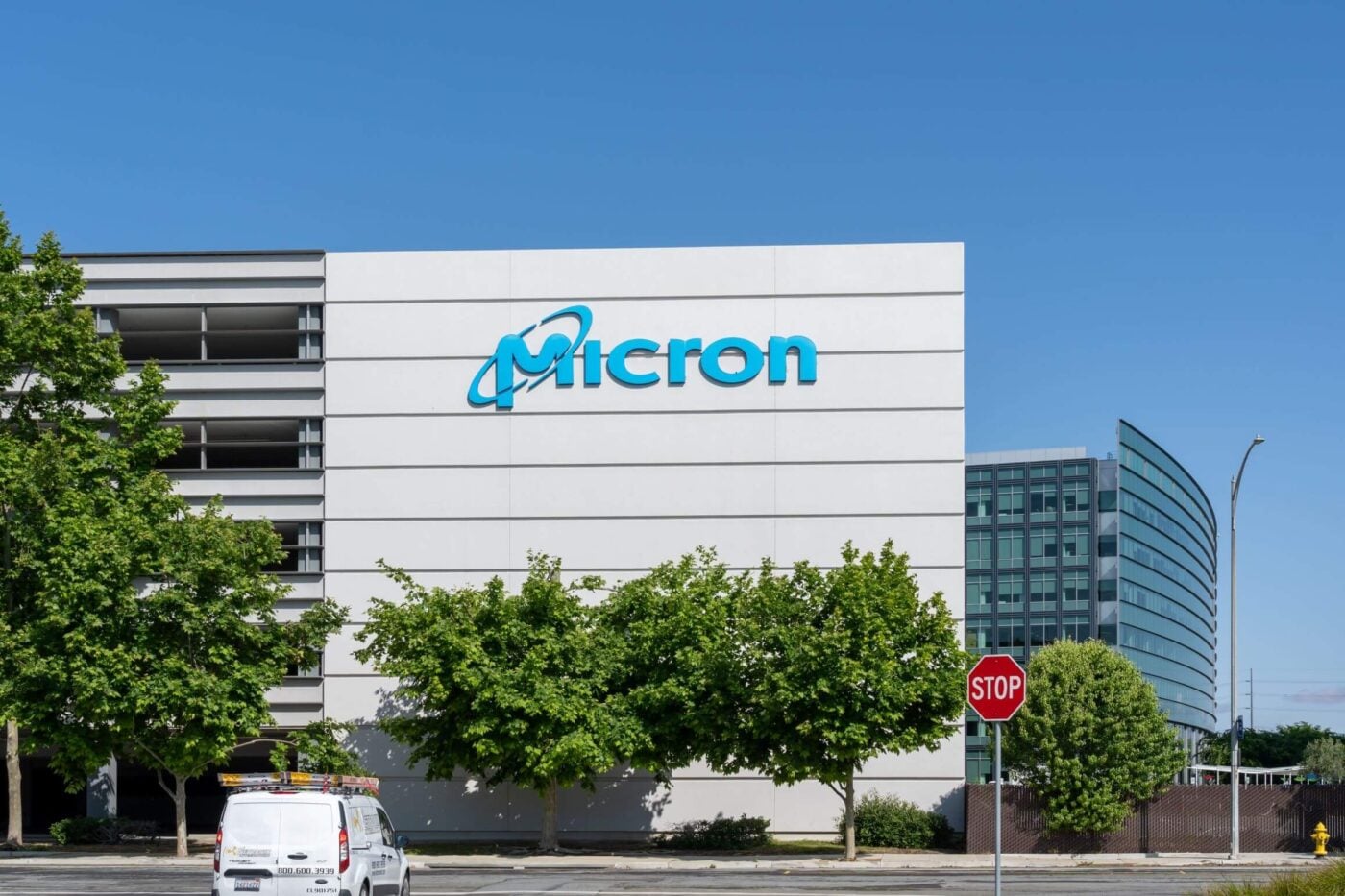
Micron Technology (MU) achieved a historic milestone on Wednesday, April 22, touching $472.02 per share amid a confluence of regulatory developments, optimistic analyst projections, and explosive artificial intelligence-driven memory chip requirements.
Shares advanced approximately 4.7% during Wednesday’s trading session. The semiconductor giant has posted a remarkable 540% appreciation over the trailing twelve months, positioning it among the S&P 500’s elite performers.
The principal catalyst behind Wednesday’s rally was Micron’s intensive efforts to persuade U.S. lawmakers to advance the MATCH Act. This proposed legislation seeks to eliminate regulatory gaps in semiconductor manufacturing equipment restrictions while compelling international companies engaged with China to comply with American export controls.
Bullish analyst revisions provided additional momentum. Goldman Sachs elevated its 2026 earnings per share projection for Micron to approximately 19% beyond current Wall Street consensus estimates. The Street now anticipates 605% EPS expansion for the complete fiscal year.

Earnings estimate revisions have surged 93% since late February. Remarkably, Micron represents 51% of all S&P 500 earnings revisions—an extraordinary statistic demonstrating the company’s influence on overall market earnings trajectories.
Morgan Stanley contributed its perspective, noting that agentic AI applications could trigger a fresh wave of CPU-associated memory requirements. The investment bank designated Micron as its top selection for capitalizing on this trend, emphasizing constrained supply dynamics as a competitive differentiator.
KeyBanc maintained its Overweight recommendation alongside a $600 price objective. Analyst John Vinh referenced ongoing price appreciation for DRAM and NAND products, with capacity expansion anticipated to remain limited through a minimum of 2027.
Lynx Equity demonstrated even greater confidence, elevating its target to $825. The firm highlighted prolonged capacity sell-through and enhanced revenue predictability, with HBM and DDR5/lpDDR5 capacity completely allocated through 2027.
UBS increased its price target to $535, emphasizing robust DRAM and NAND pricing as a margin expansion catalyst. Micron’s HBM inventory is entirely reserved through 2026, supported by extended agreements with prominent AI chip clients including Nvidia.
Revenue Skyrockets 196% Year-Over-Year
Micron disclosed Q2 2026 revenue of $23.9 billion, representing a 196% increase compared to the corresponding period one year earlier. The corporation has provided full-year revenue guidance of $109 billion for fiscal 2026, propelled by HBM3E requirements.
Regarding supply developments, SK Hynix commenced construction Wednesday on a $12.86 billion advanced packaging facility at its Cheongju campus in South Korea. The installation is projected to initiate testing operations in October 2027 with complete packaging capabilities launching in February 2028.
Additional Capacity Approaching, But Timeline Extended
Micron’s proprietary $50 billion Idaho expansion remains scheduled to commence wafer production around mid-2026. Its more substantial $100 billion New York initiative isn’t projected to become operational until 2030.
Analysts universally concur that memory requirements will exceed available supply until at least mid-2027, providing Micron sustained pricing leverage in the immediate term.
One measured perspective: Erste Group downgraded Micron from Buy to Hold, expressing concerns regarding diminished free cash flow stemming from substantial capital expenditures. BTIG similarly highlighted the introduction of a new DRAM ETF as a possible contrarian indicator, referencing historical timing precedents.
KeyBanc’s Vinh observed this week that Micron has negotiated enhanced long-term supply contracts with hyperscale clients, incorporating pricing floors and advance payments.
Get 3 Free Stock Ebooks
Discover top-performing stocks in AI, Crypto, and Technology with expert analysis.
- Top 10 AI Stocks - Leading AI companies
- Top 10 Crypto Stocks - Blockchain leaders
- Top 10 Tech Stocks - Tech giants



