



TLDR
- Both the S&P 500 and Nasdaq climbed to unprecedented levels on Tuesday, even as the 10-year Treasury yield remained firmly above 5%.
- Robust corporate profit expansion, projected to exceed 30% compared to the previous year, is counterbalancing the impact of elevated yields.
- Nvidia’s valuation is approaching the $6 trillion milestone, propelled by ongoing investments in artificial intelligence infrastructure.
- Every sector within the S&P 500 posted gains on Tuesday, indicating the market advance extends well beyond technology giants.
- Market strategists remain divided, with projections ranging from the S&P 500 hitting 10,000 by decade’s end to a potential decline toward 5,000 by 2027.
Major U.S. equity indexes pushed to fresh all-time highs this week despite bond yields hovering near levels last seen more than two decades ago. Tuesday’s trading session saw both the S&P 500 and Nasdaq establish new records, while the Dow Jones Industrial Average also advanced.
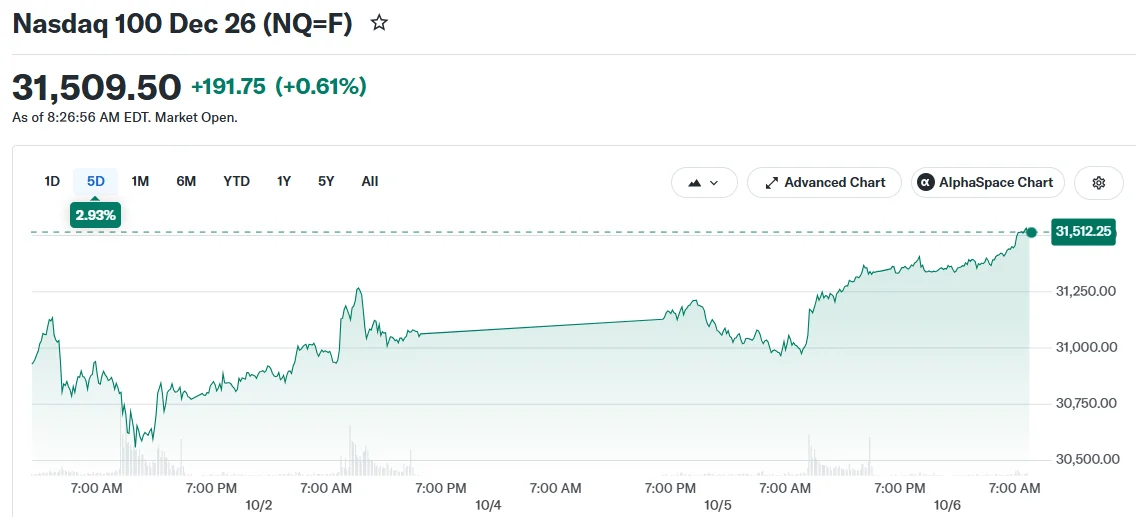
Meanwhile, the benchmark 10-year Treasury yield continues trading above the 5% threshold. Recent trading brought yields to heights not witnessed since 2002.
Traditionally, elevated bond yields exert downward pressure on equity valuations. When government securities offer attractive returns with minimal risk, the appeal of stocks diminishes considerably. High-growth technology firms typically bear the brunt of this shift.
Yet the current environment tells a different story.
Robust Profit Growth Supports Equity Valuations
The primary catalyst behind the ongoing rally is exceptional earnings performance. Wall Street analysts project that S&P 500 constituent companies will deliver profit increases exceeding 30% year-over-year.

Artificial intelligence companies continue leading this expansion. Nvidia shares extended their gains on Tuesday, bringing the semiconductor giant’s total market capitalization within striking distance of $6 trillion.
Fellow chip manufacturers also posted solid advances as market participants maintain confidence in sustained capital expenditure on data infrastructure and AI systems.
The market’s strength extends well beyond a handful of mega-cap technology names. Tuesday’s session saw positive performance across all 11 S&P 500 sectors. Utilities and real estate companies showed particular strength as bond yields retreated modestly from recent peaks.
The Significance of Rising Treasury Yields
The 10-year Treasury yield recently climbed to approximately 5.34%, marking its highest point in roughly 24 years. This surge reflects investor concerns about persistent inflation, expanding federal debt and continued economic resilience.
Elevated yields present a significant challenge for equity markets. When risk-free government securities deliver returns above 5%, the risk premium demanded by stock investors necessarily increases.
Rising rates also increase financing expenses for corporations, households and government entities. Growth-oriented stocks face particular vulnerability, as their valuations hinge on earnings anticipated years into the future.
As interest rates climb, the present value of those distant profits diminishes. To date, exceptional earnings momentum has managed to offset this mathematical headwind.
Market observers increasingly debate whether 6% yields, rather than the current 5% level, might represent the critical inflection point where equities face genuine trouble.
Predictions for the market’s trajectory diverge dramatically. With the S&P 500 nearing 8,000, certain strategists project the index could touch 10,000 before 2030 concludes.
Alternative scenarios paint a contrasting picture. Panmure Liberum recently published research suggesting the S&P 500 might retreat to approximately 5,000 by late 2027 should inflation prove stubborn and elevated rates persist.
This stark divergence in professional forecasts underscores the delicate equilibrium characterizing current market conditions.
Market participants will closely monitor upcoming quarterly earnings reports, Federal Reserve policy signals, inflation metrics and Treasury market dynamics in the weeks ahead. A combination of robust corporate results and moderating yields could propel the S&P 500 decisively beyond 8,000.
Conversely, disappointing earnings alongside accelerating yields would constitute the primary downside scenario.
For the moment, record equity valuations signal investor conviction that corporate profit growth can continue outpacing the burden of higher financing costs.
Get 3 Free Stock Ebooks
Discover top-performing stocks in AI, Crypto, and Technology with expert analysis.
- Top 10 AI Stocks - Leading AI companies
- Top 10 Crypto Stocks - Blockchain leaders
- Top 10 Tech Stocks - Tech giants



