


TLDR
- Gold prices dropped to a six-week low, briefly touching $4,480 per ounce before bouncing back to approximately $4,541
- Escalating global bond yields are creating headwinds for gold as investors anticipate higher rates due to war-induced inflation
- Washington and Tehran continue to struggle in negotiations over reopening the Strait of Hormuz
- Concerns over regional escalation intensified following a drone attack near a UAE nuclear facility
- JPMorgan experts report that fresh investment flows into gold have essentially “dried to a trickle”
The precious metal is facing significant headwinds as the prolonged US-Iran standoff continues to amplify inflation anxieties, driving bond yields sharply higher and diminishing gold’s attractiveness to market participants.
Spot gold declined to an intraday bottom of $4,480.79 per ounce during Monday’s session before staging a modest rebound to approximately $4,541. This represents the lowest level in six weeks, with the metal experiencing a 14% decline since hostilities commenced.
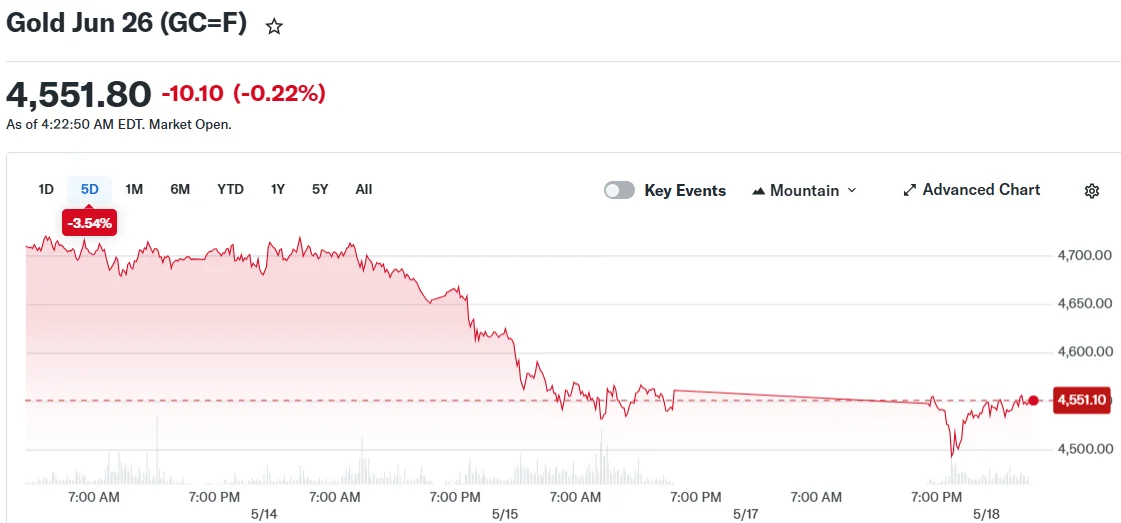
Futures contracts for gold also declined 0.5% to settle at $4,540.67 per ounce throughout Asian market hours.
Bond Market Selloff Pressures Precious Metals
Global fixed-income markets experienced widespread selling pressure on Monday. US 10-year Treasury yields advanced to their highest level in four weeks, while Japanese 10-year yields surged to a nearly three-decade peak.
Market participants are incorporating expectations that monetary authorities may implement interest rate increases to counter energy-fueled inflation stemming from the Middle Eastern conflict.

This scenario presents challenges for gold investors. Higher interest rates increase the opportunity cost of maintaining positions in non-interest-bearing assets like gold, diminishing its relative appeal versus yield-generating instruments.
The US dollar strengthened concurrently, compounding downward pressure on commodities. Silver declined 0.5% to $76.61 per ounce following a more than 5% retreat during the previous week. Platinum decreased 0.5% to $1,968.10 per ounce.
Strait of Hormuz Negotiations Remain Stalled
The Strait of Hormuz continues to represent a critical impasse. This strategic waterway serves as a vital corridor for international energy transportation, and its restricted passage has contributed to elevated crude prices.
President Trump issued renewed warnings to Iran on Monday, which propelled oil prices higher. This development increased expectations for additional monetary tightening, exerting further downward force on bullion.
A drone assault near the UAE’s Barakah nuclear installation during the weekend was linked to Iranian forces. The incident heightened apprehensions that the tenuous ceasefire might collapse completely.
Reports indicate that Washington and Tel Aviv are evaluating the possibility of resuming military operations against Iran as diplomatic discussions remain gridlocked.
Trump’s recent discussions with Chinese President Xi Jinping yielded certain trade commitments, but delivered no meaningful advancement regarding the Iranian crisis.
Market Analysis and Consumption Trends
JPMorgan strategists led by Gregory Shearer noted in a research briefing that fresh capital inflows into precious metals have essentially “dried to a trickle.” They identified concerns regarding elevated interest rates as the principal factor.
The research team emphasized that conflict resolution is necessary to rejuvenate investor appetite. Purchases by central banks may offer limited near-term price support.
Demand from India has also softened considerably. Bullion purchases have decelerated following the implementation of more restrictive import regulations and elevated tariffs. Indian authorities also strengthened restrictions on silver imports during the weekend in an effort to stabilize its currency, which reached a record low.
Market observers are now focused on the Federal Reserve’s April policy meeting minutes, scheduled for release this week, seeking insights into the trajectory of American interest rates.
Gold has predominantly lagged other assets since the conflict’s outbreak, as interest rate concerns have overshadowed the metal’s conventional safe-haven characteristics.
Get 3 Free Stock Ebooks
Discover top-performing stocks in AI, Crypto, and Technology with expert analysis.
- Top 10 AI Stocks - Leading AI companies
- Top 10 Crypto Stocks - Blockchain leaders
- Top 10 Tech Stocks - Tech giants



