


TLDR
- Gold declined roughly 0.8% to about $4,699 per ounce during Tuesday trading
- President Trump dismissed Iran’s ceasefire response as worthless, stating the peace agreement hangs by a thread
- Elevated crude prices and dollar strength are diminishing gold’s traditional safe-haven status
- Silver plunged more than 2% following Monday’s 7%+ rally sparked by a Peruvian oil company crisis
- Investors anticipate Tuesday’s U.S. inflation report for guidance on Federal Reserve monetary policy
Precious metals retreated on Tuesday as doubts intensified about the stability of a recently negotiated ceasefire between Washington and Tehran. Traders reduced their bullion positions while preparing for critical U.S. economic data scheduled for release later that day.
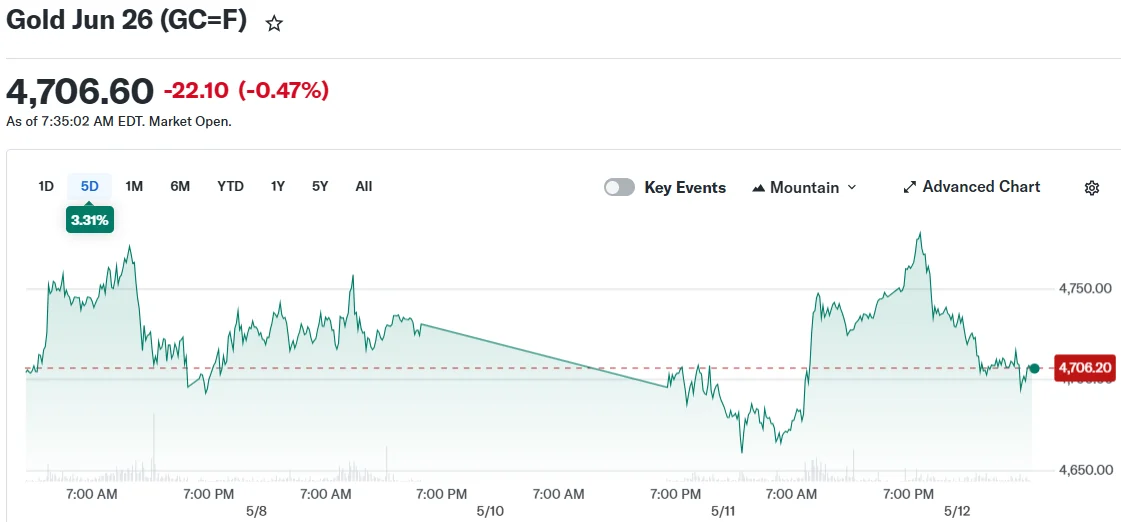
Spot gold declined approximately 0.8% to $4,699.16 per ounce. Gold futures for U.S. delivery decreased 0.5% to $4,707.20 per ounce.
President Donald Trump characterized Iran’s reply to the U.S.-supported peace initiative as worthless. He indicated the Strait of Hormuz ceasefire was barely surviving, intensifying concerns about potential military escalation in the strategically important region.
Tehran rejected the criticism, asserting its military forces stand prepared to counter any hostile actions. Iranian representatives defended their conditions — including lifting of sanctions, restoration of petroleum exports, and acknowledgment of sovereignty over the Strait of Hormuz — as reasonable and justified.
Crude prices remained high on Tuesday amid worries about potential supply interruptions through the Strait of Hormuz. This narrow passage serves as a vital corridor for worldwide oil transportation.

Why Rising Oil Is Hurting Gold
Escalating oil prices are creating challenges for precious metals. Market participants fear that prolonged energy cost inflation could drive overall price increases higher, potentially compelling the Federal Reserve to maintain restrictive monetary policy for an extended period.
Elevated interest rates diminish gold’s attractiveness since the metal generates no yield. This relationship has weighed on precious metals despite ongoing geopolitical uncertainty.
The U.S. dollar strengthened on Tuesday, with market participants viewing the currency as a comparative refuge. Dollar appreciation makes gold costlier for international buyers, creating additional downward momentum.
Analysts at ING offered a straightforward assessment. “Gold’s safe-haven appeal tends to perform best in a financial crisis or growth shock — when real yields fall and the dollar weakens. A supply-driven energy shock does the opposite,” they wrote.
Silver and Other Metals Also Drop
Silver declined over 2% on Tuesday after jumping more than 7% during the previous session. Monday’s advance came after news emerged about financial difficulties at a government-controlled oil company in Peru, a major global silver producer. Platinum fell 2.7% to $2,078.23 per ounce.
Gold has experienced significant volatility throughout the year. The metal reached an all-time peak in late January before declining. The Middle East conflict outbreak has maintained market uncertainty ever since.
Investors are also monitoring an anticipated summit between Trump and Chinese President Xi Jinping in Beijing scheduled for later this week. Discussions are expected to address Iran, Taiwan, commercial relations, artificial intelligence, and energy security.
Economic forecasters anticipate Tuesday’s consumer price index data will reveal a substantial inflation increase. They attribute the surge to cascading impacts from the Middle East conflict on production and agricultural expenses.
Christopher Wong, a strategist at Oversea-Chinese Banking Corp., described gold as trading “less like a straightforward safe haven and more as a macro risk proxy caught between oil, inflation, Fed-pricing, US dollar dynamics and risk sentiment.”
The primary catalyst for gold’s next directional move will likely emerge from the CPI release and any breakthroughs from the Trump-Xi summit later this week.
Get 3 Free Stock Ebooks
Discover top-performing stocks in AI, Crypto, and Technology with expert analysis.
- Top 10 AI Stocks - Leading AI companies
- Top 10 Crypto Stocks - Blockchain leaders
- Top 10 Tech Stocks - Tech giants



