



Key Highlights
- Bullion advanced as high as $4,796 per ounce following a two-session selloff
- Washington implemented a naval blockade at the Strait of Hormuz amid ongoing diplomatic efforts
- Tehran and Washington both expressed willingness to pursue additional negotiation rounds
- Dollar weakness provided tailwinds for gold, with the greenback declining for seven consecutive sessions
- March Producer Price Index figures scheduled for release Tuesday could reveal energy-linked inflation pressures
Precious metals gained traction during Tuesday trading after consecutive daily declines, boosted by renewed diplomatic momentum between Washington and Tehran that improved risk appetite.
Spot bullion advanced 0.7% to reach $4,773.26 per ounce. Futures contracts for gold increased 0.4% to settle at $4,784.05 per ounce. During intraday trading, the yellow metal momentarily reached $4,796.
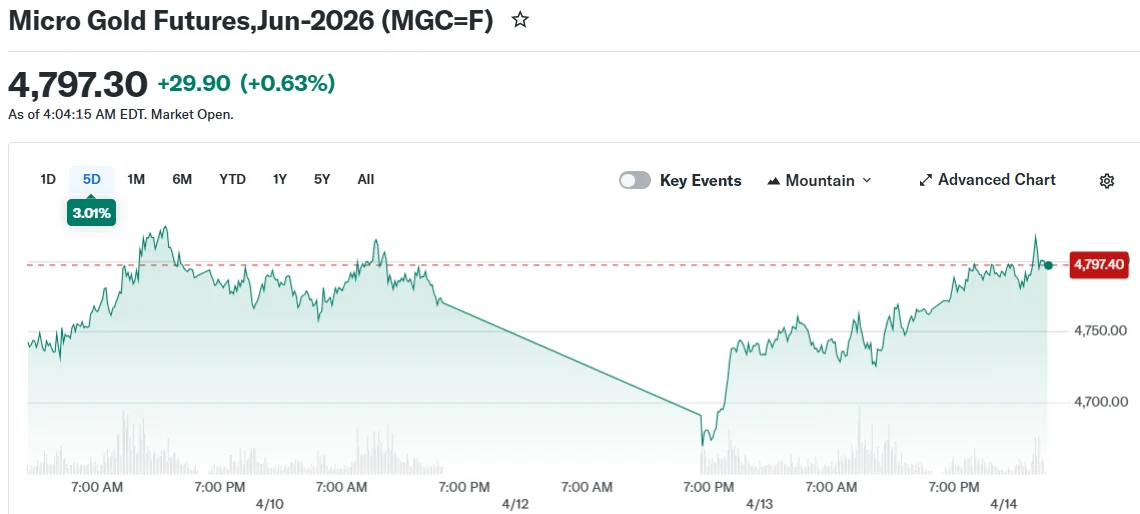
The upward movement materialized despite Washington’s initiation of a maritime blockade targeting Iranian ports and coastal regions in the Persian Gulf, intensifying military operations against the Islamic Republic.
President Donald Trump revealed that Iranian leadership had initiated contact with his administration expressing desire to “work a deal.” Iranian President Masoud Pezeshkian acknowledged Tehran’s readiness to pursue diplomatic channels within the framework of international regulations.
U.S. Vice President JD Vance, who spearheaded weekend diplomatic discussions in Pakistan, conveyed measured optimism. He indicated that any agreement’s success hinges on Tehran’s forthcoming choices.

Sources indicated American and Iranian representatives were exploring the possibility of scheduling additional negotiations before the current two-week ceasefire arrangement concludes next week. The Pakistan discussions held over the weekend yielded limited tangible progress.
The greenback extended its decline for a seventh consecutive session, marking its most prolonged downturn in twenty-four months. Currency depreciation typically bolsters gold valuations, as the commodity is denominated in dollars.
Oil prices retreated beneath the $100 per barrel threshold. This development alleviated some inflationary pressures that have constrained gold performance since hostilities commenced more than six weeks earlier.
Interest Rate Outlook Constrains Precious Metal Gains
Notwithstanding Tuesday’s recovery, gold has surrendered approximately 10% of its value since hostilities erupted in late February. During the conflict’s initial phase, market participants liquidated gold positions to offset losses in other asset classes amid a liquidity crunch.
Gold has been responding more significantly to monetary policy expectations than traditional safe-haven demand, according to Justin Lin, investment strategist at Global X ETFs Australia. He noted that bullion was receiving support from de-escalation prospects rather than geopolitical anxiety.
The Federal Reserve’s monetary trajectory remains ambiguous. Current money market pricing reflects below 20% probability of a rate reduction by December.
Silver surged 2.5% to reach $77.51 per ounce. Platinum and palladium similarly posted gains. Spot silver traded 1.4% higher at $76.64 per ounce during earlier sessions.
Producer Inflation Figures Under Scrutiny
March Producer Price Index statistics were scheduled for release later Tuesday. Analysts anticipated the data would demonstrate continued energy-related price pressures.
Previous week’s Consumer Price Index figures already revealed significant inflation acceleration. The Iran conflict disrupted worldwide energy markets following Tehran’s blockade of the Strait of Hormuz during the confrontation’s early stages.
Elevated energy costs have intensified concerns that the Federal Reserve might maintain current interest rates or implement increases, which would negatively impact non-interest-bearing assets such as gold.
Spot gold was quoted at $4,773.26 as of Tuesday afternoon Singapore time, with valuations generally confined within a $4,700 to $4,900 range throughout the previous week.
Get 3 Free Stock Ebooks
Discover top-performing stocks in AI, Crypto, and Technology with expert analysis.
- Top 10 AI Stocks - Leading AI companies
- Top 10 Crypto Stocks - Blockchain leaders
- Top 10 Tech Stocks - Tech giants



