


Key Takeaways
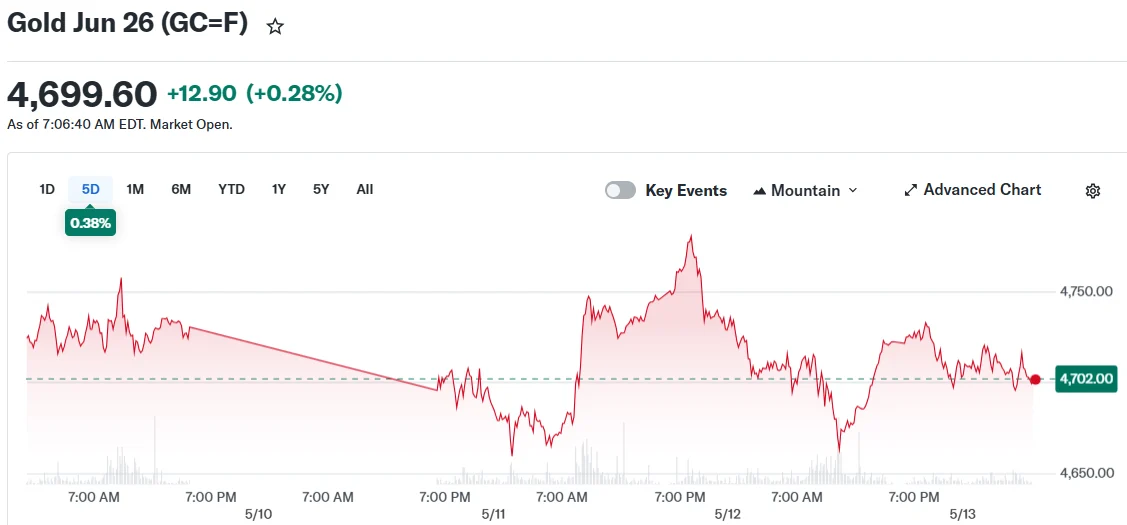
- Gold declined approximately 0.4% to settle around $4,699 per ounce during Wednesday’s session
- April’s US inflation data showed the strongest acceleration since 2023, fueled primarily by surging gasoline costs tied to Middle East tensions
- Market participants now assign approximately 33% probability to a Federal Reserve rate increase before year-end, compared to virtually zero odds a month earlier
- President Trump arrived in China for high-level discussions with President Xi Jinping, focusing on Middle East conflicts, trade relations, and Taiwan
- India unexpectedly increased gold import duties from 6% to 15%, aiming to stabilize its rupee and protect foreign currency holdings
The precious metal retreated Wednesday following unexpectedly elevated US inflation figures, which amplified market speculation that the Federal Reserve might implement rate increases before the year concludes.
Spot gold decreased 0.4% to reach $4,699.10 per ounce throughout London’s morning session. Meanwhile, gold futures contracts advanced marginally, climbing 0.4% to $4,706.72 per ounce. The precious metal had already declined 0.4% during the prior trading day.
The consumer price index in the United States accelerated to its quickest rate since 2023 during April. The pronounced jump in gasoline costs, attributed to continuing Middle East military operations, served as a primary catalyst for the inflationary acceleration.
Interest-rate swap traders currently assign approximately one-in-three probability to a Fed rate increase materializing by December. Just four weeks prior, such probability registered near zero.
Elevated interest rates typically pressure gold downward. Since the metal generates no income stream, rising rates enhance the relative attractiveness of yield-bearing alternatives.

US Treasury yields advanced following the inflation release. ING analysts characterized the movement as “more re-pricing rather than outright selling,” though they cautioned that vulnerabilities are accumulating.
“The Fed can’t cut here. And risk assets are pushing the boundaries of positivity,” ING analysts wrote in a note.
Market participants are now focused on Wednesday’s US producer price index release for additional insights regarding inflation trajectories and potential Fed responses.
Middle East Conflict’s Impact on Precious Metals
The Iran situation, now extending beyond two months, has compromised navigation through the Strait of Hormuz, a vital corridor for international petroleum transport. This disruption has intensified energy-related inflation concerns across global markets.
Trump indicated earlier this week that negotiations with Iran were hanging by a thread following Tehran’s rejection of a US-supported peace framework. His remarks sustained elevated geopolitical uncertainty and diminished prospects for an imminent conflict resolution.
Trump departed for Beijing this week to meet Chinese President Xi Jinping. Discussions will encompass trade frameworks, the Iran situation, Taiwan relations, and international supply chain coordination.
Market observers have noted China, a significant purchaser of Iranian petroleum, might contribute to facilitating a comprehensive peace agreement. Nevertheless, anticipations for meaningful progress at this particular summit remain modest.
Central Bank Purchasing Provides Price Floor
Notwithstanding rate-related headwinds, gold has maintained relative stability. JPMorgan Private Bank analysts identify robust central bank acquisitions as a fundamental supporting element.
“Gold prices stayed resilient when rates spiked. And it tended to rally when rates declined,” said Yuxuan Tang, Asia head of rates and FX strategy at JPMorgan Private Bank.
She added that central bank demand “supports our view that gold can deliver an uncorrelated return profile.”
Silver, which has appreciated 17% throughout May, remained essentially unchanged at $86.50 per ounce Wednesday. Both platinum and palladium registered modest declines.
In a related development, India elevated its precious metals import tariffs to approximately 15% from 6%. The unexpected policy adjustment reflects India’s efforts to defend its currency valuation and bolster foreign exchange holdings. India ranks as the globe’s second-largest gold market by consumption.
The US dollar index strengthened Wednesday, maintaining levels near a one-week peak. Dollar appreciation can elevate gold costs for international purchasers, contributing additional downward momentum on valuations.
Get 3 Free Stock Ebooks
Discover top-performing stocks in AI, Crypto, and Technology with expert analysis.
- Top 10 AI Stocks - Leading AI companies
- Top 10 Crypto Stocks - Blockchain leaders
- Top 10 Tech Stocks - Tech giants



